


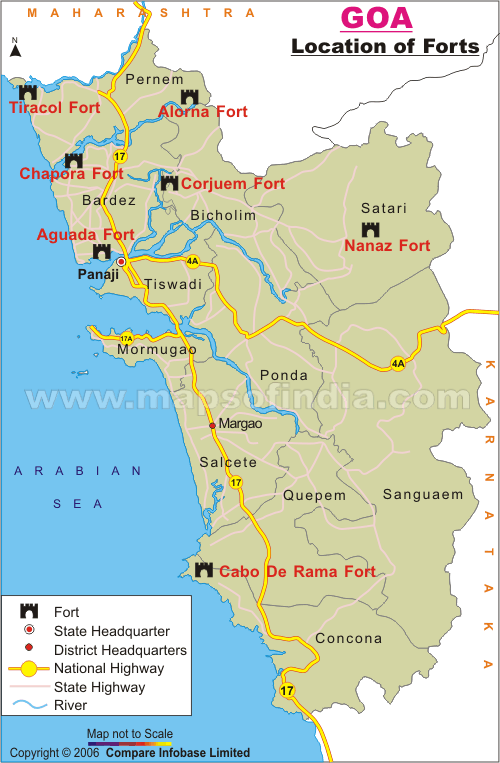




Nevertheless, the forts in Goa are historic specimens of immense military, political and economic importance.
With a history that speaks of several rulers, the forts in Goa are witnesses and testimonials of the events of a bygone era. Some of the most important of the forts in Goa that have stood the test of time are given below:
The Aguada Fort: Immediately south of Candolim, a long to laterite peninsula extends in the sea west of Reis Magos, bringing the seven kilometer long Clangute beach an abrupt end. Aguada Fort, which crowns the rocky flattened top of the headland, is the best-preserved Portuguese bastion in Goa. Built in 1612 to protect the northern shores of the Mandovi estuary from Dutch and Maratha raiders, it is home to several natural springs. A spring within the fort provided water supply to the ships that called there arriving after the long sea voyage from Lisbon, giving it the name 'Aguada' (meaning 'water' in Portuguese). On the northern side, it provides a harbor for local shipping. The Aguada fort, at present, houses the central jail.
On the north side of the fort, a rampart of red-brown laterite juts into the bay to form a jetty between two small sandy coves. This picturesque spot is known as Sinquerim Beach. Fort Aguada Resorts, among the most expensive hotels in India, lords over the beach from the lower slopes of the steep sided peninsula.

- Location: 18-km From Panaji, Old Goa
- Built By: Portuguese
- Built In: 1609-1612
- Houses: The Central Jail And A 19th Century Lighthouse

Though the Portuguese had won their rule in Goa, the threat from the Muslim and Maratha rulers went on. To protect themselves from this risk, the Portuguese rebuilt the Chapora Fort. However, the Portuguese troops had to surrender to the Maratha ruler, Sambhaj in 1684. But discord boiled over between the locals and the Marathas. Finally in 1717, the Marathas withdrew their force. The Portuguese then took over again and rebuilt the fort. The new structure of the fort was equipped with underground tunnels that ensured a safe getaway in case of an emergency. Even this glory was not for long. Again in 1739 the Marathas captured the Chapora fort. Two years later, in 1741, the Portuguese regained the fort when the northern taluka of Pernem was handed over to them.
It lies in ruins today, although the views up and down the coast from the weed-infested ramparts are still superb. One can still see the heads of the two tunnels that formerly provided supply routes for besieged defenders. Also can be seen a scattering of Muslim tomb stones on the smooth slopes of the hill. These tomb-stones are believed to be relics of the pre-colonial days. The main attractions here are the superb views from the bastion's ramparts, which look north to Morgim and Mandarem beaches, and south towards Anjuna.

In 1540, the eighth Governor, D. Estevao de Gama, proposed the idea of constructing some fortifications at the mansion site to guard the entrance to both the Mandovi and Zuari rivers. Slowly, over the years, the Cabo Fort was converted into one of the best equipped and important fortresses.
A small Chapel was constructed at the end of the mansion, and was dedicated to Our virgin lady of The cape (Nossa Senhora do Cabo). It served as a landmark for the seafarers. Later the chapel caught the attention of the Viceroy D. Matias d Albuquerque. He was a protector of the reformed Franciscan friars known as 'Recollects'. The Viceroy decided to rebuild the chapel and also constructed a monastery beside it. He paid all the expenses involved in its construction. The foundation of the monastery was laid started of on 5th February 1594 by Bishop de Santa Maria and was completed within the period of six months only, exactly on 14th July 1594. The Cabo Fort was constructed with laterite stones available at the site. The pits formed from the extractions of these stone were then covered to form cisterns to which rainwater was carried via the sloping roofs of the buildings - thus providing excellent storage tanks for water.
The Cabo Palace is now known as the Raj Bahavan (the official residence of the Governors of the States in India). It is also among the finest of the Raj Bhavans and also the oldest - as no other residence of a Governor of a State in India had its origin to over four hundred years in the past. The Raj Bhavan has a fine collection of Bohemian chandeliers, Chinese porcelain, silver and furniture. The most remarkable are the pieces of antique Chinese porcelain presumably manufactured in Canton. There is also a worn-out set of crockery having a similar design with same coat of arms. All these had been specially ordered for the use of the Portuguese Governor General. There is also an excellent collection of high quality wooden furniture with exquisite workmanship. A set of intricately carved chairs are simply remarkable for the fact that Hindu Gods and Temples have been carved on them. In the later centuries complete harmony between Christians and Hindus was very evident in Goa.

The tiny enclave of Terakol, the northernmost tip of Goa, is reached via a clapped-out car ferry from the hamlet of Querim, 42-km from Panjim. The Terekhol Fort once belonged to a local raja and was taken over by the Portuguese in 1746.
It was used as a base for freedom fighters during the liberation of Goa in 1961. The Terekhol Fort was a key Portuguese fort for the defense of Goa, on the north side of the estuary of the Teracol River, the northern most boundary of Goa.
Within the fort there is a chapel - St.Anthony's church - which is locked most of the time. The Chapel has a classical late Goan facade and is opened only on special occasions. From the battlements one can look across to Querim Beach.
To cross the Tiracol River takes twenty minutes on an ancient Goan ferry operates every 30 minutes. The Terekhol Fort has now been converted into a Heritage hotel.
Last Updated on: June 17, 2021
Places to see in Goa
