






About
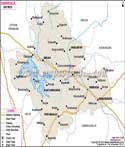
All great stories start with a name that will not go away. It is one example, Gulbarga or Kalaburagi. The former use of the title Gulbarga conveys a sense of conquests, devotions and architectural genius, whereas the official title Kalaburagi brings a sense of modernity and Karnataka. Gulbarga district map is a lot more than just a boundary creating regions of wayfaring rulers and battle-worn armies.
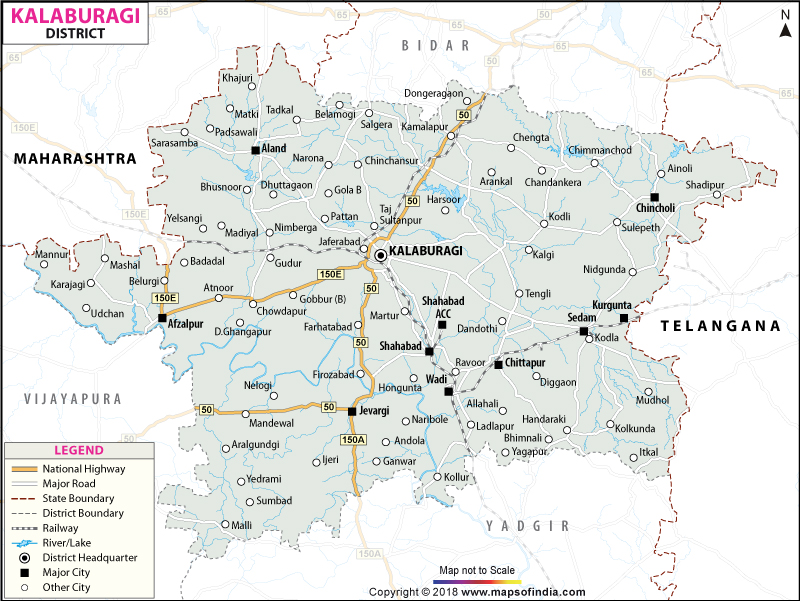
The district is in the north-eastern Karnataka region of Kalyana Karnataka. Strategically situated between Telangana and Maharashtra, it is an entrance point to southern-central India. The region consists mostly of fertile black cotton soil that is deposited by the river Bhima and Kagina, which feeds agriculture in everyday life itself with education or even business going on very well. The Gulbarga district map can feel like a roller coaster journey where the presence of each town feels like green fields opening up before the eyes and ancient monuments rise.
History & Culture
The area was already impacted by the Mauryas, Satavahanas, Rashtrakutas, Chalukyas and Kalyani Chalukyas way prior to the modern state of Karnataka. But, this gained importance during the fourteenth century when Gulbarga was the first capital of the Bahmani Sultanate. After that, the district was one of the most important political and cultural centres of the Deccan. It was a time of enlarging palaces, building grand mosques, gathering of scholars, and the growth of trade. The map of Gulbarga district seems to resemble a historic blueprint where each dynasty strived to trace a way to get immortalised.
The show-stopper, Gulbarga Fort, is the best testament to this extraordinary era. The massive defensive walls, beautiful gateways and the remarkable Jama Masjid in the fort still exhibit a peculiar mixture of Persian and Indian architecture. Though the capital of the Bahmanis was moved to Bidar, Gulbarga still played an important role politically and religiously.
Over the course of centuries, the district did not lose its spiritual quality. The shrine of Hazrat Khwaja Banda Nawaz, which had great significance to them, became one of the most respected Sufi pilgrimage centres in India. This is a practice that has persisted since the beginning of time and which sustains and continues the district's tradition of communal harmony as people from different religions continue to visit the dargah. The Urs is a yearly festival where the city becomes a feast of devotion, faith and music.
Gulbarga's culture is not static. Instead, it is a waltz between traditions. While Kannada is still the most prevalent language, Urdu has also had its share of deep historical roots as a result of several centuries of occupation by the Deccan Sultanate. The district has a multi-lingual character as Marathi, Telugu, Hindi and Lambadi are widely used languages, which are not spoken in numerous other parts of Karnataka. In the Gulbarga district map, these cultural crossings are expressed by neighbourhoods where local traditions are retained in their cultural practices, but where they tie into the larger cultural frame.
Festivals turn mundane streets into grand stages. Deepavali fills homes with light. Ugadi signifies the arrival of Kannada New Year and how it brings cheer. The festival is celebrated with zeal and gifts of love in the community. Muharram processions are centuries old customs and Urs of Banda Nawaz, held every year. Music, devotional poetry and folk performances still keep memories that only written history could never record.
The district's cultural affinity has also been influenced by education. Higher education has been given a boost in the region with Gulbarga University drawing students from adjoining districts and states. Therefore, the map of Gulbarga has depicted not only the historical monuments but also existing modern day education centres that are writing new chapters for future generations.
Economy
In every gripping drama, people always have a moment when they have to rely on their strength to survive. The power for Gulbarga is in the mix of diversified agriculture, industry, government administration and growth in services.
The main pillar of agriculture. Jowar, pigeon pea, wheat, a variety of crops such as cotton, sugarcane, sunflower and groundnut, as well as gram and pulses are cultivated in rich black cotton soil. The irrigation schemes added up in the upstream part of the Krishna have enhanced the status of irrigation in many areas of the district while cultivation is also affected by the rainfall. The Gulbarga district map can be compared to a vast canvas painted with the strokes of each season in creation as fields turn different shades.
The Government Sector is important for its district administration activities, public education, health, irrigation, rural development and welfare programmes. Many government departments create employment opportunities when undertaking infrastructure projects and agricultural support schemes and providing public services in rural and urban areas.
The Public Sector contributes to power generation and, through infrastructure development, as well as through public institutions. School for education, government hospitals and assisted agencies encourage economic activity and regional development. Karnataka Industrial Areas Development Board(KIADB) promoted industrial estates have encouraged manufacturing and investment in the district.
Production is growing steadily and is still expanding. Production of cement is an important player in the presence of plenty of limestone resources in the area. Cement plants and allied industries provide jobs and a boost to the construction industry in Karnataka. The agricultural produce and food products processing sectors, steel making, and small scale engineering units are other areas that add to the diverse industrial basket. The Gulbarga district map shows the industrial clusters along with the agricultural community.
The services sector has been experiencing rapid expansion over the last few decades. City people work in such sectors as banking and retail trade, logistics, healthcare, hospitality, transport, information and communication technology (ICT) services and telecommunications. Kalaburagi city is a commercial centre for the whole of Kalyana Karnataka province and lures traders, students and entrepreneurs as well.
The district's economy remains dominated by small businesses. Nestled among these jobs are thousands of households in wholesale grain businesses, rural livestock trading, transport, handicrafts and family businesses. Historical monuments and religious sites are also important in the context of tourism and its impact on local livelihood, as it increases demand for transport and guides, as well as hotels and restaurants.
Although agriculture still provides a significant share of the working population, the ongoing and unprecedented process of urbanisation and further education is gradually expanding employment opportunities. This fact has brought the Gulbarga district map more and more into balance, both in Agriculture and the development of industries and services.
Tourism
Every visitor is left with an unforgettable impression of Gulbarga Fort. Gulbarga Fort is stunning, and it is sure to remain in every visitor's memory. It is surrounded by its immense walls, bastions and historic gates which tell tales of royal ambition, military genius and architectural prowess. Inside is the amazing Jama Masjid, the interior of which is unique in Indian Mosques.
Past the fort is the sacred Dargah of Hazrat Khwaja Banda Nawaz. It is the place for pilgrims from all over India to come throughout the year and the annual Urs turns the entire region into a celebration of spirituality, religion and the oneness of the tribes. This is an international Sufi centre of pilgrimage and there is no doubt that its importance goes hand-in-hand with the Gulbarga district map.
The remains of ancient temples dotted all over Aland, Sedam, Chittapur, etc. are a wonderful preservation of the local architecture, while old mosques, stepwells, etc. find a worthy mention in every trip. The Gulbarga district map finally takes the viewer on a scenic journey through some memorable forts, shrines, temples, reservoirs and other cultural highlights, all in an ending that creates another poignant snapshot of the district's storied history.
Demographics
Significant histories are propelled by real individuals who sustain them. As per the 2011 Census, Gulbarga district population was 2,566,326. Continued educational development was seen, given that the literacy rate was about 64.9%. The main language is Kannada and Urdu is widely spoken in the district which has a history of Urdu speaking. Other languages spoken include Marathi, Telugu, Hindi and Lambadi, which are also spoken by significant communities, making the society great in terms of multilingualism. This diversity is reflected in the Gulbarga district map which showcases settlements where the languages, traditions and customs were, and still are, getting blended over generations.
Administration
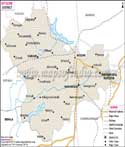
The administrative efficiency creates an invisible structure that allows the district to keep growing. With further administrative revisions, presently Kalaburagi district contains eleven taluks which includes Kalaburagi, Aland, Afzalpur, Chincholi, Chittapur, Jevargi, Sedam, Shahabad, Kalagi, kamalapur and Yadrami.
As per the Census 2011 records, the district has a total of 918 villages. The Gulbarga district map ensures that any Gulbarga administrator, planner and or citizen will be able to understand how the administrative units are connected in an extensive geographical area. Mapping is an important tool for the Gulbarga district to keep in hand, and as infrastructure, education, and governance keep going, the Gulbarga district map holds great importance to promote and give understanding of the district's amazing heritage and its hopeful future.
Administrative organisations in the district are backed up by the revenue offices, gram panchayats and municipal bodies along with government departments responsible for local governance and delivery of public services. Development programmes in the areas of agriculture, education, health, rural infrastructure and social welfare are realised through synergy at the district, taluk and village levels. It is also important to have a balanced development across the whole district while at the same time maintaining historical and cultural values and features, with the important part played by the administration in supporting this.
FAQs
Q1: What is the total population of Gulbarga district?
The population is 2,566,326.
Q2: How many villages are there in Gulbarga district?
There are 918 villages.
Q3: What is the literacy rate of Gulbarga district?
The literacy rate is about 64.9%.
Q4: What is Gulbarga district famous for?
It is famous for the Bahmani heritage and Banda Nawaz Dargah.
Q5: What is the headquarters of Gulbarga district?
Kalaburagi is the headquarters.
Q6: Which is the main language spoken in the district?
Kannada is the main language.
Q7: How many taluks are in Gulbarga district?
There are eleven taluks.
Last Updated on : July 31, 2026
