






About
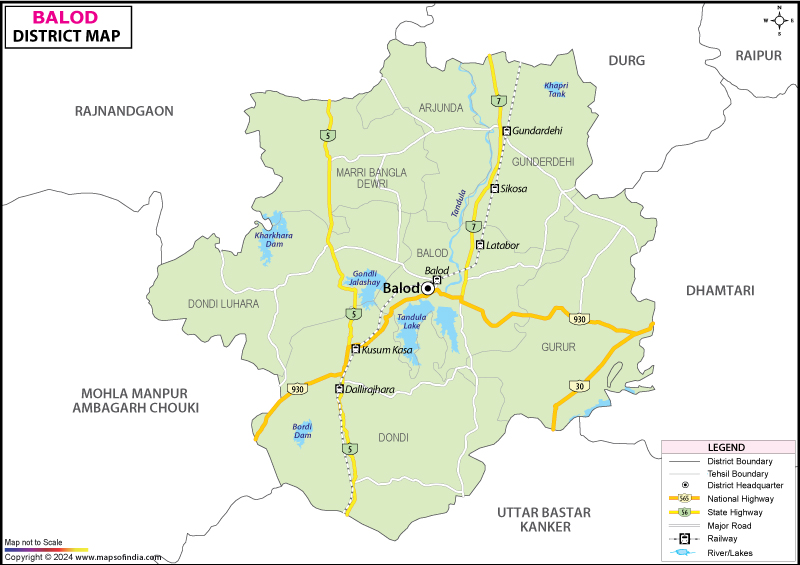
Balod district is located in the central plains region of the Chhattisgarh division Tandula and it was named after the town of Balod which was located on the banks of the Tandula river and was carved out from the district of Durg on 1 January 2012, as part of Chhattisgarh's process of decentralizing administration in the more remote and tribal populations of the state. Balod spreads over an area of about 3527 km² and has a landscape of fertile agricultural plains, nurtured by the Tandula and Sukha rivers. In the western parts of Balod, there are forest hills around Gurur and Rajhara. The district is more than likely most famous for being the site of the Dalli-Rajhara iron ore mines that have supplied the nearby Bhilai Steel Plant for decades, despite its otherwise agrarian and rural character. Balod is a district where almost one-third of the population belongs to Scheduled Tribes, mostly Gond tribes, and also has a definite tribal character, apart from being a food-grain producing district.
History & Culture
Archaeological evidence of Balod dates back to the Paleolithic period, such as a painted rock shelter recovered at Madvapathra in the Balod tehsil, where Middle Paleolithic stone implements made from quartzite were recovered. There are also sites of the Mesolithic period in the wider Durg-Balod area where there are a number of sites of more than 300 sites of the prehistoric period scattered throughout Chhattisgarh and a continuous occupation that has taken place in the area from the Mesolithic period.
The region was subsequently influenced by the Gond kingdoms which dominated most of central India from the 14th century onwards, while tribal groups such as the Gond and Halba have populated the district for generations and have had an impact on its culture and land-use.
The Balod area was part of the Central Provinces during the colonial period and it was amalgamated with the Bhandara district in 1818 which was then separated from it in 1857 and was given a tehsil status under Raipur district along with Durg and Bemetara. After independence, it was in the jurisdiction of Durg district, continued to be so after the formation of Chhattisgarh in 2000 and finally became a district in 2012.
Today Balod is culturally influenced by the tribal life of its people and its festivals and traditions are still practiced with more popular festivals and traditions like Hareli and Pola which are in line with the agricultural calendar. The district's temples, especially the Kapileshwar Shiva Temple, attract pilgrims from all over the district, and its dams and reservoirs are a point of pride for the locals and provide a daily source of enjoyment, such as the Tandula Dam, which was built more than a century ago.
Economy
Balod's economy is of a mixed nature, comprising substantial mining, agricultural and relatively small services components around its headquarters town.
Balod is a relatively new district and since 2012 several government departments have invested heavily in establishing administrative and civic facilities, such as a District & Sessions Court in October 2013. Though government employment is still an important source of livelihood, especially in the district headquarters town.
The Bhilai Steel Plant (a company of the Steel Authority of India) is the only significant public sector establishment in the district, providing raw material to one of India's largest integrated steel plants in neighbouring Durg district. This mining activity has traditionally furnished much employment and allied economic activity not only in the western tehsils of the district but also in the famous labour movements of Dalli-Rajhara mining community.
Agricultural Services: Agriculture continues to be the primary economic activity of most residents in Balod, with paddy growing encouraged by the irrigation from the Tandula and Aadmabaad dams. The town of Balod, the headquarters of the district, is equipped with a college, a community health centre (CHC) and the district court, which are the key service centres of the rural tehsils in the district. Balod's economy is mostly rural and reliant on its resources, with small-scale sales of produce from the agricultural sector as well as services related to the mining workers in the district rounding out its economy.
Tourism
Balod's tourism attractions are rather limited yet authentic; it's created around dams, temples and the forested western tracts of the district.
Tandula Dam is one of the oldest water infrastructure in the district and is a picturesque reservoir constructed in 1912 and provides a calm environment for boating, picnicking near Balod town on the Tandula River.
Kapileshwar Shiva Temple is an esteemed Shiva temple in Balod district which is a popular place for pilgrimages, especially on Mahashivaratri and during other significant Hindu festivals.
The hilly and forested areas around Dalli-Rajhara are known as Rajhara Forest and Mountains, in contrast to the district's agricultural plains which are flat, and are a favourite among the visitors because of their mining history and natural beauty.
Another smaller but local temple, in the towns adjoining Balod, is the Ganga Maiyya and Siyadevi Temples, which attract worshippers during their respective annual festivals.
Aadmabaad Dam is another Dam built on the Sukha River, offering a quieter, less-visited alternative to the nearby Tandula Dam.
As a whole, these sites provide a subtle yet authentic tourism image for Balod, which is more attractive to those who are familiar with the area or pilgrims than large-scale tourist circuits. Most visitors to the Tandula Dam visit the Kapileshwar Temple which is close to Balod town; and those interested in the industrial and labour history of the district will also make a visit to the mining township of Dalli-Rajhara, one of the most historically important in India.
The western tracts of the district, which are mostly tribal lands, may not be as developed as the rest of the district for conventional tourism, but they do provide the visitor with a true glimpse of Gond life, if they are prepared to explore beyond the more popular areas of the district.
Demographics
According to the 2011 Census the population of Balod district is 8,26,165 with a population density of approximately 234 persons per square kilometre and the sex ratio in the district was 1022 (Females per 1000 Males) which was good compared to State and National averages.
Urban population of the district was limited to 1,05,498 people or 12.77% of the total population, mostly residing in towns such as Balod and Dalli-Rajhara, while the rest of the population was residing in the rural tehsils of the district. The District was also endowed with an impressive 31.36% population belonging to Scheduled Tribes and another 8.28% were Scheduled Castes, which indicated the profound Gond influence in the District.
Chhattisgarhi is the most widely used language with 93.07% of the population followed by Hindi with around 4.88% and the literacy rate in the district was about 80.28% which is higher than the literacy rate of the state of Chhattisgarh; this is due to school and college infrastructure in the district which have been established since it became a separate district.
These figures collectively highlight the impact that the tribal population and the predominantly rural and agricultural lifestyle have on the demographic character of the district. The favorable sex ratio and high literacy rate indicate that targeted investment in education has paid off, even in a district where the western tribal areas retain cultural traits that are different from the eastern plains with their more agricultural character, despite the district's predominantly rural population.
Administration
The Balod district consists of 7 tehsils namely Balod, Dundi, Deori, Dondi Lohara, Arjunda, Gunderdehi and Gurur under 5 sub-divisions and 5 development blocks. The urban administration is managed by the six ‘Nagar Panchayats’ and the rural administration is managed by 437 ‘Gram Panchayats' which coordinate the administration of villages in the district.
There is a district collector's office located in Balod town which has administrative and coordinating jurisdiction over the tehsils and blocks in the District for revenue administration. The district also has its own District & Sessions Court established in October 2013, which shows Balod's increasing judicial and administrative independence since its formation as a separate district.
Although the administrative system of Balod is relatively new, compared to most of the Chhattisgarh districts, it has evolved with special emphasis on the district's more isolated tehsils which are inhabited by tribals. This tribal-oriented administration is reflected in the functioning of the district collector's office in relation to the forest departments and the mining authorities in the vicinity of Dalli-Rajhara, where the administrative jurisdiction related to land use, resettlement and labour welfare of the tribals overlaps with mining operations of the Bhilai Steel Plant.
There is a trend of the Balod administration to ensure easy accessibility of people to the judicial forum since the district was formed, with the creation of a dedicated District & Sessions Court as early as 2013, just a year after the district's constitution. Balod's governance is underpinned by a vibrant local administration, with 6 Nagar Panchayats covering the more urbanised areas, while 437 Gram Panchayats cover the remaining areas, with a majority (> four-fifths) of the district's population still residing in villages.
| Facts of Balod District | |
|---|---|
| Official Name | Balod |
| Location | Chhattisgarh |
| Area | 3,52,700 hectares |
| Population | 8,26,165 |
| Language | Chhattisgarhi |
FAQs
Q1. How many villages are there in the district?
There are 704 villages in Balod district.
Q2. How many people live in Balod district?
As per the 2011 Census, the district's population was 8,26,165.
Q3. What is Balod famous for?
Balod is known for its Dalli-Rajhara Iron Ore mines which provide raw material for Bhilai Steel Plant, Tandula Dam, Kapileshwar Shiva Temple and its important Gond tribal population.
Q4. What is the literacy rate in Balod district?
The literacy rate in the district was 80.28% as per 2011 Census, which is higher than the literacy rate of the state of Chhattisgarh.
Q5. What are the languages spoken in the district?
Chhattisgarhi is the main language of the population and is spoken by approximately 93% of the people and at the same time, Hindi is also spoken by a minority.
Q6. In how many tehsils is the district Balod divided?
The district consists of 7 tehsils Balod, Dundi, Deori, Dondi Lohara, Arjunda, Gunderdehi and Gurur.
Q7. In which year was Balod district formed?
Balod district was established on 1st January 2012 from the erstwhile Durg district, thus making it the 27th district of Chhattisgarh.
Last Updated on : September 15, 2026
