|
||||||||||
| ||||||||||
|





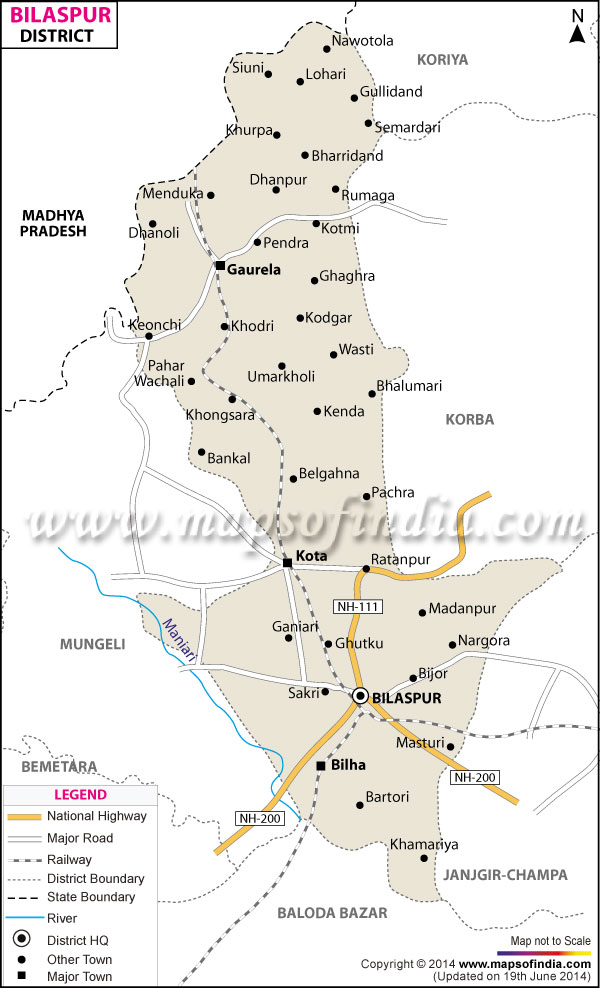
| *Map showing the National Highway, Major roads, other Roads, District Headquarter, Town, etc in the Bilaspur District, Chhattisgarh. |
About
It's a unique combination of functions that most districts of its size do not usually have to handle in a single cab: judicial hub, railway nerve centre, and agricultural heartland, all in a small administrative area. The city has assumed an aura quite different from that of Raipur, the political capital of Chhattisgarh, since the establishment of the Chhattisgarh High Court, attracting lawyers, litigants and judicial officers from all over the state to its courts and chambers on a day to day basis.
Meanwhile, Bilaspur Junction's importance is heightened because of its role as the headquarters of the South East Central Railway zone, making it one of the busiest transit points in the state with its high transportation value compared to its population density, which connects the state with Nagpur, Kolkata and the rest of Eastern and Western Railways.
These institutional functions are not the only legacy of Bilaspur's older character, however, as the villages in the district also continue to produce fragrant rice called Dubraj for each harvest season, the weavers still produce the traditional Kosa silk, and the temple towns, notably Ratanpur, continue to welcome pilgrims as they have done for the past millennia.
History & Culture
The Kalachuri dynasty had a strong influence on Bilaspur and the wider region from about the 5th century CE, and is responsible for some of the most important temple architecture in central India. Ratanpur is the ancient name of the current town of Bilaspur, about 25 kilometres away, whose name is derived from King Ratnadeva I, who constructed the Mahamaya Devi Temple nearly a thousand years ago, and which is now considered a major Shakti Peetha, where the right hand of Goddess Sati fell.
The ruins and temples of Malhar (also important in the district) provide some of the most tangible physical traces of the artistic and architectural contributions of the Kalachuri dynasty from the 9th to 13th centuries. Further, the region was ruled by the Marathas from the 18th century till it was finally a part of British India and then undivided Madhya Pradesh, before finally becoming Chhattisgarh as a separate state in November 2000.
In the cultural scenario, Bilaspur is also known as the “Cultural Capital of Chhattisgarh” and has been a strong supporter of the arts, music and classical education from olden times. Thousands of people flock to the Mahamaya Temple in Ratanpur every year to celebrate Navaratri, and the district's vibrant festival schedule also features Hindi-belt events such as Diwali and Holi, as well as Chhattisgarhi-specific events like Hareli and Pola, which are closely linked to the local agricultural calendar. The district is also famous for its aromatic Dubraj rice and the Kosa silk weaving tradition, which are still a source of pride to the district and play a significant role in its craft and agriculture.
Economy
The economy in Bilaspur is a mixture of administrative and judicial jobs, a strong railway & transport presence, agriculture and a growing services sector related to health, education and trade.
The government sector at Bilaspur also has a significant group of legal and judicial administration officials in addition to the typical number of offices of the collectorate and officials of the government of the State of Chhattisgarh for the administration of tehsils and blocks in the district. This judicial dominance provides Bilaspur with a unique administrative economy as compared to other districts of Chhattisgarh.
Bilaspur is also the headquarters of South East Central Railway, one of the zonal headquarters of Indian Railways and the district is also a public sector railway hub as Bilaspur Junction is a major zonal station of the city that connects with Nagpur, Tatanagar and Katni. The railway facility, coupled with the Bilaspur Airport, has made the district an important transport hub in the central region.
Services Sector: Bilaspur city has expanded its services sector comprising educational institutions, retail outlets and hospitals, not only at Bilaspur but serving a larger population from across northern Chhattisgarh. The Kosa silk industry, a traditional business in the district, is still sustaining the livelihood of the weavers and the agricultural trade with Dubraj rice and other paddy crops is supporting a significant local milling and marketing economy. There is also a rather small but steady supply of hospitality and transportation services from the tourist visits to the temples and the Achanakmar Wildlife Sanctuary in the district.
Tourism
Among the most important temples of the district, Mahamaya Devi Temple, Ratanpur, is a Shakti Peetha of the 11th century constructed by King Ratnadeva I, with Nagara-style architecture features a large courtyard and a tank, and is a favourite destination for pilgrims, particularly during the Navaratri festivals.
A destroyed temple and the Kalachuri-era Bhima Kichak temple and a fort at the site are the remnants of Malhar, an archaeological wonder about 30 km away from Bilaspur.
Achanakmar Wildlife Sanctuary, a UNESCO-designated tiger reserve and biosphere reserve, is 60 kilometres from Bilaspur, which has a high density of bison, leopard, tiger and rich biodiversity in the dense forest.
Tala (Deorani-Jethani Temples), a village on the banks of the Maniyari River about 30 kilometres from Bilaspur, housing an unknown number of animal, insect, and mythological figures carved into the rocks with an unusual style.
The picturesque Khutaghat Dam, on the Kharung river, approximately 33 kilometres from Bilaspur along the Bilaspur-Ambikapur highway, is where people enjoy picnics and boating.
Combined, these sites provide Bilaspur with a tourism image of a place that harbours really rare Kalachuri-era heritage and has proximity to wildlife and picnic spots around the city. The Mahamaya Temple at Ratanpur and the ruins of Malhar are fairly close to each other and so many visitors combine a trip to the temple with a day visit to the ruins of Malhar; Achanakmar is a day trip for wildlife enthusiasts from Bilaspur. Nearer the city itself, however, are the more sedate Bilasa Tal and the riverfront of the Arpa, which complete the picture of a mix of old and new that is the city's tourism.
Demographics
After 2020 bifurcation of Gaurela-Pendra-Marwahi district, Bilaspur has a size of approximately 16,25,502 people with a population density of around 468 persons per km² as per 2011 Census and the literacy rate in the district was 70.78 % with male literacy level being much higher than female literacy level and sex ratio of 971 females for every 1000 males.
The urban population is about 25% of the district's population, most of whom reside in Bilaspur city, with the rest of the population being distributed among the rural tehsils and blocks of the district. The district has a socially diverse population base with the percentage of Scheduled Tribes at about 19% and the percentage of Scheduled Castes at about 21%.
Hindi and Chhattisgarhi are the two main languages spoken throughout the district, and Chhattisgarhi is of considerable everyday and cultural importance in the rural areas. The city of Bilaspur, being an important railway, judicial and administrative centre, has also attracted a large number of migrants from various parts of Chhattisgarh and neighbouring States, making the district diverse in terms of its demography.
These numbers illustrate a district where the population is becoming more and more defined by its dual role as an administrative-judicial center and an agricultural heartland. With a stronger attraction for the urban Bilaspur city, and the fact that even today the district is predominantly agricultural (paddy) and traditional silk weaving (rural tehsils), Bilaspur has a demographic profile of a district which falls between the more strictly rural districts of Chhattisgarh and its larger urban centres like Raipur.
Administration
Bilaspur district has been divided into 11 tehsils and 4 community development blocks as per the post-2020 boundaries of the district and it also includes 708 inhabited villages and 11 towns including the city of Bilaspur that is administered by the Bilaspur Municipal Corporation which is the main civic body of the city.
The administration in Bilaspur has a weight which is not found in many other districts of Chhattisgarh, most likely due to the judicial position. In addition to the revenue machinery of tahsildars with land records and certification work in the 11 tehsils and Block Development Officers coordinating various development activities under 4 community development blocks, the district also boasts a significant legal-administrative ecosystem with bar associations, sub-ordinate courts and supporting staff which creates one of the largest legal employment clusters in the state.
This layer of judges work more or less independently of the normal flow of collector-driven revenue, but they do interact with each other regularly in land disputes, public interest litigation related to local development projects, and administrative appeals.
The Bilaspur Municipal Corporation, on the other hand, has the responsibility of civic governance in the district's biggest urban center, with the rural tehsils remaining under the control of Gram Panchayats at the village level. That this is a mixed bag of revenue administration, judiciary and municipal services brought under one umbrella of the district headquarter sets Bilaspur apart from Raipur, which is the political capital of the state of Chhattisgarh.
| Facts of Bilaspur District | |
|---|---|
| Official Name | Bilaspur |
| Location | Chhattisgarh |
| Area (km2) | 3475.61 |
| Population | 16,28,202 |
| Language | Bilaspuri |
FAQs
Q1: How many villages are there in Bilaspur district?
The district of Bilaspur has 708 villages., out of which 11 tehsils and 4 Community Development Blocks have inhabited villages.
Q2: How many people live in Bilaspur district?
Taking into account the creation of Gaurela-Pendra-Marwahi district in 2020, Bilaspur's population is now estimated at around 16,25,502 as per the 2011 Census.
Q3: What is Bilaspur district well-known for?
Bilaspur is most famous for the Chhattisgarh High Court, the Mahamaya Devi Temple at Ratanpur, the Mahamali Kalachuri's ruins at Malhar and Achanakmar Wildlife Sanctuary.
Q4: What is the literacy rate of Bilaspur district?
74.46 %.
Q5: Which languages are spoken in Bilaspur district?
Hindi and Chhattisgarhi.
Q6: Bilaspur district has how many tehsils/blocks?
There are a total of 11 tehsils.
Q7: What is the importance of Mahamaya Devi Temple?
The Mahamaya Devi Temple dates from the 11th century and is considered one of the most important Shakti Peethas as well as one of the most important pilgrimage sites in the district particularly during Navaratri.
Q8: Major economic activities of Bilaspur district?
Judicial and railway administration, as well as agriculture, Kosa silk weaving and trade related to Dubraj rice and other paddy crops constitute the backbone of the district economy.
Last Updated on : August 24, 2026
