






About
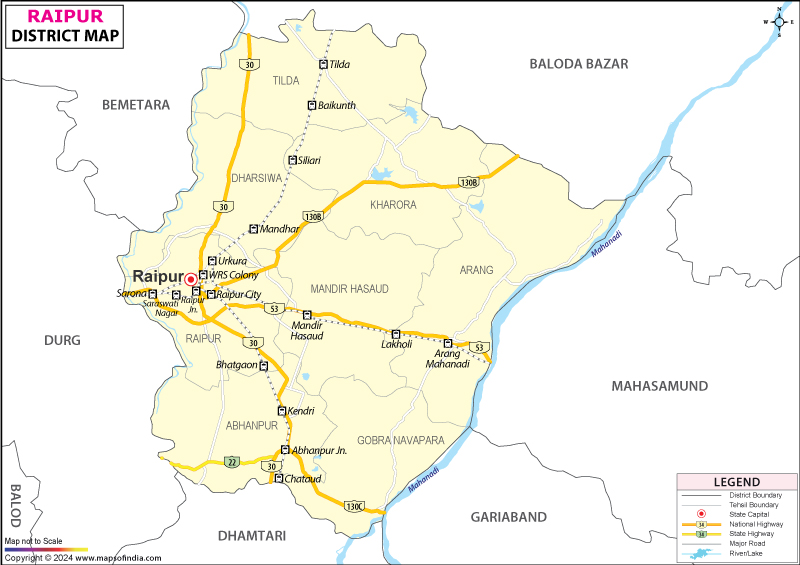
The district of Raipur is the central district of Chhattisgarh both administratively and geographically. Now, since the establishment of Chhattisgarh in November 2000, Raipur district is the capital of the state. It was established by the name of its founder Brahma Deo Rai of the Rai family and is currently the political, economic and cultural hub of the whole state. To the west, the district is surrounded by Durg district and Bemetara district, to the east by Balodabazar-Bhatapara district, to the south by Mahasamund district and further south by Dhamtari district. Raipur has similarly been greatly affected by the reorganisation of the state, including in January 2012 when the Baloda Bazar-Bhatapara and Gariaband areas were cut off to create separate districts, significantly decreasing Raipur's geographical area to the present size of some 2,892 square kilometres. What is left is a smaller, but equally significant district, which is the seat of the Chhattisgarh government, Naya Raipur (Atal Nagar) - a planned twin city of Raipur that has developed as the new administrative capital of the state of Chhattisgarh.
History & Culture
The history of the city of Raipur goes back to long before it became a state capital and it was believed to have been established by Brahma Deo Rai, a ruler whose name is the origin of Raipur's name "Rai" from his own name and "pur" town or settlement. However, the entire region had earlier been under the Kalachuri dynasty which had spread temples, water tanks and administrative structures throughout the region of what is now Chhattisgarh, which can still be seen in and around Raipur city today.
Over the centuries, the area was under Maratha control before being colonized by the British in the 19th century as part of the Central Provinces. During this period the town of Raipur was mostly a regional trading and administrative centre with no specific political significance and was a typical provincial town of the much larger Central Provinces and Berar. The area stayed within the undivided Madhya Pradesh for more than 50 years after the Independence of India, during which time Raipur prospered but remained one of the many smaller towns of Madhya Pradesh.
All of this changed on 1 November 2000 when finally the demand for an independent state of Chhattisgarh was accepted and Raipur was declared as its capital and the choice of location of the new capital, which led to the construction of new government buildings, infrastructure investments, and population growth, turned the whole course of the city's life around practically on a dime, and eventually led to the development of Naya Raipur as a dedicated planned capital, right outside the older city.
Raipur is rich in cultural heritage including its historic temples, its artisan crafts and its vibrant street food scene which is a testament to the city's rich cultural history. Dudhadhari Math is one of the oldest temples in the city, which is dedicated to Lord Rama and has a local legend all tied up with it: one cow used to bring milk to the temple, bathing the idol with milk.
It is an energy-filled city where festivals like Diwali, Holi and Navaratri are celebrated with great fervor in the markets and public places, and at the same time, distinctly Chhattisgarhi festivals such as Hareli and Pola are still being celebrated in the rural blocks of the district, connecting the modern urban identity of the city with its agrarian past. The district's markets, especially Pandri and Mahatma Gandhi Market, continue to function as lively spots of textile commerce, tribal handicrafts, and daily living that imbue the city's administrative functions with a sense of humanity.
Economy
The economy of Raipur is a unique one, with government administration, heavy industry, and a rapidly developed services sector.
Government Sector: The Chhattisgarh state secretariat, the state legislative assembly and almost all major departments of the state government are functioning here, with a large part of this administrative burden gradually moving to the planned city of Naya Raipur. The centralisation of administrative functions also renders public administration one of the highest employment sectors in the district in terms of formal jobs.
In addition, there is a high concentration of industries in the public sector including steel, sponge iron and power generation, in the industrial belt around Urla Industrial Area of Raipur, and Chhattisgarh is one of the leading states of India in terms of steel production. The district has also been making a significant contribution as a logistical hub of the state with the presence of public sector infrastructure like major railway and road lines connecting Raipur to Nagpur, Bilaspur, Durg-Bhilai, etc.
The services sector: Raipur's capital status has seen its services sector grow at a rapid pace, including a significant increase in the number of hospitals, private educational institutions, IT and business process companies and retail development. The city has become a hub for higher education with various institutions such as the Pt. Ravi Shankar Shukla University, Hidayatullah National Law University and the National Institute of Technology, Raipur.
The district has witnessed significant expansion in the hospitality, real estate, and transport-related services sector, thanks to the continuous flow of business trips and students and government officials in and out of the area, especially around Swami Vivekananda Airport and the rapidly growing Naya Raipur corridor.
Tourism
The tourism identity of Raipur is a combination of all the features of the city, spiritual places and emerging tourism spots in the planned city of Naya Raipur.
The historic lake of Raipur, known as Vivekananda Sarovar (Budha Talab), is named after Swami Vivekananda, believed to have stayed and swam here, and has a 37-foot statue of the philosopher, which is the tallest in the Limca Book of Records.
Dudhadhari Math — Lord Rama's Temple with detailed Architecture and Legends of Devotion, one of the oldest Temples of Raipur.
The Mahant Ghasidas Memorial Museum, a prominent archaeological museum of Chhattisgarh, is a museum that displays a significant collection of archaeological items, tribal arts and culture and about the region's history and heritage, providing another interesting insight into the cultural heritage of the State of Chhattisgarh.
The Chhattisgarh government made Purkhauti Muktangan — an open-air cultural museum spread over 18 hectares that showcases the State's natural resources, industries, and cultural heritage in one integrated space.
These help to create a tourism profile of the city of Raipur, blending urban heritage with outdoor adventures, instead of relying on one major landmark. Most visitors spend a day touring the older city, visiting the markets, the Dudhadhari Math and Budha Talab before making a trek to the newer city of Naya Raipur where they see the modern planned architecture, the jungle safari, and Purkhauti Muktangan cultural park. The extra time is commonly spent visiting Ghatarani Waterfalls or the nearby Jatmai Temple, making a tour of the old city and its modernising agenda as a capital city.
Demographics
The current population of Raipur as per the 2011 Census is 21,60,876 and all the major portion of the population live in urban areas; due to the high number of educational institutions and the capital of the state, the literacy rate in Raipur is higher than the average literacy rate of the Chhattisgarh state, the male literacy rate is 87.97% and the female literacy rate is 72.79% which is higher than the national average.
Hindi is the predominant language of the district with small populations in Odia, Sindhi and Chhattisgarhi, especially in the trading and business community of the district. Majority of population in the district is of Hindu religion and there is a significant Muslim minority residing in the city of Raipur.
Taken together, they are the reflection of a district that has undergone a radical change in its demography since it became a capital and a population that has now become largely urban, relatively well educated and far from homogeneous, with a steady influx of government officials, student and business migrants from across Chhattisgarh and its neighbouring states. This is in contrast to the other majority farm districts that predominate in the state.
Administration
The district of Raipur is divided into 8 tehsils and 4 community development blocks which are named namely Raipur, Tilda, Arang and Abhanpur; the district has a significant urban presence with 2 Municipal Corporations (Raipur, Birgaon), 3 Nagar Palikas and 7 Nagar Panchayats administering urban affairs. There are about 478 villages in the district and local self-governance in rural areas is through 408 Gram Panchayats, which coordinate the administration of the villages.
The district collector's office, established in Raipur city, is responsible for revenue administration and coordination of revenue across the tehsils/blocks and closely interacts with Raipur Municipal Corporation, Raipur Development Authority and Naya Raipur Development Authority due to its dual nature as a traditional administrative unit and also the seat of the state government of Chhattisgarh.
It is very unique that Raipur's administration structure is not similar with any other district in Chhattisgarh as it serves as the headquarters of the whole state government. In addition to the normal machinery of tahsildars who manage the district's 8 tehsils and Janpad Panchayats who run 4 development blocks, the district collector office has to keep in close coordination with the Chhattisgarh state legislative assembly, secretariat of the state government and various departments based in Raipur city and especially in Naya Raipur.
This gives it a complex governance system that is unique in the state: a traditional urban governance system provided by the Raipur Municipal Corporation and Birgaon Municipal Corporation for the rural villages that have been incorporated; a newer and rapidly developing urban governance system, that of the Naya Raipur Development Authority, for the new capital city of Raipur; and a more traditional rural system of governance provided by the Gram Panchayats and Janpad Panchayats in the villages that have not been incorporated.
The police administration too is comprehensive and 32 police stations serve a district that has to deal with a large number of people in the city, as well as the security needs of the state's political and administrative capital. In India, few district collectors have such a wide range of coordinating powers as they oversee what goes on in the municipalities, in rural government and in the overall state administration.
| Facts of Raipur District | |
|---|---|
| Official Name | Raipur |
| Location | Chhattisgarh |
| Area (km2) | 2891.98 |
| Population | 21,60,876 |
| Language | Hindi |
FAQs
Q1. How many villages are present in Raipur district?
There are 545 villages in the district.
Q2. What is the population of the district?
The population is 21,60,876.
Q3. What is the literacy rate of the district?
1495145 is the literate population.
Q4. Which languages are spoken in Raipur district?
Hindi, Odia, Sindhi and Chhattisgarhi are spoken by smaller numbers.
Q5. Total Number of Tehsils and Blocks in Raipur District?
The district has 4 community development blocks and 8 tehsils.
Q6. On which date was the Raipur district bounded as it is today?
The present-day boundaries of Raipur are as of January 2012 when Baloda Bazar was separated as a district as well as the area of Bhatapara and Gariaband.
Q7. Why is Naya Raipur important?
Naya Raipur is a twin city of Raipur and is officially named Atal Nagar and is being developed to become the administrative capital of Chhattisgarh, where the secretariat of the government, the legislative assembly, and many more institutions are located.
Q8. Which are the key industries of Raipur district?
The district boasts a strong industrial base with steel, sponge iron and power generation being the major industries, especially around Urla Industrial Area, in addition to a burgeoning service sector in education, healthcare, and the IT industry.
Last Updated on : August 24, 2026
