|
||||||||||
| ||||||||||
|





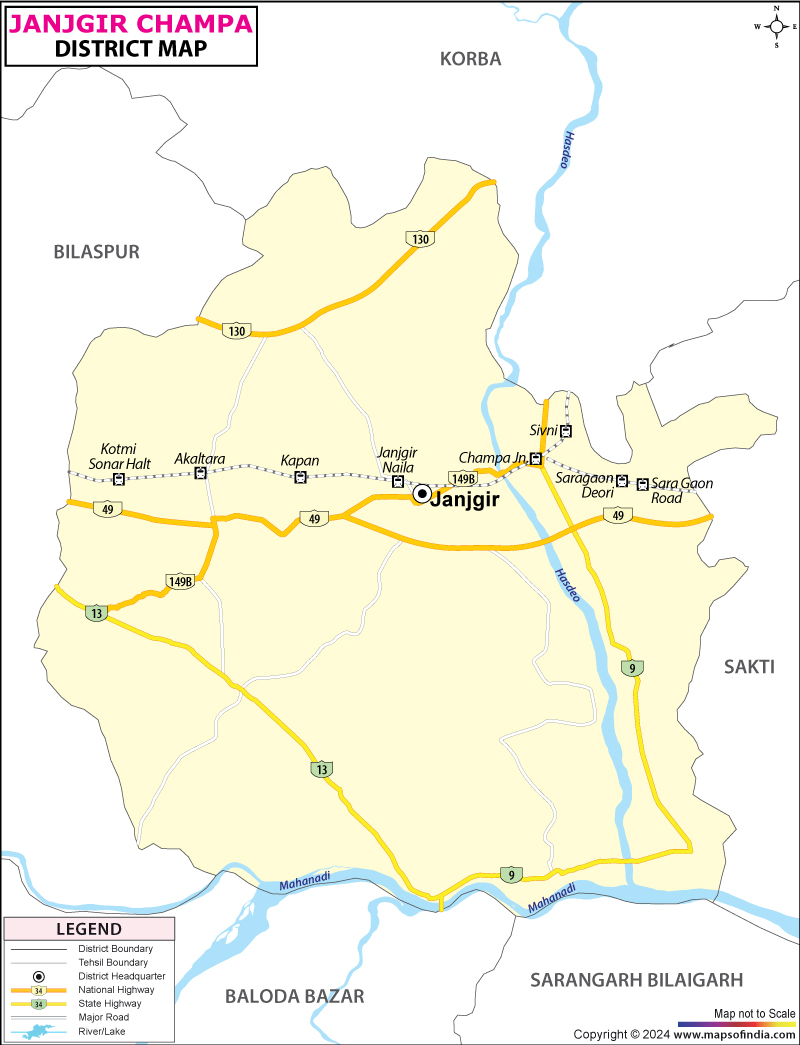
| *Map showing the National Highway, Major roads, other Roads, District Headquarter, Town, etc in the Janjgir-Champa District, Chhattisgarh |
About
Janjgir-Champa District is one of the districts of Chhattisgarh, India, in the fertile plains along the Mahanadi river basin which is part of the Bilaspur revenue division of Chhattisgarh and the district's name is derived from the twin administrative centres, Janjgir the district headquarters and Champa an important commercial town, both of which were combined to create the district in 1998, when it was split from the erstwhile Bilaspur district. The name of Janjgir and its origins go back to Maharaja Jajwalya Dev of the Kalachuri Dynasty whose rule made an impact on the temples and settlement of the area.
The district covers an area of about 3,850–4,470 square km, in the middle of the rice bowl of Chhattisgarh which is heavily depended upon by the Mahanadi, Hasdeo, Shivnath and Jonk rivers in the irrigation process. It is referred to as the "rice bowl of Chhattisgarh" owing to its highly productive paddy fields, and, in the recent past, has also been called an energy district as well as an agricultural one, due to the thermal power station in this sector. It creates a unique image of Janjgir-Champa with its amalgamation of the old and the new, the ancient towns and the history of the river and industrial development.
History & Culture
The Kalachuris of Ratanpur were the rulers over the plains in Chhattisgarh and the history of Janjgir-Champa is directly related to the Kalachuris of Ratanpur. Janjgir town is said to have been constructed by Maharaja Jajwalya Dev and many of the oldest temples of the district are believed to be built during the patronage of this dynasty in the 12th century, such as the incomplete twin-temple structure at the Vishnu temple near Bhima Talab in Janjgir, known as the "Nakata Mandir". Shivrinarayan (also known as Sheorinarayan), located at the holy confluence of Mahanadi, Shivnath and Jonk rivers is one of the most historic places in the district. It is believed to be the spot where Lord Rama stopped to eat berries from Shabari and the Laxminarayan and Nar-Narayan temple complexes were constructed by the Kalachuri rulers in the 11th century.
Culturally the district is very rooted in Chhattisgarhi traditions and the majority of the population speaks Chhattisgarhi as their primary language and Hindi as their dominant second language as recorded in the Census 2011 which reflects in the folk literature, storytelling and agrarian festival songs of the district. The district is famous for its hand woven Kosa silk and cotton fabrics especially the tradition of tie and dye and handloom weaving in Champa-Janjgir belt which is still assisting the artisans.
Religious fairs are an integral part of the cultural calendar, with the Magh Purnima mela at Shivrinarayan being a very popular event which draws large crowds every year and the Pithampur temple on the Hasdeo river hosting a ten-day celebration of Maha Shivaratri and Rang Panchami, in which Lord Shiva is ceremoniously wed by Naga sadhus. Popular harvest festivals and seasonal events like Hareli, Pola, Teej and many more throughout the rural landscape of Chhattisgarh are also common, which is indicative of the district's agro-economic orientation.
Economy
Janjgir-Champa's economy is supported by three main pillars- agriculture related government support systems, expanding public/industrial sector and expanding services sector.
Janjgir town and district headquarters are the administrative hubs of the district and house various government offices, both state and central, such as the Collectorate, district courts, police administration, agriculture and irrigation departments and municipal bodies creating a significant concentration of formal employment opportunities. Public infrastructure, particularly mandis (grain markets) and co-operative societies, is playing a key role in procuring paddy from the local farmers.
The district is also one of the important centres for power generation in Chhattisgarh with a number of large thermal power plants along the river belts of Hasdeo and Mahanadi with some significant power plants in association with the State and Central Electricity Utility. These power projects and ancillary industries have made Akaltara, Baloda and Dabhara of the district into pockets of industries which have created significant public sector and contractual jobs.
Services Sector: Trade and transport and small scale commerce is focused in towns like Champa, Janjgir, Sakti (former district), Akaltara which are market centres for the rural areas in the vicinity. The industrial development of the district has been accompanied by the growth of other service and small manufacturing enterprises, such as banking, education, healthcare and retail services, and the rice-milling industry has been one of the most important sectors of economic activity to create jobs in the region, given the district's considerable rice production in terms of the volume of paddy. Although steady growth of employment in industry and service sectors, agriculture still remains as the main livelihood of most of the rural people, especially paddy farming and in addition to paddy, pulses and oilseeds are also grown at their home.
Tourism
Janjgir-Champa's tourist appeal is largely based on the sheer number of temples, some of which have very unusual stories to tell.
Although it was never completed, Vishnu Mandir, Janjgir is an ancient unfinished temple, built in the 12th century by the Kalachuri rulers, near Bhima Talab, and is one of the finest examples of Vaishnavite temple architecture in the region.
The Shivrinarayan Temple is an important pilgrimage center located at the point where the three rivers of Mahanadi, Shivnath and Jonk meet, and is considered to be a Vaishnavite equivalent to Prayag, and linked to the local legends regarding Lord Rama's exile.
Chandrapur-Chandrahasini Temple, a sacred Shakti Mandir that is revered by people from all parts of the district and beyond. Laxmaneshwar Temple and other old temples at Kharod Temple Complex, with elaborate medieval stone carvings.
Pithampur Shiv Mandir (Kaleshwarnath Mandir) is a temple located on the banks of Hasdeo river, which is a peaceful pilgrimage stop along the river.
Bred of the temples, the next also represent the high density of devotional architecture in the district, and are associated with local legend and annual fair, the Abhardevi Temple and the Madanpurgarh Devi Mandir.
All of these sites embrace Janjgir-Champa's character as a pilgrimage site, and collectively provide a relatively uncharismatic yet substantial tour of Kalachuri and medieval architecture. Many pilgrims make a trip to the unfinished Vishnu Mandir in Janjgir town, which is also dedicated to Shri Vishnu and makes a connection with the nearby Shri Shivrinarayan, while others interested in the temple heritage of the district extend their journey to the temple at Khorod and Chandrapur. Janjgir-Champa is devoutly endowed with this cluster of shrines, each with its own local legend with a density of devotion that few areas of its size can match
Demographics
Janjgir-Champa's population is 9,72,453 according to 2011 census The undivided district's literacy rate was 73.7%, male literacy 84.72%, female literacy 61.31% and the ratio of females per 1,000 males was 986, which are likely to broadly represent the residual district due to the shared rural, agricultural nature of the areas of both halves of the original district.
The dominant languages of the district are Chhattisgarhi and Hindi; there are small communities speaking other languages in certain commercial and administrative activities. The district's population remains overwhelmingly rural and agricultural, with paddy being the main crop and livelihood of the district with its long reach of Hasdeo bango canal system in the tehsils.
The combined figures reflect a district which, despite the loss of a substantial part of its population and territory to the newly established Sakti district, still had a distinctly agrarian demographic population. Reliant on canal-fed farming and with its many temple towns, Janjgir-Champa has retained a rural-devotional character that has remained consistent over the decades since its inception in 1998 and until the last reorganisation.
Administration
After reorganisation in 2022, Janjgir-Champa district has been divided into 9 tehsils namely Janjgir, Akaltara, Baloda, Nawagarh, Shivrinarayan, Champa, Saragaon, Bamnidih and Pamgarh which are located in three sub-divisions under Janjgir, Champa and Pamgarh. Local self-governance was observed to be working through various Gram Panchayats at the village level in the villages of the district, and each of the five development blocks of the district (Nawagarh, Akaltara, Baloda, Bamhnidih and Pamgarh) had a Block Development Officer.
With the recent territorial restructuring of the district, the district collector's office, which is headquartered in Janjgir town, is responsible for coordinating and supervising revenue administration and help in coordinating the development priorities within the district, which are mostly focused on agriculture, in coordination with the elected panchayat representatives of the different tehsils and blocks.
| Facts of Janjgir District | |
|---|---|
| Official Name | Janjgir |
| Location | Chhattisgarh |
| Area (km2) | 2,37,599 |
| Population | 972453 |
| Language | Chhattisgarhi, Hindi |
FAQs
Q1. How many villages are there in Janjgir district?
There are 334 villages in the district.
Q2. What's the population of Janjgir-Champa district?
9,72,453 is the population of the district.
Q3. Which is the famous district for Janjgir-Champa?
There are a number of ancient temples such as Vishnu Mandir built in the 12th century and the Shivrinarayan Temple at the confluence of Mahanadi-Shivnath-Jonk river as well as it being the major food-grain producing district in the state.
Q4. What percentage of Janjgir-Champa district is literate?
According to the 2011 Census, the undivided district was 73.07% literate, which is likely to be fairly representative of the post-2022 undivided district.
Q5. Which languages are spoken in Janjgir-Champa district?
The district's main languages are Chhattisgarhi and Hindi.
Q6. How many tehsils are there in Janjgir?
The district was reorganized into 9 tehsils under three sub-divisions (Janjgir, Champa and Pamgarh) in 2022.
Q7. In which year Janjgir-Champa district was created?
Janjgir-Champa district was created on 25 May 1998 by splitting the Bilaspur district and was again split in 2022 when Sakti district was established from Janjgir-Champa.
Q8. What is the local administration system of the district?
The district's administration is carried out through different Gram Panchayats and Block Development Officers through 9 tehsils under the Janjgir town office of the district collector.
Q9. What is the Hasdeo Bango Project?
Hasdeo Bango Project is a massive irrigation and multipurpose dam project considered by many to be the lifeline of the agricultural economy of the district of Janjgir-Champa which provides canal fed water to a large portion of the district's agriculture.
Last Updated on : May 11, 2026
