|
||||||||||
 | ||||||||||
|





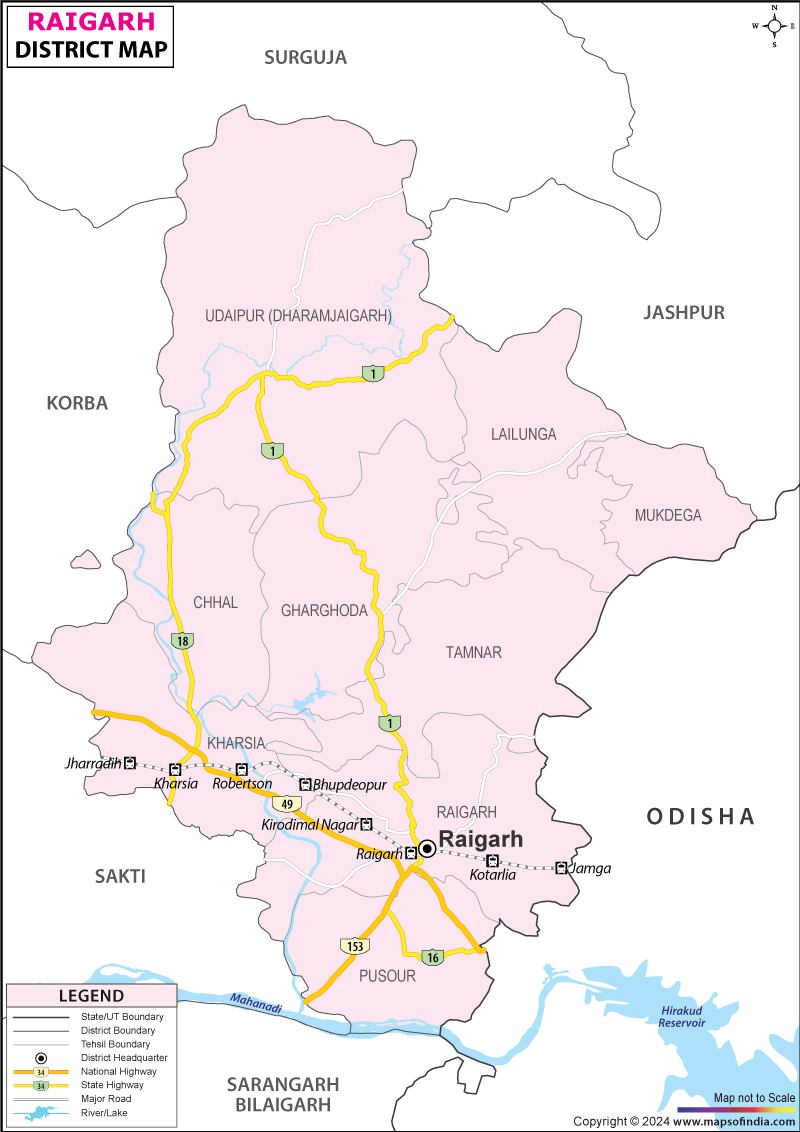
| *Map showing the National Highway, Major roads, other Roads, District Headquarter, Town, etc in the Raigarh District, Chhattisgarh |
About
It is located in the eastern part of Chhattisgarh in the Bilaspur division and is named after its headquarter town Raigarh which was founded by its namesake, the Maratha ruler Raja Raghuji Bhonsle. It was once a princely state on its own but with the independence of India it was immediately added to the Union of India and has since become one of the most significant industrial areas in Chhattisgarh, due to its coal deposits and the location of some of India's largest steel and power plants. The district is surrounded by the Jashpur district in the north, Sarangarh-Bilaigarh and Jharsuguda district of Odisha in the south, Korba district in the west and Surguja district in the north-west and it has an area of some 7086 square kilometres. Raigarh has a highly diversified topography, with dense forest and hill area alternated by fertile riverine plain, due to the presence of the fast flowing Mahanadi, Kelo and Mand rivers and the mountain ranges of Gajmar, besides the exotic caves of Kauhakunda and Kabra
History & Culture
The early history of Raigarh dates back to ancient times when the area was under the rule of the Mauryas, the Satavahanas and the Nagavanshis followed by the more recent rule of the Marathas and the princely states. Though under British paramountcy, Raigarh had no direct colonial rule and after independence of India in 1947 it became the first princely state to join the Union of India officially, which is a matter of pride for the people of Raigarh.
Raigarh has a rich and varied cultural heritage in terms of language and art. Aside from Chhattisgarhi, Hindi and Odia, more people speak Bengali, Marathi, and Telugu in the district, due to the presence of a large migrant population, this adds to Raigarh city's cosmopolitan character which is unusual for a district headquarter in Chhattisgarh. The tussar silk, especially Kosa, which is made by feeding silkworms on the vegetation of the district is particularly renowned and its weaving tradition is an important craft and livelihood in pockets of the rural areas of the district.
Local participation is still seen in the various traditional sporting and cultural competitions, such as Kabaddi tournaments taking place, and festival activities during the different seasons and festivals at various places, including the Chandrahasini Temple, which bring communities together, both rural and urban.
Economy
Heavy industry, which is based on its considerable coal deposits, dominates Raigarh's economy, but farming and traditional silk weaving also play an important role.
Raigarh town is the district headquarter and accommodates the collectorate and various departments of the Government of Madhya Pradesh which is responsible for the district's mandal and blocks. In the district, government coordination around environmental regulation, land acquisition and resettlement is a prominent role played by the government and it is closely watched in relation to the scale of mining and industrial activity in the district.
Public Sector: Raigarh is one of the most important coal producing districts in Chhattisgarh as it has some direct coal mines supplying power plants and steel plants in the district. NTPC has a significant presence in the district with power generation plants and the district also has a large volume of infrastructure for rail and road transport of coal, iron ore and finished steel products.
Services Sector: Raigarh is known nationally as the home of Jindal Steel and Power Limited (JSPL) which operates one of the largest integrated steel and sponge iron facilities, which is located near Tamnar on the outskirts of Raigarh. In addition to JSPL, the district is also home to Bhushan Power and Steel, Monnet Ispat, MSP Steel and Power, and JSW Steel. Raigarh has one of the most industrialized districts in the state of central India.
This industrial heart has, in turn, created significant business opportunities in ancillary services, transport, hospitality and retail and an education dimension has been added with the establishment of a Pandit Ravi Shankar Shukla University campus. Despite an increase in the share of the working population employed in industry, agriculture, and especially paddy farming, continues to support a large proportion of the rural population.
Tourism
The tourism image of Raigarh is a combination of natural beauty, ancient caves and temple sites, which makes it an extremely diverse mix of attractions for a district which is largely known for its heavy industries.
Gomarda Wildlife Sanctuary — a forested sanctuary with abundant fauna and natural beauty, a more tranquil natural holiday spot in the district.
This is the famous Shakti temple of Chandrahasini Temple in Chandrapur, which attracts devotees from all parts of the district as well as from outside the district especially during major Hindu festivals.
Singhanpur Caves and Kabra Caves — old rock shelters and caves, which are believed to be of pre-historic significance and provide a glimpse into the district's rich archaeological history.
The scenic natural site of Ram Jharna, Bhupdevpur, which is a part of Hindu mythology, is very popular among the visitors travelling the rural parts of the district.
The natural attractions include Kailash Caves and Ghatarani Waterfall (close to the district's boundaries) which feature waterfall views and cave exploration for outdoor enthusiasts.
Maharaja Agrasen Museum in Raigarh city is a museum which displays the local history and the time of the city as a princely state.
In addition to these known sites, the rivers and hill ranges of the Raigarh district are also less developed areas that provide tranquility for the people who are more interested in the natural beauty of the district, rather than the organised ones. If you are interested in the industrial metamorphosis of the district, the JSPL steel plant near Raigarh has once in a while, guided tours, to give you an uncommon, but very informative glimpse of one of India's largest integrated steel-making plants. In sum, a blend of ancient caves, temple pilgrimage, forest sanctuaries and the present day industrial scale makes Raigarh a tourism destination that mirrors the district's own multifaceted identity of old and new Chhattisgarh, one and the same.
Demographics
According to Census 2011, the population of Raigarh was 11,12,982 with population density of approximately 211 per km2. The literacy rate in the district was 73.7% with 9,59,866 literate people of which 993 females were in every 1,000 males, which is favourable. Despite the amount of industrial development in the vicinity, the balance of urban population (2,18,821) and rural population (the majority) in the district was still quite rural.
The district's main languages are Chhattisgarhi, Hindi, and Odia; other communities that have migrated to the district in the past few decades speak Bengali, Marathi, and Telugu. This linguistic diversity sets Raigarh apart from most of the other rural districts in Chhattisgarh which are linguistically homogeneous, as a result of the ongoing migration of the workforce that its industrial sector continues to attract.
These statistics show a district going through a major economic and demographic transition – with persistent agricultural and rural traditions and a growing industry sector consisting of people from all over India. The above average literacy rate and relatively favourable sex ratio mean that the population in the district is likely to be reasonably well equipped to benefit from this industrial expansion, though issues of environmental impact and land use are continuing to influence the public discourse in the district's mining and industrial belts.
Administration
The district of Raigarh has been divided into 9 tehsils in terms of its geographical extent in Bilaspur division. There are many Gram Panchayats and Janpad Panchayats, and the mechanism of local self-governance is found at these levels. The administration of the district is under Raigarh Municipal Corporation and in smaller towns like Kharsia, Sarangarh, Dharamjaigarh etc. small towns' municipal or Nagar Panchayat bodies are functioning.
The district collector's office in Raigarh town coordinates and oversees the administration of revenue, coordinates the significant mining and industrial activities in the district and the general administration throughout the tehsils, and works alongside the elected panchayat representatives to prioritise development activities in rural and rapidly industrialising areas of the district.
| Facts of Raigarh District | |
|---|---|
| Official Name | Raigarh |
| Location | Chhattisgarh |
| Area (km2) | 4059.90 |
| Population | 1,112,982 |
| Language | Odia, Hindi |
FAQs
Q1. What is the number of villages in Raigarh district?
951 revenue villages.
Q2. How many people are in Raigarh district?
The population of the district, according to the 2011 Census was 11,12,982.
Q3. What is the district famous for?
Known for its one of the big integrated steel and sponge iron plants of Jindal Steel and Power Limited, Kosa silk weaving process and natural beauty such as Gomarda Wildlife Sanctuary, Raigarh is best known for this.
Q4. What % of people in Raigarh district can read?
As per the 2011 Census, the district's literacy rate is at 73.7%.
Q5. Raigarh district is divided into how many tehsils?
The district has 9 tehsils.
Q6. In what way was Raigarh a part of India's Independence Movement?
Raigarh is the first princely state to formally join India after independence in 1947.
Q7. Which are the important industries of Raigarh district?
The district has a strong industrial base with the presence of steel, sponge iron, cement and power generation industries, with Jindal Steel and Power Limited being the leading industry and coal mining and traditional Kosa silk weaving are also found.
Q8. In what manner the Raigarh district is managed locally?
The district is administered by 9 tehsils and many Gram Panchayats and Janpad Panchayats working under the supervision of the district collector's office, and the Raigarh Municipal Corporation in Raigarh, the district headquarters.
Q9. What is the natural attraction of Raigarh district?
The forest, cave and riverine landscape are all found in Raigarh where you can find Gomarda Wildlife Sanctuary, ancient Singhanpur and Kabra caves and beautiful places such as Ram Jharna and Ghatarani Waterfall.
Last Updated on : August 24, 2026
