






About
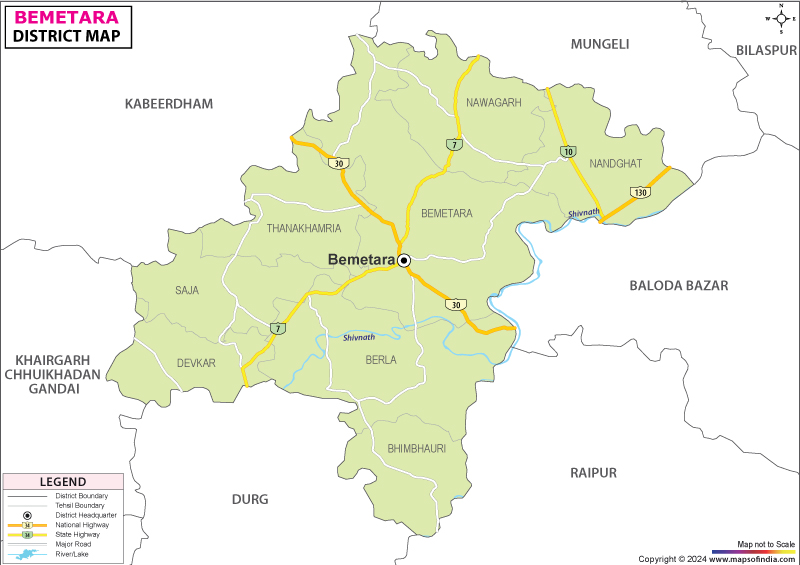
Named after the local queen Vyomtara who is believed to have ruled the area for a long period of time, Bemetara district is located in the central plains of Chhattisgarh, a part of the Durg division. The district of Bemetara was formed as part of the 'Narmada Sarover Mission' of the Government of Chhattisgarh and was formally inaugurated on 13 January 2012 by the then Chief Minister Raman Singh from Durg district.It is surrounded by Durg district in the south, Raipur and Baloda Bazar-Bhatapara in the east, Bilaspur in the north and Kabirdham (Kawardha) and Rajnandgaon in the west, thus having a truly central location within the plains of Chhattisgarh.
Bemetara is an overwhelmingly agricultural area, spread over an area of about 2,854.81 sq.km. with the flat, fertile terrain being dominated by paddy cultivation as the major crop to support the majority of the rural population. The district has a rich historical background in relation to the queen of its name and has been steadily growing in terms of its development as a small regional trading and transport hub in the western plains of Chhattisgarh, since its administrative formation.
History & Culture
Bemetara has a long history as a place, although documents from the more distant era are scarce, but its origins are even older than its establishment as an administrative district in 2012. Local lore goes that the district's name was inspired from Queen Vyomtara, a ruler believed to have ruled this part of the Chhattisgarh plains for a long time and which was softened over the generations of common speech till it became ‘Bemetara'.
The wider area was probably populated by the same general waves of people which populated the rest of central Chhattisgarh, namely early settlement related to the ancient Dakshina Kosala area, its later association with the sphere of the Kalachuri dynasty which ruled much of the Chhattisgarh plain during centuries, and its eventual integration with the administrative system of the Maratha dynasty before the British rule took over and the area became part of the Central Provinces.
Over most of its recent past though Bemetara had no place in the administrative imagination beyond being a tehsil under a larger administrative unit of Durg. This implied that the mythic tales of Bemetara's history were always subordinate to the overarching administrative-economic history of Durg, while it carried on its own rhythm of agricultural life in a quiet and uninterrupted way, over the years. The region has an older, continuous history of settlement and farming than this, and it wasn't until the formal inauguration of Bemetara as the newest district of Chhattisgarh, in January 2012, that Bemetara gained an administrative identity of its own.
About 98% of the population is Hindu, and every town and village pulse with festive energy around Diwali and Holi; all major religious festivals here also have an impact on the local communities, rendering local temples as the hub of devotion, the Deorbeeja temple being the most prominent among them for the celebration of the Navaratri festival, which has its own local lore and Ramayana-based traditions.
In addition to these mainstream Hindu festivals, Bemetara's cultural calendar is intricately linked with its agri-life in some ways that may even be more fundamental to life than religious ritual. The rituals on the occasion of Hareli, which begins the agricultural season and invokes a good harvest, and Pola, a festival in honour of bullocks and farming tools, which are essential to traditional agriculture, are also of great importance here and do not seem to have been similarly reduced in significance in other districts where farming is less prominent in people's lives.
For Bemetara, where nearly half the populace is directly active in farming, these festivals are not merely cultural events but authentic indicators of the working year of the district, and observed in a way that can be said to be more sincere than merely traditional.
But many times Bemetara's culture is an example of it being a district, rather than an ancient city or a grand monument, but rather a very down-to-earth, rural, and one that is much more influenced by the demands of the agricultural calendar than any single dramatic event. While districts such as Raipur and Bilaspur are defined by great temples, royal palaces or judicial importance, Bemetara's cultural identity is defined by the steady continuity of village life, the Chhattisgarhi language and custom, and the farming rhythm that may have shifted definitely over the generations since the time of Queen Vyomtara, who is said to have named the area.
Economy
Bemetara's economy is predominantly agricultural, with a small services and government sector focused in the town of Bemetara.
The Government Sector, characterized as a relatively new district, sees district estimates of roughly 10% of local employment by its education, irrigation, public works and food grains department. Government infrastructure and establishments have been steadily expanding since the district was established in 2012.
Public Sector: In a district with a strong agricultural orientation, the provision of water for irrigation and agricultural extension services is important for Bemetara's paddy-based agriculture. The public sector banks and co-operative credit institutions have a significant contribution to make in financing the big cultivator population of the district.
Services Sector: Jobs in this sector (Trade, business and real estate) constitute about 10% of the total employment in the area, with Bemetara town and other tehsil headquarters like Saja and Nawagarh having more of them. The district is located on NH-12 and has led to a small transport and trade economy; the agricultural surplus has enabled a network of rice mills and of grain markets for local consumption and trade between the district and its neighbouring districts. The services industry has been growing in Bemetara, but is clearly a secondary industry to agriculture, which employs almost four-fifths of the working population.
Tourism
Though Bemetara's tourism identity is still small, due to its recent establishment, and its mostly agricultural nature, it does have a few interesting points of local interest.
Deorbeeja Sita Temple, a significant temple in the district, revered for its connection with the local religious tradition and Sita-related folktales.
Bemetara Town, the district headquarters itself, provides a more compact introduction to civic and administrative development since 2012, to city markets, and to the everyday Chhattisgarhi small town.
This is followed by the other tehsil centres of Saja and Nawagarh, which are both worth a visit to offer a glimpse of rural life in Chhattisgarh, away from the more heavily-touristed circuits of the state.
For those who prefer a more serene and reflective experience of rural tourism, the rural agriculture landscape is a great place to start and the district's vast paddy fields, especially during the monsoon and post-harvest seasons, create a peaceful ambiance for visitors eager to witness the heartland of Chhattisgarh up close and personal.
As one of the newer and less known districts in Chhattisgarh, Bemetara has not yet built up sufficient infrastructure for tourists and most people transiting through the district for some administrative or business purpose related to agriculture, do so for the purpose of sightseeing. Bemetara, however, is also close to the popular heritage circuits of neighbouring Durg, Raipur and Bilaspur districts and may be a practical, low profile point of rest for visitors to the central region of Chhattisgarh, providing authentic and authenticating glimpses into the lives of the state's rural and small-town population.
Demographics
According to the Census 2011, Bemetara district has a total population of 7,95,759, consisting of 3,97,546 males and 3,97,788 females, with a male to female ratio of 1,001:1,000; this is a fairly balanced ratio. The literacy rate was 70.58% in the district, with 82.36% of males and 58.91% of females achieving this status, which is significant given the gender disparity in education seen in many rural Chhattisgarh districts in the past. The district was highly agrarian as only 9.37% (74,567) of the population lived in the urban regions with more than 90% in the rural tehsil areas of the district.
The district had a relatively small tribal population compared to other districts in Chhattisgarh with a large percentage of Scheduled Tribes (4.67%) and Scheduled Castes (18.10%). The majority of people, 97.43%, still speak the Chhattisgarhi language, while a smaller 1.96% speak the language of Hindi. The religion of the population in the district is predominantly Hindu (98.26%) with a small minority group of Islam, Christianity and Sikhism.
These numbers reveal a district which is still predominantly rural and agricultural, people whose activities are still mostly agricultural and who reside mostly outside the towns. While the relatively low sex ratio of males to females is a positive sign, the disparity in literacy level indicates further work needs to be done in the educational accessibility for women in the rural tehsils of the district.
Administration
Bemetara district comprises 5 Tehsils namely Bemetara, Nawagarh, Saja, Berala, and Thankhamhariya with 2 Administrative Sub-Divisions, Bemetara and Saja and 4 Development Block namely Nawagarh, Bemetara, Berala, and Saja. There are 700 villages in the district where 387 Gram Panchayats provide local self-governance in a coordinated manner, and there are several municipal and nagar panchayat bodies across the district's seven urban centres, which provide urban administration.
Since the district's formation in 2012, the district's development priorities are largely agricultural with the collected revenues being administered by the district collector's office, based in Bemetara town, in concert with elected panchayat representatives, to coordinate and supervise revenue administration and coordination across the tehsils and blocks.
| Facts of Bemetara District | |
|---|---|
| Official Name | Bemetara |
| Location | Chhattisgarh |
| Area (km2) | 2854.81 |
| Population | 7,95,759 |
| Language | Hindi, Chhattisgarhi |
FAQs
Q1. In Bemetara district, how many villages are there?
Bemetara District has 5 Tehsils and 4 Development blocks with 702 villages.
Q2. How many people live in Bemetara district?
The population of the district as per the Census 2011 is 7,95,759.
Q3. What is Bemetara well-known for?
Bemetara is known for the heavy reliance on agriculture, as one of the newer districts in Chhattisgarh created in 2012 and the religious shrines including the Deorbeeja Sita Temple.
Q4. What is the Bemetara district's literacy rate?
According to the 2011 census, the literacy rate of the district was 70.58%.
Q5. What are the languages of Bemetara district?
Hindi is spoken by a far lesser proportion of people than Chhattisgarhi, the dominant language, with 97.43% of the population speaking the Chhattisgarhi language.
Q6. Bemetara district has how many tehsils?
The District comprises five Tehsils, Bemetara, Nawabgarh, Saja, Berala and Thankhamhariya.
Q7. In which year Bemetara district was established?
Bemetara district was established on 13 January 2012 out of the erstwhile Durg district.
Q8. How did the name "Bemetara" come about?
The district takes its name from Queen Vyomtara—a local ruler believed to have ruled the district for a long time and whose name changed to "Bemetara" over time.
Q9. Which is the main economic activity in Bemetara district?
The district's economy is dominated by agriculture, especially paddy, with almost 80 per cent of the population working in this sector and government services, and a small but significant trade and retail sector.
Last Updated on : September 15, 2026
