|
||||||||||
| ||||||||||
|





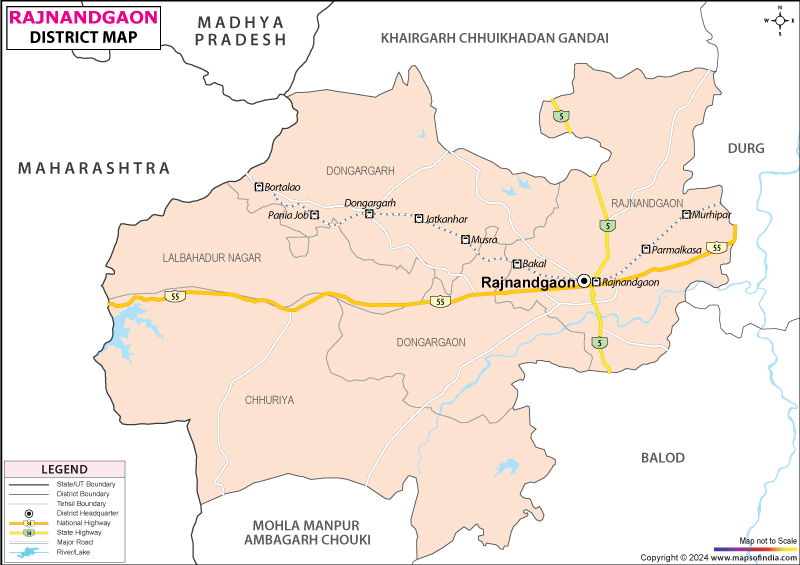
| *Map showing the National Highway, Major roads, other Roads, District Headquarter, Town, etc in the Rajnandgaon District, Chhattisgarh |
About
Rajnandgaon has an identity of its own, as much because of its reputation as a center of culture as a seat of administration. The district is still commonly called "Sanskardhani", a nickname that was given to them centuries ago due to the patronage given to music, literature and classical arts by the previous ruling families; a legacy which persists in the institutions associated with fine arts and performance beyond the district.
The significance of the district is not only as a transport and trade hub, but also as a cultural hub, as Rajnandgaon town is located on the Mumbai-Howrah rail line, which makes it a significant logistical hub for the area.
Rajnandgaon's most interesting quality today is its striking transformation in its borders in the last couple of years. In addition to losing ground during the formation of the Kawardha district in 1998, Rajnandgaon has lost out twice in recent years, first in 2003 when the newly established Chhattisgarh state was split into numerous smaller districts, and again in 2005 when a third district, Nuxad, was created, with its territory largely consisting of forest lands.
What is left is a district which although smaller than it used to be in decades gone by, still has its essence preserved, its focus through its headquarter town, its hilltop temple at Dongargarh, and a rural economy that remains strong on the foundations of paddy fields and traditional handloom weaving.
History & Culture
Before the establishment of Rajnandgaon as a modern administrative unit, its history goes back to the period of ancient Dakshina Kosala which is the name given to much of the Chhattisgarh plain. Later evidence such as Indo-Sassanian coins that were excavated in the vicinity of the district (3rd century CE) suggest that there was a settlement with indirect but real contact with the rest of the ancient world, far beyond the reach of any central Indian landlocked area.
The Gupta empire's shadow fell over the region when Samudragupta extended his conquests south, but the general consensus seems to be that it did not penetrate this far south of the Mahanadi, and that local chiefs who accepted Gupta authority were in fact de facto independent.
Over the next few centuries this power alternated from the Nalas of Bastar, the Vakatakas and finally the Kalachuris of Tripuri whose remnants can still be seen in the temples of the Chhattisgarh plain. Eventually the northern parts of the district, especially around Khairagarh, fell under the rule of the Raj Gond rulers from the famous revolt of Rani Durgavati against Mughals' invasion and became the part of Garha-Mandla. The founding history of the town itself is somewhat more peculiar: it was set up at the end of the 18th century by a religious ascetic, and ruled by a series of religious ascetics (a dynasty of Vaishnav mahants) until it became a full princely state under British paramountcy in 1879.
This multi-layered past has bequeathed a District that has an authentic sense of pride in its culturally rich heritage, which is highlighted by its age-old nickname ‘Sanskardhani', abode of culture. The palaces that remain in Rajnandgaon town are tangible evidence of this erstwhile princely life, and the devotional life of the district continues to revolve around the hilltop Maa Bamleshwari Devi Temple at Dongargarh, one of the most important Shakti Peethas of the region.
In addition to religion, Rajnandgaon is also identified with craft and learning – its various handloom weaving cooperatives continue to sustain its centuries-old textile heritage, and its rich history of its music and fine arts teaching centers has left it with an intellectual and artistic legacy that extends well beyond the administrative boundaries of the district today.
Economy
The economic base of Rajnandgaon is based on the combination of agriculture, small-scale and traditional handicrafts and medium-scale industry, with headquarters in the town.
The town of Rajnandgaon is the district headquarters, with the collectorate and different government departments of the state, managing the tehsils and blocks of the district. Government jobs are still an important and steady source of livelihood, especially as the district is the regional headquarters of the western part of Chhattisgarh.
The presence of small and medium industries like Bengal Nagpur Cotton Mills (Government of India) and companies like Minwool Rock Fibres and MP Maharashtra Minerals in the district adds to the economy of the area. With the district being a hub of rail and road connectivity between Mumbai and Howrah, there are also significant public and semi-public industrial businesses related to limestone mining and agro-based processing activity.
Cooperative Societies: The handloom industry is an old industry of Rajnandgaon district. The government has created cooperative societies, which cater the production of various items such as Bedsheets, Carpets, Towels, Sarees, Dress material, etc. in the district and are providing meaningful income and employment for the weaving community in the district.
The district being a transport hub has also encouraged a continuous trading of rice and oilseeds and handicrafts, with several government colleges located in towns within the district, such as Dongargarh, Khairagarh and Chhuikhadan, continuing to cater to the district population before the recent reorganisation. Agriculture is still the principal source of livelihood with paddy being the principal crop, and pulses and oilseed grown in the fertile plains of the district.
Tourism
The temples are the primary attraction of Rajnandgaon and its palatial heritage makes it a worthy place to visit for those who are interested in exploring the devotional and royal past of Chhattisgarh.
The most important pilgrimage centre of the district is the Maa Bamleshwari Devi Temple located on the top of a hill of about 1600 feet height at Dongargarh, and also known as Shakti Peeth, attracting millions of pilgrims each year, during the time of Navaratri, a festival in which the town of Dongargarh is full of festivities.
The historic palaces in Rajnandgaon town built by the line of local rulers of the town provide an insight into the architecture, society and traditions of the era of the princely states of the district.
Although these towns have been incorporated into the newly created Khairagarh-Chhuikhadan-Gandai district, they are closely linked to Rajnandgaon's cultural and historical background, especially the renowned music and fine arts university, Indira Kala Sangeet Vishwavidyalaya.
The Handloom Villages in Rajnandgaon, under the rural handloom cooperative centres in the district, provide an opportunity to witness the traditional weaving style, which is closely linked to the district's culture and is still alive.
Shivnath River Belt — the river with its source in the district and running through the central part of the plain into Durg district is scenic and provides riverside locations for natural explorers in the district.
This helps to create a tourist image of Rajnandgaon that is based on devotion and heritage, and not on big tourist sites, as the Bamleshwari Temple at the top of the hill is the district's undisputed tourist hub. Pilgrims who come to Dongargarh may also make a detour to Rajnandgaon town to visit the old palaces of the town and those interested in the district's cultural depth can also venture into the music and art institutions of the wider region, making their trip a visit of both spiritual and cultural importance, as Rajnandgaon has long been known as a hub of music and arts.
Demographics
The population of Rajnandgaon is estimated to be around 8,84,742 as of now, as per the official published data of the district after the latest rounds of reorganisation in Chhattisgarh. This is a drastic decrease from the earlier population of the undivided district which was more than 15 lakh, a direct result of the division of two adjacent districts, Mohla-Manpur-Ambagarh Chowki and Khairagarh-Chhuikhadan-Gandai in 2021 and 2022 respectively. With today's population the district is now fairly compact and well populated at about 273 people per square kilometre, a reasonable size administrative unit in the western belt of Chhattisgarh.
As for education, Rajnandgaon also has a reasonably high literacy rate of 78.46%, which is higher than the national average and a few other neighbouring districts of the Chhattisgarh state. This is an improvement on the historical pattern of the undivided district, where Rajnandgaon consistently showed good literacy rate in comparison to other districts of the state, probably due to its high cultural and learning reputation in the district as well as the concentration of colleges and educational institutions near and in the district headquarters.
The sex ratio (1009 females per 1000 males) in the district is highly favorable and is observed in some districts of Chhattisgarh and is also in accordance with the general trend of the region, which is not attributable to a specific factor. Even though Rajnandgaon town has become a continuously expanding urban and commercial hub, the population continues to be predominantly rural in nature with people still relying on agriculture and allied activities for their livelihood.
Demographically, the district has a tribal and Gond influence owing to its historical tribal and Gond rule in Garha-Mandla and therefore has a tribal profile with significant tribal influence in most of the areas of the district. In spite of the recent reorganization of the district which transferred many more heavily tribal areas into the newly created Mohla-Manpur-Ambagarh Chowki district, there are still significant populations of SC and ST people present in the district even within its current boundaries, apart from the more agrarian, caste-Hindu rural communities.
Combined, these numbers reflect a district that is in a real state of ‘recalibration' in terms of absolute numbers, but which has the relatively high literacy rate and the favourable sex ratio which have always marked it out within the framework of the Chhattisgarh districts. The population of Rajnandgaon, which still inhabits a large part of its administrative area, seems poised to focus more heavily on the administration center, with its well-established core of agriculture and culture.
Administration
The district of Raipur is divided into 8 tehsils and 4 community development blocks which are named namely Raipur, Tilda, Arang and Abhanpur; the district has a significant urban presence with 2 Municipal Corporations (Raipur, Birgaon), 3 Nagar Palikas and 7 Nagar Panchayats administering urban affairs. There are about 478 villages in the district and local self-governance in rural areas is through 408 Gram Panchayats, which coordinate the administration of the villages.
| Facts of Rajnandgaon District | |
|---|---|
| Official Name | Rajnandgaon |
| Location | Chhattisgarh |
| Area (km2) | 8022.55 |
| Population | 884742 |
| Language | Chhattisgarhi |
FAQs
Q1. How many villages are there in Rajnandgaon district?
The villages of Rajnandgaon are distributed in the 7 Tehsils and 4 development blocks of the district and the rural administration is managed by Janpad Panchayats of the district.
Q2. How many people live in Rajnandgaon district?
Official district data indicate that there are currently around 8,84,742 people in the district, after the last reorganisation in the district.
Q3. Rajnandgaon district is renowned for?
Rajnandgaon is well known for the Dongargarh Maa Bamleshwari Devi Temple, which is a Shakti Peeth, for its historic palaces and for being the “Sanskardhani” or “Abode of culture” owing to its rich history in the fields of music and education.
Q4. In Rajnandgaon district, what is the rate of literacy?
Official district data shows that the literacy rate in the district is 78.46%.
Q5. In which language do people speak in Rajnandgaon district?
The main language in the district is Chhattisgarhi and Hindi is also widely spoken, especially in administrative and commercial circles.
Q6. What is the number of tehsils and blocks in Rajnandgaon district?
The district has been divided into 7 tehsils and 4 development blocks as per the division of 2021 and 2022, with the formation of two neighbouring districts.
Q7. Which year was Rajnandgaon district established?
The district was carved out from erstwhile Durg district on 26 January 1973, followed by the separation of Kawardha district on 31 December 1998 and the most recent separation of the 2021 and 2022 districts.
Last Updated on : May 11, 2026
