






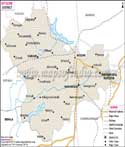
About
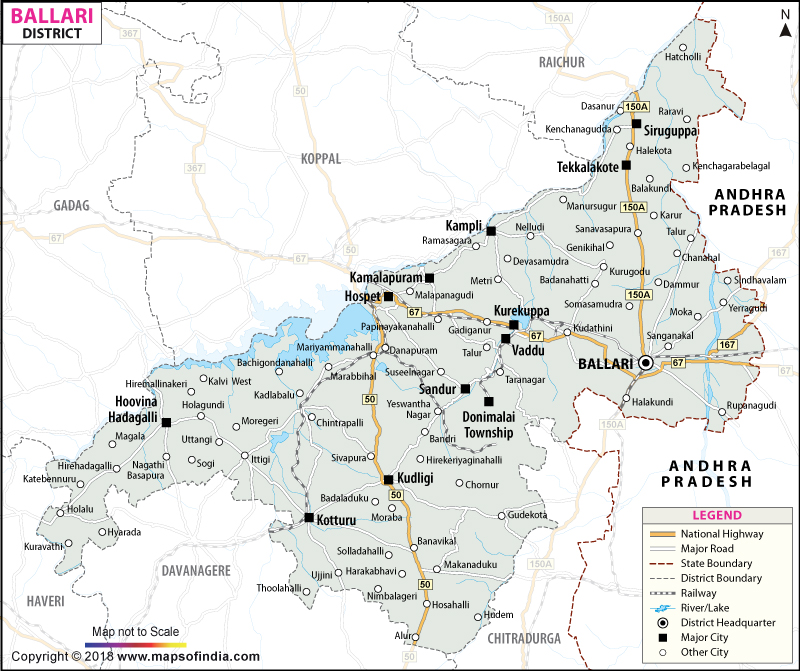
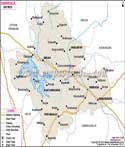
Ballari is located in the eastern plains of Karnataka. It is a remarkably historic and economically strong district that is widely known as the ‘Steel City' or ‘Gani Nadu' (the Land of Mining) across the State. The meaning of the word ‘Ballari' is rich in epigraphic data and interesting mythology. Lithic inscriptions from nearby areas date back to 1131 AD, and mention the settlement as Ballare. According to the local legend, the title is derived from a samiti that took place at the Basava Purana, where a dedicated Shiva devotee by the name Ballesha Mallayya is blessed by Lord Shiva, who appeared inside a Balla (a traditional measure of grain which the locals use). Another popular belief in the scriptures is the Yashadhara Charite by the classical poet Janna, who mentions that the word Balari was due to a guardian goddess who manifested here to protect the frontier town – Goddess Durgamma. The topography of the district is clearly visible and is composed of large, exposed boulders of volcanic granite and large monoliths (boulders) that stand up out of a level plain of black-cotton soil, which is semi-arid. Ballari is now considered a gateway to the history of medieval Deccan, and the town is one of the most significant mineral centers and a textile hub in India.
History & Culture
History & Culture takes the reader on a journey through the greatest ruling empires of South India. Neolithic stone tools are obtained from archaeological sites such as Sanganakal and indicate that Ballari has been continuously occupied by man for thousands of years. The major events of the region in the classical period were under the Satavahana, Kadamba, Badami Chalukya, Rashtrakuta and Hoysala rulers. But the strategic significance of Ballari was further boosted during the 14th century under the Vijayanagara rule. The first fortifications were built on the Ballari Gudda (Fort Hill) by the rulers to protect the capital from the Deccan sultanates' attack in the North.
The Vijayanagara forces were decimated in the battle of Talikota in 1565 and the area was subjected to an unstable trace of change of ownership. It was captured by the Sultans of Bijapur, by Shivaji under the Marathas in 1678 and later by the Kingdom of Mysore under Hyder Ali and Tipu Sultan in the latter part of the 18th century. The station was completely refortified by Hyder Ali, who built the Lower Fort with the help of French military engineers.
The Nizam of Hyderabad gave Ballari to the British East India Company in 1800 via the Treaty of Seringapatam. It became the administrative base of the vast Ceded Districts under the Madras Presidency and finally became part of the Mysore State in 1953.
The district has a rich culture because it is located at the border of Kannada and Telugu language-speaking cultures. Buddhism and mysticism are a major part of the cultural calendar, as are classical temple festivals. Every year, Mallara Jatram and Kanakachalapathi car festivals see thousands of pilgrims gather to tow giant wooden temple chariots through the ancient streets. Another important cultural event of Ballari is the Ballari Durgamma Jatre, an event dedicated to the city's presiding guardian deity. The district has a strong heritage in the performance arts, including the brilliant Bayalata open-air folk theater about mythological episodes and the drum dances Dollu Kunitha. Religious harmony and the syncretic Sufi-Bhakti devotion continue to be embedded in the local monasteries, with mystical compositions from the saints like Sarpabhushan Shivayogi still reverberating. The economy is highly dynamic and multi-layered, with large heavy-metal heavy industrial operations, and large agrarian systems that span the entire.
Economy
It contains some of the highest and largest iron ore reserves in the Indian sub-continent. The government sector (state and central) offers a significant base of employment in Ballari. The administrative gears, public education system and government health care networks are constant economic stabilizers.
Importantly, the complicated regulatory framework of the district's mines belongs to the Department of Mines and Geology, as well as the Karnataka Forest Department. In addition, there are irrigation canals in the state and government-supported irrigation bodies that manage the canals from the Tungabhadra river network and help the large-scale agriculture activities.
The Steel Industry: Huge conglomerates, mostly private, and having a strong alliance with the public sector, such as JSW Steel at Toranagallu, operate massive integrated steel plants, and are engaged in processing native iron ore into structural steel for export.Power & Generation: Bellary Thermal Power Station (BTPS) at Kudathini is an important state asset and provides a significant transmission of heavy power to support the industrial foundries.
Services & Textile Sector (The Jeans Capital)
The services sector is supported by strong shoulders with transportation, heavy-machinery logistics, retail and historic apparel manufacturing – The Denim Hub: Ballari. The story of what started in the early 20th century as a small stitching mill for the British army has grown into a huge cluster of garments, dispersed throughout the country. There are thousands of medium and small-scale industrial units producing denim textiles, which give livelihood to the immense urban population of the area. Industrialisation has not reduced the basic dependence of about 75% of the total labour force on agricultural activities.
Tourism
Ballari has a lot to offer heritage tourists, rock climbers and nature lovers. It is close to historical circuits, and it is an important stopover for tourists.
The Ballari Fort: Divide the Ballari Fort into two halves, the upper and lower fort, which are huge military structures and are the face of the city. Vijayanagara kings constructed the Upper Fort, which occupies the top of Fort Hill at a height of nearly 500m with ancient cisterns cut out of solid rocks. Later, added by Hyder Ali, the Lower fort was built with thick ramparts and deep moats, designed on French inputs.
Kumbara Gudda (Face Hill): This is a very special rock formation and is a natural rock face, which stands next to the main fort hill and immediately attracts visitors with the silhouette of a person looking towards the sky, created by the natural arrangement of a number of huge rocks. The Labeled Temples are the historic Malleshwara Temple (situated within the fort precinct) and the legendary Kanakachalapathi Temple which are rich in regional Hoysala and Vijayanagara architecture.
Apart from its monumental military architecture and the vicinity of medieval empires, Ballari district has a remarkably diverse range of ecological, spiritual and modern pleasures that appeal to modern travellers. Nature and wildlife lovers often visit the Sandur hill ranges, renowned for their beautiful monsoonal trekking paths and the beautiful sight of India's rare Neela Kurinji flower, which flowers in every season on the rich hills.
The Ankasamudra Bird Conservation Reserve is a tranquil paradise that attracts thousands of colourful migratory birds each winter, to the delight of birders. The spiritual tourism is also deeply rooted across the plains with old pilgrimage centres such as the Sri Kumara Swamy Temple in Krauncha Giri and the Jiva Samadhi Shrine of Yerri Tata, Chellagurki and the temple has a huge number of visitors during the annual car festival. Ballari, a city with a rich ecological fabric, now creates a new identity for the city, blending with the modern recreational places like Kaladham cultural center with an expanse of Toranagallu or Bhagya Amusement park as it becomes one of the most dynamic and experiential tourist sites in the city.
Demographics
The mode of the human settlement pattern shows a clear rural-urban dichotomy where about 62.48% of a human population lives in rural agrarian villages and 37.52% in the expanding municipal limits of Ballari district. There is a favourable gender balance in the district (983 females per 1,000 males).
The Ballari region is linguistically a highly polyglot frontier region owing to its proximity to the Andhra Pradesh border and the presence of many languages. The Kannada language is the main official language and the first language of the district. As a result of historical migration and cross-border trade, it has a sizable and substantial community of Telugu speakers and Urdu speakers, as well as small populations who speak Hindi, Marathi and Lambadi as their native language for day-to-day usage.
Administration
Ballari district has a revenue administrative framework with Kalyana-Karnataka districts where the governance is streamlined, public service is delivered effectively and balanced socio-economic development across the region is achieved. The Deputy commissioner (DC) is the top of the district's executive body, who is responsible for coordinating the land revenue administration, maintaining law and order and also responsible for implementing various welfare schemes of the state government and central government programmes from the headquarters of Ballari District.
The district is divided into five core functional Tehsils: Ballari, Kurugodu, Sirugoppa, Kampli and Sandur, with each Tehsil having its own Tahsildar, who is responsible for the local land records and complaints. The grassroot administrative network consists of the 100 Gram Panchayats that are the basic governance units. In these tehsils, there are altogether 522 villages, some of them are inhabited clusters of dwellings of the agrarian class and the rest are small revenue tracts, so that the services of the municipality attain the very grass-roots level of the Deccan plains.
| Official Name | Ballari |
| Location | Karnataka |
| Area | 4252 sq. km |
| Population | 14,00,970 |
| Language | Kannada |
FAQs
Q1: How many villages are there in Ballari district?
In the reorganized Ballari district, there are 100 villages in all under different tehsils.
Q2: How many people live in Ballari district?
The official Census records of Ballari district show that the total population of Ballari district is 14,00,970 citizens.
Q3: Which is the famous district of Ballari?
There are two reasons why Ballari is famous nationwide: It is the home of huge iron ore mining blocks and the steel industry, which makes Ballari the "Steel City", and it is the home of a huge cluster of apparel, which makes Ballari the "Jeans Capital of India". It is also renowned for its monumental historic Ballari Fort.
Q4: What's the tallest peak and the most historical landmark in the city of Ballari?
The highest point is the summit of Ballari Gudda (Fort Hill), where the historic Upper Fort was constructed during the period of the Vijayanagara Empire.
Q5: What is the main river that supplies drinking water and irrigation water to the Ballari district?
The main source of irrigation canals and civic water needs in the district is the Tungabhadra River with its tributary, the Hagari/Vedavati.
Q6: When would be the best time of year for tourists to plan a trip to Ballari?
The best time to visit is the winter season (November – February). These months mark the end of the harsh, hot and dry summer season of the Deccan and the beginning of a pleasant cool wind.
Q7: Which is the nearest wildlife sanctuary located in Ballari, and it protects what kind of animal?
The Daroji Sloth Bear Sanctuary is on the outskirts of the district and is exclusively dedicated to the conservation of the Indian Sloth Bear.
Last Updated on : July 31, 2026
