






About
The place of Hassan district at the heart of Karnataka is unique with its convergence of history, religion, landscape and agriculture. The district's name goes back to antiquity and is dedicated to the name of Hassanamba, a deity whose temple is one of the most sacred shrines around. Hassan is located in Karnataka's south-west where it is a corridor between the fertile plains of southern Karnataka and the mist-covered ranges of the Western Ghats. Headquarters of the district, Hassan city, is an important administrative and trade centre, and has significant linkages with its cultural heritage.
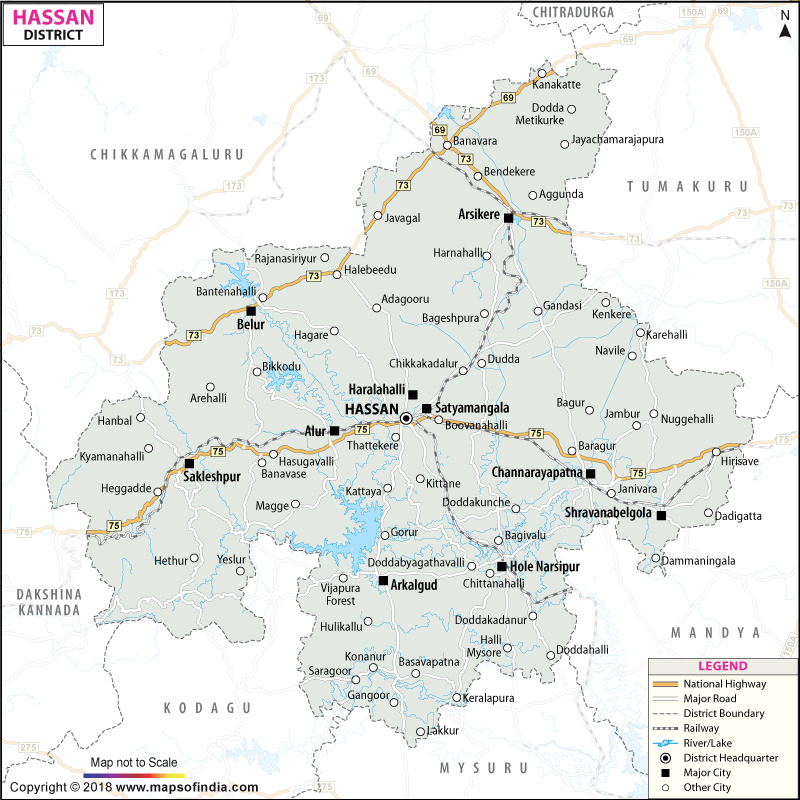
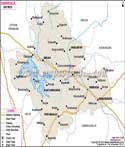
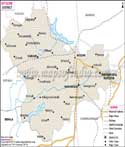
The Hassan district map also indicates the strategic location of the district, with it being surrounded by Kodagu, Dakshina Kannada, Chikkamagaluru, Tumakuru, Mandya and Mysuru districts. This status has historically played a significant role for Hassan as a trading and transport hub, centre for migration and cultural exchange. Today's roads wind and twist through regions where travellers go to see tourist sites and merchants ford markets, but which in past days provided access to lending centres and strong kingdoms.
The Hassan district map is not just a geographical guide but a journey through history and culture, offering a look at local heritage and attractions for travellers, scholars, and locals alike. It tells a tale of grand temples, fertility and lengthy traditions. The district is home to a variety of spectacular natural features and accomplishments, spanning the renowned site of Halebidu and Belur, the spectacular coffee fields of Sakleshpur, and the hills, and much more.
History & Culture
The story of Hassan district interweaves with the rise of the most powerful dynasty in South Indian history - the Hoysala. The Hoysala ruled in the region in the 11th to 14th centuries and turned the area into a region of brilliant architecture and artistic brilliance as well as political power. Their legacy lives on in the temples, their masterpieces of carvings and uncanny workmanship, which still dazzle visitors to today's stones.
The way the ancient settlements were distributed over the Hassan district is evident from the data of settlements of Hassan which shows the effect of the Hoysalas on the landscape. Later, Belur turned out to be a centre of religious as well as art and Halebidu acquired a second capital role for the Hoysala. Towns have left their legacy of monuments, with some of the best architectural treasures of India today found in these towns.
The Hassan district map also tends to lead visitors to a place that is related to faith and religious practices. From a long, long history of devotion, there are ancient temples, prestigious Jain basadi and sacred water bodies. One of the best traditions that will class up the district is the opening of the Hassanamba Temple, a ceremony that takes place every year.
Deepavali, Dasara, Ugadi and Makara Sankranti are partially celebrated with a lot of emphasis and excitement as festivals. In rural fairs, communities are coming together in colourful-processions, traditional demonstrations, and local-markets. The Kannada language is the primary language of expression and there has been a long history of interaction between neighbouring areas and the district, enriching their customary practices and traditions.
In Hassan, culture is not a one-dimensional element of monuments and festivals. It's in the food, the chats that occur under old trees, the freshly brewed cup of coffee and the pride people take in their heritage.
Economy
Hassan district's economy is a dynamic balance between agriculture, industry and services. The district is well provided for in transport/service, climatic conditions and fertile soils, which have made the district have a diversified economy.
The agricultural sector still represents the main economic activity. The farmers cultivate rice (paddy), ragi, maize, sugar cane and pulses on a very large scale. Coffee cultivation is important for the agricultural income especially in Sakleshpur and neighbouring areas. Crop-based plantation work and horticultural crops account for a dozen thousand people in their livelihood and significant economic activities. Regions are displayed on a map which symbolises different areas of the region where the activity of farming is conducted with some areas being higher and others being fertile.
Governments are very important actors in jobs and development. Job security in administrative jobs, educational institutions, healthcare, and public welfare programmes. The economic growth and living conditions of the district have been boosted by the government funding for infrastructure, irrigation and rural development.
The government has also helped Hassan a lot to grow. Agricultural support and transport, ubiquitous in both the urban and rural contexts, are assisted by publicly-owned institutions that work in infrastructure, banking, and the transport sector. Cooperative organisations, especially in the dairy industry, have led to a change in the livelihood of the people. Thousands of primary producers are engaged in milk production, a significant part of the rural economy that connects them to organised markets.
The significant role played by transport in facilitating economic activities is illustrated by a study of the Hassan district map. The information on the municipality of Hassan district map exemplifies the importance of transportation networks in economic development. The agricultural produce, manufactured products and passenger flow through national highways and railway networks. Improved connectivity has led to investments and facilitation of entry into markets.
The service sector has been a very rapidly growing industry over the past few decades. The number of people working in the banking, education, healthcare, and retail sectors, and related to the hospitality and tourism sectors, is increasing. Hassan city is considered a commercial center which is attracting people from the neighbouring districts to the city to utilise educational institutions and hospitals.
The Hassan district map also illustrates the development of urban centres serving as hubs for trade and service activities. Tourism provides extra money for the housing market, restaurants, transport and local handicrafts. Agriculture and governmental institutions, along with public institutions and the private sector combines together a highly resilient and more diversified economy.
Tourism
Hassan district is a destination for tourists to explore some of the most acclaimed landscapes and monuments of Karnataka. Earlier, if you walked down every street, you'd find your way into a tale; if you walked up every monument, you'd find your way into a forgotten chapter of history.
One of the best places to see in Belur is actually a twelfth century Chennakesava Temple constructed by King Vishnuvardhana which is an exceptional example of Hoysala architecture. The walls have been sculpted in forms, the pillars are awesome and interesting along with meticulous finishing of art. The Hassan district map is still, sporadically, a road map for many travellers beginning their journey through Hoysala heritage.
Not so far away at Halebidu is the splendid Hoysaleswara temple. Myths, as well as the real lives and history, are evident with an extraordinary quality of detail in the complex monument. While one dabbles about within the complex of the temple, its almost atmospheric effect makes one feel as though it were a stone chronicle to be carved centuries ago.
The Hassan district map also indicates the important place of pilgrimage Shravanabelagola, which is one of the most significant places of pilgrimage for Jains in India. This incredibly majestic statue of Bahubali stands to date as a symbol of peace and commitment to the people. They go seeking a climactic scenic view on the hilltop to see the whole site and take advantage of its tranquillity.
There are many lovers of nature who go to Sakleshpur. Lush hills, coffee farms, foggy valleys and trekking and scenic getaways abound. Waterfalls and forests are definitely part of its scene in the season of monsoons, as are extraordinary beauties.
Demographics
The population, as per the Census of India 2011, in Hassan district is 1776421. The District became a prominent district in both socio-economic and demographic aspects in recent times, amidst the process of urbanisation and increased population in the state of Karnataka.
The 2011 Census showed that just about 75.89 per cent of people were literate. District schools have helped to make steady gains in human development and literacy. Students of urban and rural backgrounds do studies in school, college or professional institutions.
The main language used throughout the district is Kannada and this is the principal language of communication. In addition, Urdu, Tamil, Telugu, Tulu and local languages are also spoken by the communities that migrated here and interacted with them over time.
The settlement pattern in the Hassan district is revealed on the Hassan district map with population spread out among urban centres, market towns and a lot of villages. Rural communities continue to be significant in the maintenance of traditional livelihoods and cultural practices, as Hassan city remains the largest urban centre.
Administration
From an administrative perspective, Hassan district is divided into various taluks which ease administrative management and public services. The district is made up of 8 taluks – Hassan, Arsikere, Arkalgud, Alur, Belur, Channarayapatna, Holenarasipura and Sakleshpur. Administrations within the country are facilitated to coordinate development programmes, revenue administration and local governance.
The Hassan district map is commonly utilised by the planning, administration, and examination departments. The district has made successful management of agriculture and infrastructure development, whilst preserving heritage, possible.
Approximately 2562 villages (both inhabited and uninhabited) are located in Hassan district, across the taluks of the district, according to the Census 2011. These villages are at the core of the district's rural economy and culture. PRIs have a significant role in grassroots governance and in the development of the communities.
The Hassan district map is still an irreplaceable tool in conducting administration; it is used for detecting the activities of development, infrastructure projects, resources, etc., in various geographical sections. The district strives to continue to make progress through cooperative government and civic involvement in the district while maintaining its cultural and historical legacy.
FAQs
Q1: What is the population of Hassan district?
The population was 1,776,421 in Census 2011.
Q2: What is Hassan district famous for?
It is famous for Hoysala temples and coffee plantations.
Q3: What is the literacy rate of Hassan district?
The literacy rate is about 75.89 per cent.
Q4: Which is the headquarters of Hassan district?
Hassan city is the district headquarters.
Q5: How many taluks are in Hassan district?
Hassan district has eight taluks.
Q6: How many villages are in Hassan district?
The district has about 2,562 villages.
Q7: Which language is mainly spoken in Hassan district?
Kannada is the principal language.
Last Updated on : August 03, 2026
