






About
Betul district is a large geographical area of the central region of Indian state of Madhya Pradesh and is known as the land of natural beauty, tribes and strategic location facing the highlands of Satpura. Betul name is said to have been derived by the term Baitul meaning dwelling or abode symbolizing a home of settlement and cultural coexistence.
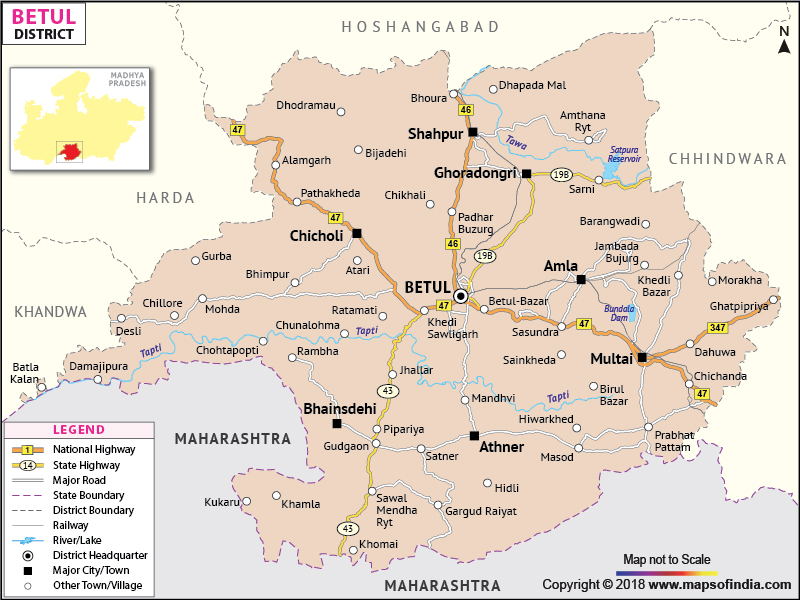
The town of Betul is the centre of administration, commerce and education and it is the district headquarters. Geographical dispensation and topography is best interpreted by the Betul district map which depicts the diversified topography of the district, forest cover and the river systems of the district. The map of the Betul district also indicates the connection with the major roadways and railway lines and the frequent railways line of the region, which is the Delhi- Chennai railway line.
The district is located in the Satpura Range and thus has a unique topography of rolling hills, valleys, plateaus and forests. This is a topography that has made it to have a great biodiversity and favorable climate. The map of Betul district further indicates that there are located the important rivers and streams where the tributaries of the Tapti and Narmada rivers are situated which are very important in agriculture and water supply.
The scenic beauty, moderate climatic conditions and ecological significance of Betul are factors that have seen it being called the Queen of Satpura. Having mostly rural population and having its essential reliance on the natural resources, the district is closely linked to the environment. Betul district map is a crucial reference document used to learn about land use trends, forest cover, and agriculture zones within the district.
History and Culture
Betul district has a strong history in terms of the ancient traditions and tribes. The archaeological evidence indicates that the region is more than 1000 years old as the traces of early human settlements in the regions took the form of stone tools and rock shelters. The district passed through different dynasties, which established their own mark on its culture and history over the centuries.
The area was once a part of greater empires: the Maurya and Satavahana dynasties of ancient times. Nonetheless, the Gondwana region of which Betul is a part came to be prominent under the rule of the Gond kings. Even nowadays, there are tribal groups of people of such kind as the Gonds, Korkus and Bhils who comprise a significant part of the population. These communities are more conveniently visualised by the Body of the Betul district map which show the residence of high tribal population.
Betul fell into the hands of the Mughals in the medieval period after which the Marathas took power which governed the area until the British arrived. The British realised the richness of the forest of the district, and built infrastructure to utilise timber resources, such as railway lines and administrative centres. The map of the Betul district used in history different periods of this era tends to focus on division of forest and road systems made on economical basis.
Betul district is a cultural hotchpotch of tribal and mainstream Indian cultures. There are numerous festivals celebrated by people including Diwali, Holi, Dussehra and Makar Sankranti amongst others and tribal festivals like Bhagoria and Pola are particularly important. These events are characterized by folk songs, dance and communal events. Others like Saila and Karma are folk dances which portray a tribal artistic expression.
There are also handcrafts such as bamboo products, wooden artefacts, and traditional jewellery, which are part and parcel of cultural diversity of the district. Cultural exchange and economic activity takes place in other significant ways like weekly markets and fairs. Betul district map is frequently employed in determining places of the major fairs, and tribal settlements, giving a clue into the cultural geography of the area.
Economy
Betul district economy is mostly agricultural, forestry, and allied based but the growth on industrial and service sector is slow. The map of the Betul district is the main map that gives the global picture of the agrarian land, the forest land, and the industrial land and tries to realize the economic structure of the district.
A major percentage of the population works in the government sector in areas such as administrative services, education, health services and law enforcement. State policies related to rural development, tribal affairs and improvement of infrastructures are essential in defining the economy of the district. The schemes that are associated with irrigation, housing schemes, and employment ensure schemes that have helped in advancing living standards.
The presence of the public sector is observable especially in the aspects of mining, energy and forestry. The local coal fields and thermal power initiatives give employment opportunities and help in economic growth of the region. The construction of roads, electrifying and irrigation projects are also undertaken by the public sector. The Betul district map is commonly considered by the planners to allocate resources and track the developmental projects.
Services industry is rapidly growing, particularly in cities like Betul, Amla and Multai. The banking sector, retail trade, transportation services, education, and healthcare facilities are expanding, providing new job opportunities. The tourism is also becoming a source of service economy, and natural and religious tourist spots are being visited by tourists. Betul district map is significant in determining the possible tourism and service sector development areas.
The economy of the district is still based on agriculture. The crops are major like wheat, soybean, maize, gram and pulses. The fertile soil and good climate favour a wide range of agricultural practices. The rivers, wells and small dams have assisted in irrigation as shown on the map of the Betul district. There is also increased emphasis on horticulture such as the cultivation of fruits and vegetables.
Another important sector of the economy is forestry and the district boasts of large forest area. Major forest cover with tendu leaves, bamboo, honey and medicinal plants give tribal peoples a livelihood. The Betul district map depicts clearly the forest discretions that are very important in balancing ecologically and economic sustenance.
Tourism
Betul district is highly tourists friendly and has got numerous tourist attractions such as natural landscapes and wildlife, religious and cultural sites. Betul district map is also a useful guide to the tourists, as it will help them navigate the area and see various destinations it offers.
Muktagiri, a popular Jain spiritual centre on the Maharashtra border is one of the attractions. The map of Betul district indicates its position in a scenic environment and thus it becomes a favorite pilgrimage and tourist site.
Another tourist site of interest is Multai which is a place of worship as the source of Tapti river. Sacred Kund at Multai is a place of attraction all the year round. The Betul district map clearly marks this site, emphasising its religious and geographical significance.
The area of Satpura forest affecting the territory of Betul district has a high level of biodiversity and provides the opportunity to take eco-tour and watch wildlife as well as do trekking. The tourists might experience dense woodlands, scenic sceneries and wildlife. The map of the Betul district is particularly handy with the map of the excursions that are scheduled.
The tourism attraction in the district is augmented by Balajipuram, Tapti Udgam Sthal and a number of temples and natural viewpoints. Waterfalls and wood roads encourage adventure tourists, and local fests and festivals offer an idea of the cultural life of the area. Betul district map assists tourists in finding out these attractions and determining the route they will follow.
In growing concern over sustainable tourism, eco-tourism projects are being mooted to conserve the natural environment at the same time encouraging tourism. Betul district map is a key resource in strategizing and coordination of such efforts.
Demographics
There is a heterogeneous population in Betul district with a high level of tribalism. Most of the population is found in rural areas with villages scattered throughout the district as indicated on the Betul district map.
The literacy level of the district is approximately 69.1 that indicates a slow progress in education levels. The government and non-governmental organizations are in the process of developing literacy and skills based education especially in rural and tribal regions.
The major language used in the Betul district is Hindi; although, indigenous languages like Korku and Gondi are also used by native citizens. The map of the Betul district assists in determining the distribution of language and the area covered by culture in the Betul district.
The percentage of Scheduled Tribes in the district is high and affect the social structure, tradition and lifestyle. The population is characterized by community-based living, traditional knowledge system and a strong association with nature.
Administration
The Betul district is split up into a number of administrative units in order to maintain good governance and development. The district has the following major tehsils; Betul, Multai, Amla, Bhainsdehi, Shahpur, Athner, Chicholi, Ghoradongri and Prabhat Pattan. The tehsils are all revenue administrative and local governance centres.
The district has a rural economy and social fabric that is structured around its villages, with 1344 villages forming the basis of this local governance and administration of various government schemes and rural solutions.
The Betul district map is a significant administrative aid that is utilized in the planning of infrastructure, administration of resources, and facilitating the development processes. It is also needed during the disaster management and environmental conservation processes.
| Facts of Betul District | |
|---|---|
| State | Madhya Pradesh |
| District | Betul |
| District HQ | Betul |
| Population (2011) | 1575362 |
| Growth | 12.92% |
| Sex Ratio | 971 |
| Literacy | 68.9 |
| Area (km2) | 10043 |
| Density (/km2) | 157 |
| Tehsils | Betul, Multai, Bhainsdehi, Shahapur, Amla, Athner |
| Lok Sabha Constituencies | Betul-Harda-Harsud |
| Assembly Constituencies | Multai, Amla (SC), Ghoradongri (ST), Bhainsdehi (ST) |
| Languages | Hindi |
| Rivers | Tapti, Ganjal, Morand, Tawa |
| Lat-Long | 21.911197,77.903953 |
| Travel Destinations | Balajipuram Temple, GOV Dev baba temple, Shri Rukmani Balaji Temple, Lord Hanuman Temple, Navagraha, Saint Shirdi Sai Baba etc. |
| Government Colleges/Universities | Dr Bhimrao Ambedkar Govt Degree College (Amla), J H Govt PG College, Govt College (Bhaisdehi), Govt College (Sarni), Govt College (Athner), Govt Girls College, Govt College (Multai), Govt College (Shahpur) etc. |
FAQs
Q1: How many villages are there in the district?
Betul district has approximately 1,344 villages.
Q2: What is the population of the district?
The population of Betul district is around 1,575,362 as per the 2011 Census.
Q3: What is this district famous for?
Betul district is famous for its Satpura landscapes, dense forests, tribal culture, and dharmik sites such as Muktagiri and Multai.
Last Updated on : May 12, 2026
