

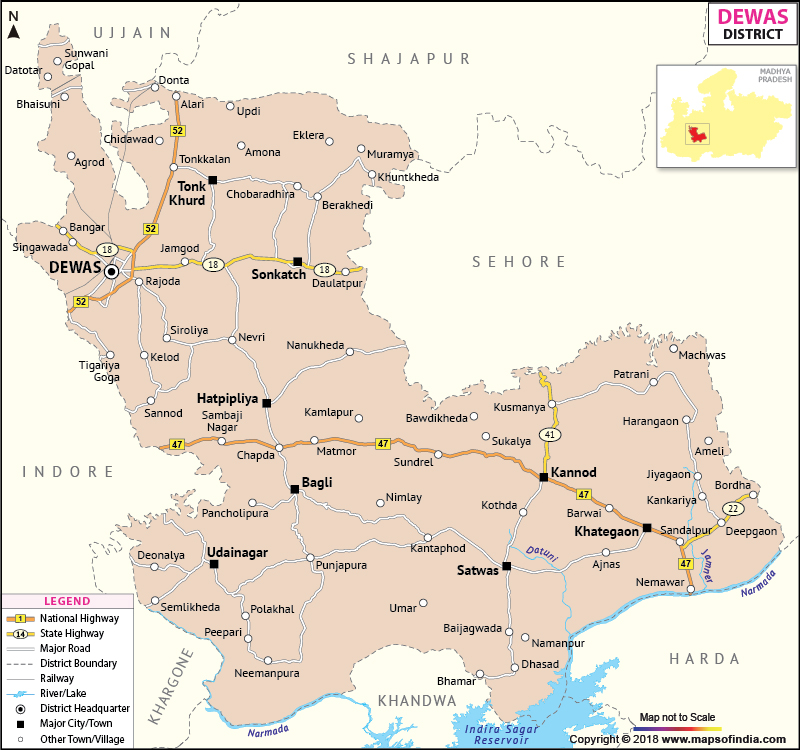





About
West of Madhya Pradesh rests Dewas district, shaped by layers of time - spiritual echoes meet steady production here. Over seven thousand square kilometers stretch across the Malwa plateau, known for dark soils that feed wide farming lands. Not just any town, the city holds central ground: placed between Indore and Ujjain, both key urban nodes in the area.
Among ancient terms, "Dewas" traces back to the Sanskrit Devas, translating as the dwelling place of deities. Rising above the urban spread, Tekri Hill carries this legacy forward. Upon its summit rest sanctuaries honoring Chamunda Mata alongside Tulja Bhavani. From distant points, the elevation stands noticeable. For generations, it has represented sacred tradition within the region. Pilgrimage flows remain steady throughout the seasons.
Hills roll across the land, where flat fields meet streams cutting through rock. Not far from here, near Nemawar in Khategaon, an invisible line circles Earth - its path crossing this district quietly. To its northern edge lies Ujjain; Indore rests beyond the western border. Eastward stretch both Hoshangabad and Sehore, while Khandwa anchors the southern reach. Because of such positioning, movement has always flowed through these parts.
People from differing ways of life arrived over time, bringing customs shaped elsewhere. This place became a point where paths intersect without announcement. Nowadays, the district gains recognition through ancient shrines alongside sprawling factory zones. Temples stand near paper mills, while farming trade hubs thrive close to city centers. This mix creates contrast - spiritual sites exist beside busy commercial zones. Life here moves between old customs and present-day industry. The area reflects Madhya Pradesh, shaped by variety, layered history, held together without force or flash.
History and Culture
Deep roots tie Dewas to the larger story of Malwa. Long ago, that area thrived - not just in farming but through bustling commerce and rich traditions - under kings like the Paramaras, then shifted under Mughal reach. A new chapter opened when Maratha power grew. Then came division: two separate realms took shape here, both called Dewas, each led by different lines of the Puar family. Their rule defined much of what followed. Split rule marked this place apart - one leader ran his zone, another theirs, each holding court in distinct palaces, commanding private forces, managing separate offices.
Among its flavors, the area carries forward Malwa's food traditions - poha, dal bafla, and sev tamatar appear regularly on plates. Craftwork thrives quietly, particularly cloth woven by hand and carvings made from wood, shaped in rural homes then offered at neighborhood bazaars. Temples stand near factories; old palaces overlook new routines, forming a place where habits of long ago share space with today’s rhythm.
Economy
A mix of farming, factories, shops, and public offices shapes Dewas's economic life. While crops feed local markets, manufacturing units supply goods beyond city borders. Government bodies operate alongside private ventures, creating jobs across sectors. Services grow steadily, responding to urban demand. Each part relies on the others, forming a balanced system. Economic strength comes not from one source, but multiple streams running together.
Among jobs in Dewas, many come from state-run operations. Offices like the district collectorate, municipal body, or tehsil centers form a core part of daily work life. Education and health services add steady roles through publicly managed schools, colleges, and medical facilities. Stability often follows where these institutions stand rooted. Employment flows not just from policy but from classrooms, clinics, and clerical desks alike.
Home to one of India’s biggest currency printing facilities, it gained national recognition through its Bank Note Press. Set up during the early 1970s, it handles production of money along with secure official papers. Oil extraction, livestock fodder, and similar outputs define much of what comes from these units. Because of such activity, the district plays a key role in shaping the agricultural industry across the state.
Now shaping much of the district, urban expansion fuels activity across shops, finance, learning spaces, clinics, yet lodging options too. Trade thrives in neighborhood bazaars - grains, cloth, daily essentials changing hands fast. Because needs shift, private tutoring hubs, schools, medical facilities multiply slowly but steadily. Fertile black soil here grows soybean, wheat, gram, and maize reliably. Despite irrigation from rivers plus canals boosting output, rain still plays a decisive role. While farming forms the core of the local economy, practices are shifting slowly. Modern methods, machinery use, along with varied cropping patterns now appear more often across Dewas fields.
Tourism
Tourism in the district centers on sacred sites alongside scenic landscapes. While temples draw visitors, so do nearby green spaces. Because of their cultural weight, pilgrims arrive regularly. Yet nature trails hold equal appeal for others. Though small in size, the town offers layered experiences. Where faith leads, scenery follows closely behind.
Perched high above Dewas, Tekri Hill marks the skyline with its cluster of sacred sites honoring Chamunda Mata along with Tulja Bhavani. Reaching upward on foot, visitors come not only for spiritual solace but also for what unfolds beyond - the sweeping vista of rooftops and streets laid bare beneath open skies. Though faith draws many here, few leave without pausing at the edge to absorb the quiet sprawl below.
On the edge of the Narmada River lies Nemawar, home to old temples and stepped riverbanks. Penance by the sage Jamadagni supposedly happened right here. Gatherings swell each year during the festival, pulling vast crowds toward this quiet riverside spot.
Pilgrims trekking through central India pause in the distrcit each year when bearing sacred water from the Narmada. Their journey unfolds as rains drench the land, turning paths muddy underfoot. This ritual takes place amid the heavy downpours of monsoon time. Devotees carry riverwater long distances, destination clear - Shiva shrines waiting to receive it. One such resting point lies nestled in Madhya Pradesh’s heartland. Vessels balanced carefully, travelers refill strength before moving on. Faith drives the pace; tradition shapes every step forward.
Once home to royal families, the old structures of Dewas Senior and Dewas Junior still stand as quiet markers of a bygone era. Though time has worn their walls, traces of intricate design remain visible. Visitors drawn to tales of power and legacy often find themselves wandering these grounds. Details carved into stone speak without words, revealing layers of local heritage.
Among the region’s draws are its flowing rivers, thick woodlands, and open countryside - spaces where nature-based travel fits easily. Near Khategaon, the land folds into the Narmada valley, revealing views that stand out for their quiet beauty.
Few come only for stone structures; most stay drawn by the rhythm of daily rituals, seasonal gatherings. Life unfolds in open fields, courtyard dances, shared meals under sky. Moments stretch beyond guidebooks when travelers walk beside farmers at harvest time. Celebration pulses through temple courtyards during festival nights. Even quiet lanes hum stories older than maps.
Demographics
About 1.56 million people lived in Dewas district according to the 2011 Census, showing a mix typical of the wider Malwa area. Though not crowded, the land holds enough residents to support steady development in towns and countryside alike. At its core lies the city - serving as administrative hub - and clearly more built-up than surrounding settlements.
Most inhabitants, however, live beyond it, spread through village networks within each tehsil. Nearly seven out of ten adults can read and write, a figure just higher than Madhya Pradesh's overall mark. Yet men still outnumber women in educational attainment by a visible margin. Since then, programs run by public agencies and community groups have focused energy on lifting female learning rates. Particular attention goes to schooling for girls where remoteness or tribal identity adds complexity.
Across the district , language thrives in many forms. While Hindi holds official status, used openly in towns and countryside alike, it shares space with stronger local currents. In village lanes and household talk, Malwi shapes how people connect - its rhythms setting a unique tone. Far beyond mere words, speech patterns shift among tribal groups like the Bhils and Gonds, where native tongues carry stories through generations.
On matters of faith, Hindu residents make up most of the population; yet Muslim, Jain, and Christian neighbors add depth through differing practices. Each group, speaking and believing differently, quietly weaves into the area’s broader identity. Among its layers, caste and community practices add depth through long-held festivals and rituals. Though shaped by city dreams, the area holds fast to country endurance along with indigenous roots. Because of this mix, Dewas mirrors much of what defines society across Madhya Pradesh. What stands out is how tradition persists within changing patterns.
Administration
Dewas district splits into multiple tehsils - Dewas, Sonkatch, Khategaon, Kannod, Bagli, and Tonk Khurd - each acting as a center for administrative work. Because of their role, these areas oversee nearby rural zones grouped into more than 1,200 villages. Governance reaches downward through gram panchayats, structures rooted in the Panchayati Raj framework. From village matters to broader concerns, decisions emerge locally when it comes to farming, schooling, clean water, or waste management.
Oversight flows upward, though, with the district collector stationed in the city steering coordination. Supporting this position are field-level officers handling land records, public safety, medical services, teaching systems, and crop development. While authority spreads across levels, daily operations depend on presence closer to residents. Often, solutions take shape where people live rather than distant offices.
Administrative reach extends far because staffing covers many ground-based roles. Even so, balance rests between central guidance and community-driven planning. Such structure allows response without delay when challenges appear in remote parts. Though complex, the network functions due to layered responsibility sharing. Since tasks divide among units, oversight remains possible despite scale. In practice, proximity shapes how rules meet reality across settlements. Where one lives affects who handles problems first.
Behind routine function stands an arrangement built on geographic segmentation paired with functional delegation. Not always visible, yet active, this machinery keeps civic processes moving quietly beneath surface calm. Despite size, the system leans toward localized decision paths instead of top-heavy control. Through division of labor, effectiveness rises even in scattered regions. As demands shift, adaptation happens mainly at lower tiers where contact with citizens stays constant. Ultimately, governance here follows terrain as much as hierarchy.
| Facts of Dewas District | |
|---|---|
| State | Madhya Pradesh |
| District | Dewas |
| District HQ | Dewas |
| Population (2011) | 1563715 |
| Growth | 19.53% |
| Sex Ratio | 942 |
| Literacy | 69.35 |
| Area (km2) | 7020 |
| Density (/km2) | 223 |
| Tehsils | Sonkatch, Dewas, Bagli, Kannod, Tonk-Khurd, Khategaon |
| Lok Sabha Constituencies | Dewas |
| Assembly Constituencies | Sonkatch (SC), Dewas, Hatpipliya, Khategaon, Bagali (ST) |
| Languages | Hindi, Maalvi, Bangla, English, Bareli Rathwi |
| Rivers | Narmada, Kali Sindh, Kshipra, Datuni |
| Lat-Long | 22.71539,76.395721 |
| Travel Destinations | Mahakaleshwar Temple, Kela Devi Temple, Mahadev Temple, Shri Manibhadra Veer Temple, Grace Church, Datta Mandir, Gurudwara, Kassabban Maszid, Kali Maszid, Shahi Jama Maszid, Kavadia Hills, Pawar Chattries, Gidya Khoh, Sayaji Gate, Shukrawaria Gate, Pathan Kuan Gate, Nahar Darwaza, Manduk Pushkar, Meetha Talab etc. |
| Government Colleges/Universities | Govt College (Bagli), Govt Girls College, Govt College (Kannod), Amar Shahid Raja Bhau Mahakal Govt College (Sonkatch), Govt College (Satwas), Govt Shri Krishnajirao Pawar PG College, Govt Degree College (Hatpiplya), Govt College (Khategaon), Govt College (Tokkhurd) etc. |
FAQs
Q1: How many villages are there in Dewas district?
There are more than 1,200 villages in the district. They are spread across its tehsils.
Q2: What is the population of the district?
According to the 2011 Census, the population is about 1.56 million.
Q3: What is the district famous for?
It is famous for its Tekri Hill temples, the Bank Note Press, and its industrial estates, particularly soybean processing units.
Last Updated on : May 12, 2026
