|
||||||||||
 | ||||||||||
|





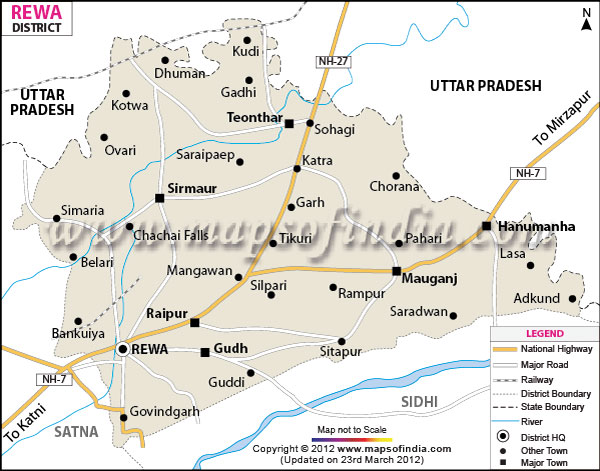
| *Rewa District Map highlights the National Highways, Major Roads, District Headquarter, etc in Rewa. |
About
Among India's lesser-known regions, Rewa stands out quietly in the northeast of Madhya Pradesh. Stretching across around 6,240 square kilometers, it touches Uttar Pradesh above, Satna on its western edge, Sidhi to the east, and Singrauli toward the southeast. Its main town, also called Rewa, pulses with life - old customs meeting new rhythms without pause. Known widely as where white tigers were first spotted, the region carries a quiet pride in that legacy. Back in 1951, Maharaja Martand Singh came upon one such rare animal deep within these forests - a moment that drew worldwide attention unexpectedly. Waterfalls tumble through Rewa, not just animals drawing attention. Fertile stretches host fields that have fed people for generations beyond counting. Life pulses strongest in villages, even as towns slowly widen their reach. Here, voices speak Bagheli with ease, passing tales that tie closely to soil and season. Songs emerge during planting, echo at harvests - rhythms older than records suggest. Culture lives within routine, not performance; tradition flows without announcement. Settlements cluster naturally, drawn by land that gives reliably. Though cities stretch outward now, roots stay fixed deep in rural ground.
History and Culture
Once upon a time, Rewa turned into ground where power changed hands, one after another, each ruler pressing faint marks into rock and recollection. During the lasting rule of the Baghela lineage, buildings emerged slowly from dust - Venkat Bhawan was one - its structure now holding itself upright like someone who has seen too much but refuses to speak. These times involved more than royal figures sitting on thrones; creativity began spreading quietly during those centuries.
Music, tales, and traditions gained supporters under gentle care, then wove themselves tightly into common routines without making noise. Still today, traces remain, not loud, yet impossible to miss if you pay attention. Long before lines appeared on maps, forests here answered to Vindhya Pradesh, where kings held power under ancient customs. Integration arrived quietly in 1956; then, Rewa began drifting into new tides reshaping life through central India.
Out of many chapters across time, one event shines differently. During 1951, near Govindgarh, Maharaja Martand Singh laid eyes on a rare animal - a pale-colored tiger eventually called Mohan. Because of that brief meeting, Rewa shifted onto a new path. Though small at first, the impact grew; now each white tiger held in zoos traces back to him. So it is that a forest sighting linked this region to conservation stories worldwide.
One night changed everything, lifting the area from silence to global attention. Yet beyond research papers, the tiger shaped daily routines. Celebrations repeated its tale, stories passed it on, while exhibits preserved what mattered. To residents of Rewa, Mohan meant more than fur and bone - he stood for belonging, proof their home might astonish distant places.
What makes Rewa distinct within India’s cultural mosaic is its embrace of Bagheli. This form of Hindi does more than communicate - it holds stories, songs, and verses like an open book passed through time. Rhythm shapes daily talk, as if old poems still breathe in common phrases. Tied to northern traditions, yes - yet festivals unfold here with unique intensity. Light during Diwali glows warmer in inner yards. Holi dyes streak along tight alleyways, loud and bright. Devotion moves in steps throughout Navratri nights. Meanwhile, seasonal gatherings hum with voices bargaining, children shouting, tunes drifting between stalls.
Every meal in Rewa carries a quiet history. Rooted in fields, food grows from millet, lentils, and rice tended through seasons. In homes, cooking unfolds without spectacle, yet holds deep rhythm. Instead of grand gestures, meaning rises in steam from earthen stoves. Along paths, pottery emerges from hands trained by time - each pot shaped slowly, fired simply. Baskets appear too, bent from bamboo strands, used more than admired. Fabric finds its way into lives: spun by hand, worn every day.
Though some know Rewa for royal walls or striped animals, these objects tell different truths. What lasts often fits within palm size. Quiet work shapes identity just as much as monuments do. What matters most shows up softly, through small acts repeated without fanfare. Not loud, tradition breathes in the pace of shared food, unfolds in melodies passed hand to hand. Craftsmen shape it slowly, fingers moving like those before them, shaping what time has spared.
Economy
Deep roots in farming define Rewa, where open fields stretch across river-fed terrain. Though mines and services grow slowly, most people still rely on crops to survive. Water from the Tamas and Bichiya keeps the earth rich, allowing grains such as wheat and rice to thrive alongside lentils and oil-rich seeds. Life in villages moves with planting and reaping, each month guided by nature's cycle rather than clocks or calendars. When harvest arrives, workers fill the farmland, hands busy under sunlit skies. From there, goods travel toward small market hubs, feeding families whose income depends entirely on what the season yields.
Government work helps steady Rewa's economy. Being the seat of district authority, Rewa city holds many official departments, shaping its role in regional oversight. Jobs tied to public service matter here - district management, law enforcement, healthcare, education - all form key parts of local employment. Teaching positions fill schools and colleges throughout the area, involving large numbers in instruction and operations, which keeps learning vital to progress. Medical facilities - from hospitals down to village clinics - not only care for people but create livelihoods too.
In Rewa, government-run enterprises play a major role, especially in sectors linked to local natural assets. Energy output gets a boost from operations by the National Thermal Power Corporation, creating jobs across the area. Cement manufacturing thrives here - thanks largely to abundant limestone deposits beneath the surface. These quarries feed not just cement works, but supply material used widely in building projects and related fields. Industrial activity centers around extraction, turning rock into foundational inputs for broader economic functions. With hundreds of workers on payroll - from technicians to factory hands - these firms shape much of Rewa’s production capacity. Because government-run units form the backbone, industry here stands apart from farming alone.
Tourism
Blessed by lush landscapes and old-world charm, Rewa stands out as a quiet gem for travelers. Waterfalls tumble through green hills here, while grand palaces rise from forgotten eras. Wildlife roams freely in reserves that pull nature lovers far and wide. History hums softly between forest trails and stone ruins. Few places blend wild serenity with royal echoes quite like this.
Water tumbles down at Chachai Falls - among India’s highest drops, measured at 130 meters. Thick woods wrap around the base, making the scene striking when rains arrive. Monsoon brings out its full force, mist rising where rock meets flow.
Falling close to Rewa, Keoti Falls draws visitors who carry cameras along with quiet wanderers. A rush of water spills down stone steps where light shifts through mist at midday.
From up high, the domes catch sunlight like old stories waiting to be told - this palace rose under Maharaja Venkatraman Singh’s rule. Not just stone and arch but layers of time shaped by both Mughal grace and Hindu detail. Once home to power and ceremony, it now watches silently over Rewa’s shifting streets.
Out by the green edges of Rewa, a new park breathes quietly beside an auditorium shaped like folded stone. Where people once had few places to gather, now benches line shaded paths near open-air halls. One follows footprints through trees, another listens to voices rise under high ceilings. Spaces grow slowly into daily life, not loud but present - like morning light hitting concrete at odd angles. What was missing before now sits simply, used without fuss.
Waterfalls cut through the hills, shaping what travelers carry home. Culture hums behind every festival, each quiet temple corner. History hides in palace walls where echoes speak louder than guides. The white tiger once walked here - its legend sticks around long after footprints fade. Wildlife moves beyond sight, felt more than seen. What stays isn’t just scenery - it’s how a place shapes people.
Demographics
More than two and a half million people live in Rewa district, according to the 2011 count. Over thirteen lakh eighty thousand of them are men, while women number close to twelve lakh seventy-seven thousand - a fairly even split across genders. Education levels show about 72 percent can read and write, which suggests improvement over time. Still, villages face difficulties when it comes to learning access.
Most people speak Bagheli here, though Hindi shows up too. Folk songs rise through Bagheli voices, stories pass down in its rhythm. Official work happens in Hindi - schools, paperwork, that kind of thing. The way folks talk at home often stays rooted in Bagheli sounds. Even so, reading signs means seeing both tongues side by side. Culture breathes easiest in the local dialect, yet numbers and rules arrive in Hindi.
Administration
Down south of Rewa lies a system built on order. Split into parts like Sirmour, Semariya, Teonthar - each named to mark place and purpose. Offices stand in every zone, not just one or two. From Mauganj through Deotalab, function follows form. Villages get decisions, towns receive updates - not by chance but design. Governance moves where people live, because structure makes it possible. Most of the 2,817 villages lie scattered through Rewa's tehsils. Life beats strongest there, fed by farming, celebrations, and each old custom passed down. Running things in Rewa town is a single urban authority - called Nagar Nigam or Nagar Parishad. That body handles city matters, keeps daily order moving.
| Facts of Rewa District | |
|---|---|
| State | Madhya Pradesh |
| District | Rewa |
| District HQ | Rewa |
| Population (2011) | 2661189 |
| Growth | 17.63% |
| Sex Ratio | 893 |
| Literacy | 76.46 |
| Area (km2) | 6240 |
| Density (/km2) | 374 |
| Tehsils | Huzur, Raipur Karchuliyan, Mauganj, Hanumana, Gurh, Teonthar, Sirmour, Mangawa, Semariya, Jawa, Naigarhi |
| Lok Sabha Constituencies | Rewa |
| Assembly Constituencies | Sirmour, Semariya, Teonthar, Mauganj, Deotalab, Mangawan (SC), Rewa, Gurh |
| Languages | Hindi, Agariya, Bagheli, Bharia |
| Rivers | Tamas, Beehar, Mahana, Balen |
| Lat-Long | 24.756808,81.626816 |
| Travel Destinations | Rani Talab Temple, Govindgarh, Pili Kothi, Rewa Fort, Raipur Karchulian, Royal Museum, Govindgarh Palace, Baghael Museum, Deorkothar, Bansagar Dam, Ranipur Sanctuary, Chirahula Mandir, Ramsagar Mandir, Sai Mandir etc. |
| Government Colleges/Universities | Govt College (Devtalab), Govt Shahid Kedarnath College (Mauganj), Govt College (Raipurkarchul), Govt Thakur Ranmat Singh College, Govt Madhavrao Sadashivrao Golvalkar College, Govt Law College, Govt College (Semariya), Govt College (Gurh), Govt College (Naigarhi), Govt PG Science College, Govt Girls PG College, Govt Venkat Sanskrit College, Govt Swami Vivekanand College (Teonthar), Govt College (Mangawan), Awadhesh Pratap Singh University etc. |
FAQs
Q1: How many villages are there in Rewa district?
Across Rewa district, 2,817 villages shape its countryside landscape and support a strong farming economy. Rooted in custom and daily routines, these settlements sustain both heritage and livelihoods.
Q2: What is the population of Rewa district?
Some 2,661,189 individuals lived in Rewa district during the 2011 Census count.
Q3: What is Rewa district famous for?
Among India’s lesser-known regions, Rewa stands out due to an accidental find in 1951 - Maharaja Martand Singh captured a rare white tiger near Govindgarh. That animal, called Mohan, later fathered every white tiger now held in captivity across the globe. Because of this lineage, the town quietly shaped modern zoological records.
Last Updated on : May 12, 2026
