






About
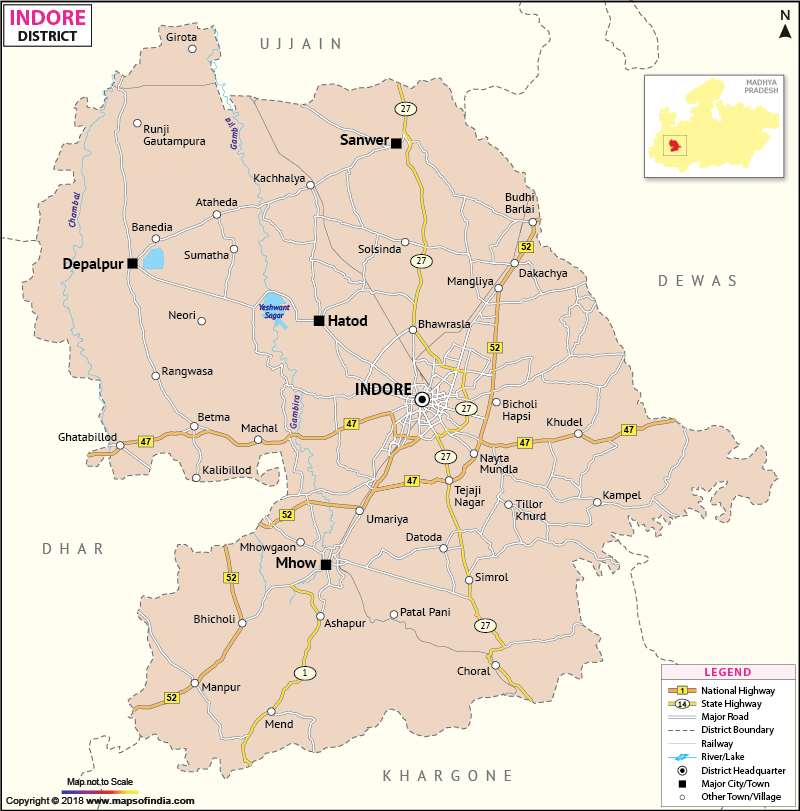
Within the rich lands of the Malwa plateau in west Madhya Pradesh, Indore district stands where old ways merge with new times. Covering close to 3,900 square kilometers, it holds ancient practices alongside present-day momentum. The core of this area is the city of Indore - district seat and active hub of exchange. Recognized throughout the region for strong economic currents, activity flows from crowded marketplaces, growing production units, along with varied cultural marks left by city dwellers. Despite deep historical grounding, everyday tempo pulses with current rhythms, formed by advancement plus ongoing shifts in human flow and thought.
Winding paths of the Khan and Saraswati rivers mark the region's form, guiding where villages rise and fields thrive. At 553 meters above sea level, it enjoys steady temperatures throughout the year, contributing to daily ease. Positioned near central India’s meeting points, movement across states has long flowed through here - people arriving from Gujarat, Maharashtra, Rajasthan, others following routes old and new. Growth continues now at a notable pace; size places it first within Madhya Pradesh, while national rankings often list it high for cleanliness among Indian cities.
Among the streets of the district, traces of tradition meet present-day movement. Where small alleys hold temples and historic homes, broader roads unfold toward shopping centers, technology zones, and learning institutions. Rooted in endurance, its character shifts quietly yet firmly. From royal beginnings to urban growth, change moves hand in hand with heritage. What remains is neither frozen nor erased - instead, shaped by time but never fully remade.
History and Culture
Long before maps marked it clearly, a quiet place grew around the Indreshwar Mahadev Temple - devoted to Lord Shiva, not Indra, despite what some assume. Centuries folded into each other, leaving behind traces of devotion that shaped the town’s earliest footprint. Power shifted slowly; by the 1700s, control settled firmly in Holkar hands, leaders among the Maratha confederacy. Their influence turned the area into a center where politics and faith walked closely together.
Indore grew under the Holkars - becoming notable for governance, commerce, market life, culture. One figure stands out: Maharani Ahilyabai Holkar, remembered widely among India’s most respected female rulers. Fairness marked her rule; so did care for people and support for building projects. Across the country, she initiated construction of temples, riverfront steps, and rest houses. Still, her seat in Maheshwar and lasting impact on Indore echo strongest today. Seven levels tall, Rajwada Palace mixes Maratha, Mughal, even French design elements - an ongoing sign of times long ago.
Though rooted in custom, it shifts shape most clearly when celebrations begin. As evening falls during Diwali, thoroughfares fill with small flames lined edge to edge, flickering much like distant constellations given form. With Holi, quiet alleys turn sudden stages where vivid clouds hang midair, voices carried on waves of amusement. When Ganesh Chaturthi arrives, slow-moving gatherings trace paths down avenues, chants drifting upward alongside fading daylight and rhythmic percussion. From poetry to performance, expression finds root here. Writers and musicians shaped by the district have contributed quietly to Hindi and Marathi culture. Gatherings centered on stories and stages bring people together regularly. Though new ideas shift how art appears now, older forms still surface naturally in daily moments. Tradition persists, not as display, but as part of routine experience.
For a long time the district has served as a confluence of different communities from Maharashtra, Gujarat and Rajasthan representing a synthesis of distinct traditions, of a culturally unified area. The folk dance traditions of Matka and Garba, enliven these gatherings. Indore's culture story is enduring and deeply human. The unusual combination of the solemnity of age - old rituals and the vibrancy of modern festivals illustrates the unique storytelling of Indore.
Economy
Farming shapes part of Indore's economic makeup, while factories contribute another layer. Services follow closely, forming a distinct strand. Trade weaves through each segment, connecting them quietly. Together, these elements make up the region’s livelihood structure.
Located within the Indore Division, the district hosts a range of governmental operations due to its role as an administrative center. Among its key features are leading academic centers such as IIT Indore and IIM Indore. While these institutes draw learners nationally, they simultaneously support progress through scholarly work. Because of their presence, advances in enterprise and discovery continue alongside manufacturing expansion. Knowledge-based activity now runs parallel to economic development here.
Once central to Indore’s economy, textile mills gave rise to the title “Manchester of Central India.” Though most large mills shut down, fabric-making lives on via compact workshops alongside updated industrial sites. Not far away, the Pithampur zone draws comparison to Detroit - not for cars alone but due to dense clusters of makers shaping metal and machines. Presence grows stronger where firms such as Tata Motors, Eicher, and Force Motors set up assembly lines, bringing work to vast numbers. Alongside them, major medicine producers run facilities, positioning the city as a quiet force behind shipments of health goods abroad.
Indore now hosts significant IT operations, developed over recent years. Although global companies including Infosys and TCS established facilities here, small technology ventures also find footing within the urban environment. Growth in retail, medical care, and lodging reflects expanding consumer capacity among residents. Instead of fading, traditional commerce continues through hubs like Chhawani Anaj Mandi, where farm output moves toward national demand networks. Not far from the fields where crops take shape, factories hum with steady rhythm. Despite shifts in global demand, livelihoods here adapt without spectacle. Where tractors prepare soil, digital tools chart new paths - each rooted in practical effort. Progress appears quietly, shaped by routine choices rather than bold claims. Stability grows not through sudden change but layered continuity.
Tourism
Within Indore district, travel unfolds across palaces, then moves toward ancient temples. Waterfalls appear beyond quiet trails, each set apart by natural calm. Food streets emerge later, alive with steady rhythms of daily craft. Rajwada Palace rests at the center of Indore, a structure nearly two centuries old that reflects the legacy of the Holkars. From its detailed terraces to open inner spaces, the design mixes Maratha influences with Mughal forms in quiet harmony. One moment you face carved stonework, then wide halls follow without warning. Time seems slower here, shaped by arches and shaded walkways built long ago.
Lal Bagh Palace rises from European design, shaped by the Holkar vision beyond borders. Within its walls, a grand hall glows beneath hanging lights made of glass and metal. Underfoot, stone imported from Italy marks every step. Splendour lives here, not declared but felt in stillness. From Mhow, the Patalpani Waterfall drops nearly 300 feet through thick forest cover. When rains arrive, visitors gather here more frequently. Green folds of land hold the fall tightly on all sides. Height adds force to its flow, yet calm remains nearby. During wet months, paths leading down become busier without noise.
At the entryway stand four full-scale elephant figures, carved in stone. This place of worship honors the deity Annapurna, known for nourishment. Its design draws attention without seeking it. From a distance, the structure appears balanced, yet detailed up close. Found along busy lanes, Sarafa Bazaar and Chhappan Dukan serve as hubs where flavor shapes the city's rhythm. Drawn by reputation rather than guidebooks, visitors arrive seeking what words struggle to capture. Each stall operates like a small stage, revealing methods passed down through quiet years. Though not marked on every map, their presence echoes in the patterns of movement after sunset. Taste guides attention here, shifting focus from sight to sensation without warning. What appears at first as simple eating transforms into something resembling ritual over time.
Mhow Cantonment holds weight in military history. It stands out, being where Dr. B.R. Ambedkar first drew breath. Because of this, memory lingers here. Significance builds through time, shaped by events long past. Few places carry such layered meaning. History settles into the streets, quiet but present. Focused on moments rather than landmarks, tourism here unfolds through quiet encounters. From late-night bites along crowded lanes to pathways leading beyond city edges, each choice shapes a different impression. Palaces stand beside routines of daily life, where gestures matter more than guided paths. What remains afterward is not a checklist, but something carried quietly - history felt in steps, culture tasted without labels.
Demographics
Ten tehsils make up Indore district, which also includes 676 villages under its administration. Governance falls to the district collector, with support arriving through various functional units. Health matters are managed separately from education, though both report upward. Agricultural oversight operates alongside provisions for public safety. Each department functions within a structured framework, yet remains distinct in responsibility.
A network of services operates under the Indore Municipal Corporation, handling city planning, waste systems, along with public works. Recognition as India’s most hygienic urban area through half a dozen straight years stems not just from policy but also community involvement. In rural centers, administrative control shifts to Nagar Parishads - structures designed to distribute authority across local levels.
In cities, 49 police stations uphold legal authority; meanwhile, village affairs rely on Panchayati Raj frameworks. Governance here moves neither purely toward metropolises nor away from farmland, but holds equilibrium. Citizens inside municipal borders receive support just as those beyond do. Public systems serve all without distinction, shaped by design rather than chance.
| Facts of Indore District | |
|---|---|
| State | Madhya Pradesh |
| District | Indore |
| District HQ | Indore |
| Population | 3276697 |
| Growth | 14.49% |
| Sex Ratio | 914 |
| Literacy | 75.29 |
| Area (km2) | 3898 |
| Density (/km2) | 839 |
| Tehsils | Depalpur, Sanwer, Indore, Mhow, Hatod |
| Lok Sabha Constituencies | Indore, Dhar |
| Assembly Constituencies | Depalpur, Indore-1, Indore-2, Indore-3, Indore-4, Indore-5, Dr. Ambedkar Nagar-Mhow, Rau, Sanwer (SC) |
| Languages | Hindi , English , Gujrati , Marathi , Sindhi |
| Rivers | Chambal, Kshipra |
| Lat-Long | 22.847071,75.804062 |
| Travel Destinations | Lal Bagh Palace, Kanch Mandir, Rajwada, Bada Ganapati, Khajrana, Geeta Bhawan, Gandhi Hall, Gopal Mandir, Indore Museum, Nehru Park, Krishnapura Chhatries, Chhidiya Ghar, Annapurna Mandir, Meghdoot Upvan, Gomat Giri, Inkar Giri, Bijasan Tekri, Dev Guradia, Kamla Nehru Park, Somako Park etc. |
| Government Colleges/Universities | Govt College (Depalpur), Shri Atal Bihari Vajpai Govt Arts and Commerce College, Govt Girls PG Colege, Govt Sanskrit College, Bhurelal Patidar Govt PG College (Mhow), Govt College (Sawer), Shri Govindram Seksaria Institute of Technology & Science, Govt Holkar Science College, Govt Mata Jija Bai Girls PG College (Moti Tabela), Govt Nirbhay Singh Patel Science College, Govt Law College, Govt Arts and Commerce College, Maharani Laxmi Bai PG Girls College, New Science College etc. |
FAQs
Q1: How many villages are there in Indore district?
There are 676 villages in the district.
Q2: What is the population of the district?
The population is approximately 5.27 million (2011 Census).
Q3: What is Indore district famous for?
It is famous for being the commercial capital of Madhya Pradesh, its street food culture, and its reputation as the cleanest city in India.
Last Updated on : May 12, 2026
