






About
In the north of Madipa Pradesh lies Gwalior district, where traces of old times blend with current rhythms. Strategically placed, Gwalior carries weight beyond geography. Near where Uttar Pradesh meets Rajasthan, motion defines its history - trade flowed, people moved, ideas crossed. Long ago, caravans brought wares alongside tales; now concrete routes, rails, air lanes continue the rhythm. Movement persists through sky links feeding regional access, ground networks binding north to central plains. Gateways endure not by design alone, but persistence.
Still, Gwalior holds deeper meaning beyond location. Music lives within its streets, tied closely to remembrance. From this city came Tansen, famed master of Hindustani song, whose presence lingers in the Gwalior Gharana - an influential lineage guiding core principles of India's classical sound. Passages through the area reveal time built upon itself: modest temples hidden in alleys, royal buildings from Mughal years showing slow decay, traces left by Maratha rulers, and dignified symbols of Scindia authority.
History and Culture
From whispers of old tales emerges Gwalior - a place shaped by vision, power, yet also quiet rites passed through time. A tale holds that a holy man named Gwalipa restored health to a dying monarch. Because of this, the sovereign chose to honor him, giving his name to fortresses and towns alike atop the ridge. Such was the beginning - unplanned, almost accidental - from which a lasting sense took root.
From within the reign of the Tomar line, Gwalior grew as a hub for artistic expression and built form. During the years 1486 to 1516, leadership under Raja Man Singh Tomar leaned less on force, more on support for creative life. What remains visible now lies in the structure of the Man Mandir Palace - medieval craftsmanship shown vividly in its shape and surface. Upon those surfaces, detailed tiles and sculpted lines hold attention even at present, revealing quiet elegance once valued in daily vision. Stone itself speaks of balance, not conquest.
With the Mughals came a change - no longer just a center of culture, the fortress now served war. Under Akbar’s rule, security tightened; thus, Gwalior rose among central India’s foremost defended sites. High ramparts stood firm, location dominant, together forming a key shield within imperial lines. The peak of strength was seen here.
Into the 1700s, shifting authority brought Gwalior under Maratha control, followed by rule through the Scindias. Under their guidance, culture and design took new shape across the city. One result was the construction of the Jai Vilas Palace - where European styles met traditional Indian forms - a structure remaining today as a quiet marker of regal presence.
Festivals punctuate daily life across Gwalior, shaping its identity in subtle yet lasting ways. Joy radiates during Diwali, Holi, though Navratri brings rhythm and motion into open spaces. Meanwhile, Tansen Samaroh draws listeners into classical soundscapes, whereas the Gwalior Trade Fair reveals local enterprise in full view. Artisan work stands apart - not mass-produced, but shaped by hand over long hours. Items emerge slowly: carved stone, woven cloth, objects made without haste. Each piece carries traces of knowledge shared quietly from one lifetime to the next. Though markets shift, these forms remain rooted, evolving at their own pace.
Economy
A mix of farming, manufacturing, trade, alongside travel-related activities shapes Gwalior district's economic profile. Though rooted in land cultivation, production units play a growing role. Services appear steadily present across towns. Tourism contributes without dominating. Each sector operates at different paces, yet fits within the broader structure.
Home to several government departments, courts, and military bases, Gwalior serves as a regional hub. Due to its cantonment and public sector facilities, steady jobs exist here. Because of universities such as Jiwaji and multiple academic centers, thought and learning form part of daily life. Farming tools, carved stones, and wooden items come from modest factories across the region. While public offices help maintain jobs, older trades like cloth-making still hold steady. Handwoven fabrics and handmade goods continue to matter just as much today. Work tied to these crafts supports many households throughout the area.
Each year, large numbers arrive drawn by sites such as Gwalior Fort, Jai Vilas Palace, and Tigra Dam. Services gain momentum because tourism fuels growth across many areas. Hospitals and colleges support residents while meeting broader regional needs. Movement through roads, stays in lodging places, shopping - all rise when travelers come. Among economic activities, those tied to assistance and care hold steady importance.
Tourism
History shapes much of what visitors find in Gwalior district. Architecture stands alongside rivers and hills, quietly present. Natural beauty appears where least expected - between forts, beyond markets. Stone carvings endure under open sky. Travelers arrive drawn by reputation, stay because of atmosphere. Each site tells its own version of time passed. Not every path is marked; some discovery happens by chance.
Ahead of most landmarks stands Gwalior Fort, holding within its walls structures including Man Mandir and Gujari Mahal. Temples are present too - one example being Sas-Bahu Temple. Because of sweeping vistas across the region, attention is drawn naturally here. History plays a role in shaping how people regard the site today.
Jai Vilas Palace rises from a 19th-century vision, shaped under Maharaja Jayajirao Scindia's rule. European design threads through its structure, woven without mimicry. Inside, a museum holds objects of grand scale, among them a chandelier unmatched in size globally. From the eleventh century emerged the Sas-Bahu Temples, shaped by detailed craftsmanship and deep reverence. Though time has passed, their stone surfaces still speak through finely chiseled patterns.
Some 23 kilometers out of Gwalior lies Tigra Dam, where water meets open land. Boats move across its surface during fair weather. Visitors often bring meals to eat near the banks. This place gives distance from city noise. Quiet spreads here more easily than in crowded streets.
A stone structure shaped by sunlight's ancient path rises here, its form echoing Konark’s legacy through red-toned blocks carefully placed across time. Though born of present hands, reverence lingers within each carved angle, where shadow meets geometry without hurry.
Gopachal Parvat holds centuries-old Jain carvings shaped directly into stone, beginning as early as the 600s. Though rooted in one tradition, these figures suggest a broader spiritual mix once present across the region. While time has passed, traces of varied beliefs remain visible within the landscape. What stands today offers quiet evidence of layered devotion carved into rock faces. From afar, the hill appears still - yet up close, stories emerge through detailed forms. Each figure adds depth without demanding attention.
Demographics
Population figures from the 2011 Census show Gwalior district recorded 2,032,036 residents. By 2021, estimates indicate a rise toward approximately 2.45 million people. Growth appears consistent over the decade, based on available data trends.
Home to many people, this area combines towns and countryside living. Though crowded in parts, villages remain scattered throughout the region. Where buildings cluster tightly, open fields still border narrow roads. Settlement patterns show contrast between busy centers and quiet outskirts. Life unfolds at different speeds across its varied landscape.
Gwalior shows a literacy level of 76.65%. This figure exceeds the state's typical rate. Education there gains support from established learning centers. The city’s developed nature also plays a role. Although rural areas lag, urban infrastructure contributes here. A pattern emerges when comparing regions. Such outcomes tie closely to access and investment. Not every district sees similar progress. Still, schools and colleges help shape these numbers. Progress appears steady over recent years.
Across the region, Hindi holds primary status among spoken languages. Alongside it, regional forms such as Bundeli and Braj maintain presence in daily communication. In official settings and schools, usage of English appears common despite linguistic diversity. While national trends favor standardization, localized speech patterns persist quietly beneath.
Administration
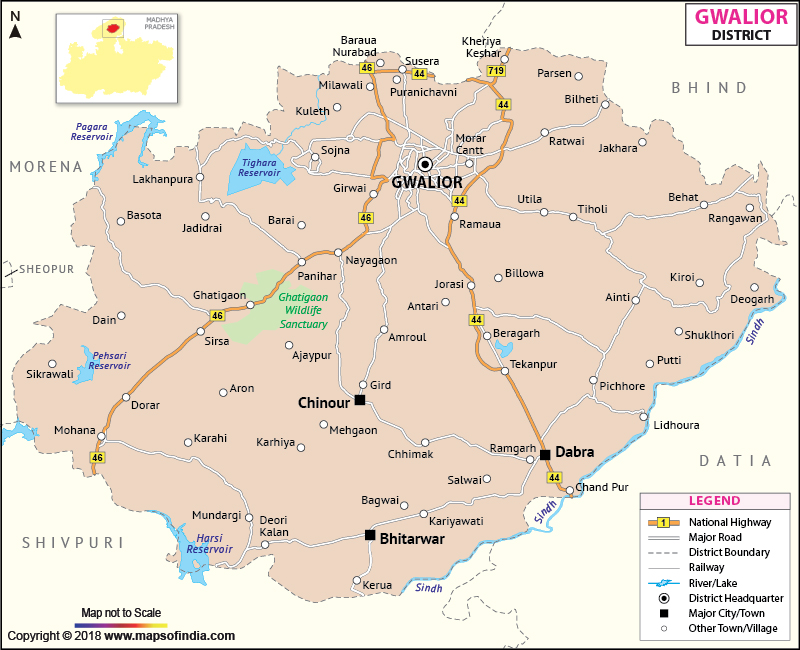
One way Gwalior district takes shape is through its four core tehsils: Gwalior, Bhitarwar, Dabra, and Chinour - serving as centers for local oversight. Far beyond mere lines on a map, these areas mark where policy begins touching routine existence. From within them, tasks like gathering revenue, maintaining property details, and guiding countryside progress unfold. Proximity matters, since choices take place near those directly involved.
Away from the tehsils spreads a network of over twelve hundred villages, forming the quiet core of the district. Each one operates under a distinct gram panchayat, shaping decisions close to home. Governance here takes on a human scale, shaped by proximity and familiarity. Farming demands receive attention alongside repairs to pathways and supply networks for clean water. Efforts around wellness, learning, and shared well-being unfold through locally managed initiatives. Distance fades when authority stays grounded in community soil - tradition meets structure without losing its voice.
Leading the district is the District Collector, overseeing revenue matters while guiding efforts in order enforcement and regional progress. Beneath this role operate dedicated officials, their work linking central directives to remote village centers through steady implementation. Urban functions rest within the authority of the Gwalior Municipal Corporation, tasked with road networks, movement systems, waste handling, and spatial design.
Within this framework, tehsils work alongside gram panchayats, guided by the Collector’s office while the Municipal Corporation oversees urban zones. Although rooted in older forms of local rule, procedures adapt where new demands arise. One finds continuity between rural councils and city management through shared oversight channels. Functionality emerges not from uniformity, but from layered responsibilities shaped over time. Progress takes place quietly, embedded within routines that link village needs with municipal planning cycles.
| Facts of Gwalior District | |
|---|---|
| State | Madhya Pradesh |
| District | Gwalior |
| Location | Northern Madhya Pradesh |
| District HQ | Gwalior |
| Population | 2032036 |
| Growth | 26.97% |
| Sex Ratio | 912 |
| Literacy | 63.23 |
| Area (km2) | 5465 |
| Density (/km2) | 445 |
| Tehsils | Gwalior, Bhitarwar, Dabra |
| Lok Sabha Constituencies | Gwalior |
| Assembly Constituencies | Gwalior Rural, Gwalior , Gwalior East, Gwalior South, Bhitarwar, Dabra (SC) |
| Languages | Hindi, English |
| Rivers | Sindh |
| Lat-Long | 26.056783,78.221054 |
| Travel Destinations | Gujari Mahal, Man Mandir Palace, Ghaus Mohammed's Tomb, Gurudwara Data Bandhi Chhod, Gopachal Parvat, Sun Temple, Sarod Ghar, Jai Vilas Palace/Museum etc. |
| Government Colleges/Universities | Govt College (Bhitarwar), Govt Modal Science College, Govt Kamlaraja Girls PG (Autonomous) College, Bhagawat Sahay Govt College, Govt Arts and Commerce College (Mohana), Vijaya Raje Govt Girls PG College (Morar), Vrinda Sahay Govt PG College (Dabra), Maharani Laxmi Bai Govt College of Excellence, Virangna Jhalkari Bai Govt Girls College, Govt Sanskrit College, Govt SLP College (Morar) etc. |
FAQs
Q1: How many villages are there in Gwalior district?
There are over 1,200 villages spread across its tehsils, reflecting the district’s strong rural base alongside its urban centers.
Q2: What is the population of Gwalior district?
As per the 2011 Census, the population was 2,032,036, with current estimates suggesting growth beyond 2.4 million.
Q3: What is Gwalior district famous for?
Gwalior is famous for its fort, its musical heritage as the birthplace of Tansen, and its architectural landmarks like Jai Vilas Palace and Sas-Bahu Temples.
Last Updated on : May 12, 2026
