






About
Satna district is regarded as one of the most prominent districts of the central Indian state of Madhya Pradesh which is characterized by its historical richness, religious and economic complexity. It was said that the word Satna was a conglomeration of two other words-Sat (seven) and na (river or stream) which meant the seven little rivers that the area used to get. The fact that it is associated with water bodies means that the district is geographically and culturally identified, which in the past has afforded settlement, farming, and commerce.
Satna is a district in the Baghelkhand region of the north eastern region of Madhya Pradesh. It borders Uttar Pradesh to the north making it a key entry point between the central and northern India. The city of Satna is the district headquarters, and also a large administrative and commercial centre. The area boasts of an efficient rail and road network that further increases the ease of access and strategic value.
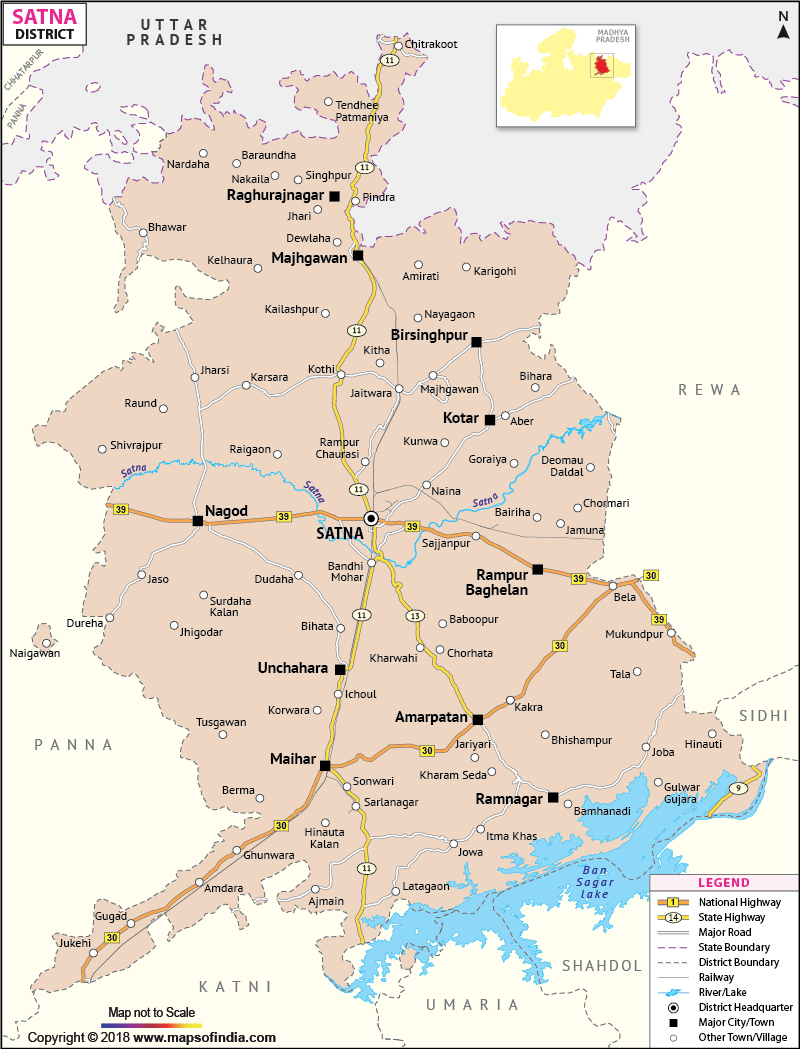
Satna district is a well established district of cement industry, religious centres and natural landscapes. It also aptly ties with the pilgrimage tourism particularly owing to the existence of Maihar where the well-known Sharda Devi Temple is located. The topography of the district is of plains, plateaus and rocky outcrops that make it a diverse terrain. The Satna district map emphasizes its strategic location in Madhya Pradesh and its connectivity to the adjacent areas.
History and Culture
The history of Satna district is characterized by the ancient Indian civilisation and mythology. The area is known in several historical documents and is said to have been a part of the ancient kingdoms which prospered in central India. Throughout the early history era, Satna was under the influence of the Mauryan Empire and later the Gupta Empire that helped in shaping the culture and architecture of the region to a great extent.
During the medieval era, the area came it was subdued by different Rajput dynasties and then the Baghel of Rewa State. The Baghel dynasty was also instrumental in determining the identity of the region especially as a region in terms of administration, culture, and architecture.
Satna district is culturally an amalgamation of Bagheli traditional and general influences of Madhya Pradesh. The Bagheli tongue, a variant of Hindi, is highly spoken in the area and is a significant element of its culture. Dance and folk music, like the Ahir dance and the Karma dance is played during parties and festivals.
Religions play a pivotal role in the life of people in Satna. There are numerous festivals which are adorated with great excitement like; Diwali, Holi, Navratri and Makar Sankranti. Thousands of devotees in particular come to the Maihar temple during the Navratri festival. The Satna district map regularly shows important cultural centres and pilgrimage sites which are visited by people throughout the country.
There is also a relation of the district with various myths and legends especially the myths and legends about Ramayana and Mahabharata. There are parts of the region that are said to be related to the sages of the ancient times and epic stories contributing to its spiritual significance. The map of the Satna district gives a visual explanation of how these culturally important places are spread throughout the district.
Economy
The Satna district has a wide and strong economy that has been supported by all three components of agriculture, industry and services. Its natural resources and industrial base makes it one of the economically important districts in Madhya Pradesh.
Government Sector:
The state is an important component of the economic system in the Satna district. There are several administrative offices, general welfare schemes and development programmes that aid in generation of employment as well as development of infrastructure. Schools, hospitals and administration offices serve as government institutions that offer steady workforce and promote the general development of the district. The Satna district map tends to map out administrative divisions, which would make things easier to govern.
Public Sector:
Large-scale industrial operations, especially that of cement manufacture dominate the public sector in Satna. The district is considered as one of the largest cement producing regions in India, having a number of well-known cement plants located in the district. They are industries that use the reserve of the limestone available in the area and thus Satna has played a significant role in the construction sector.
Other than cement, they also have small and medium scale industries that deal with mining, manufacturing and processing. These sectors employ a large percentage of the population and can contribute to the economic quality of the district. The map of the Satna district provides information about the location of industrial zones and areas which are rich in resources.
Services Sector:
Services sector in Satna district has been on a steady growth especially in the urban areas. Key elements of this sector include trade, transport, education, health and tourism. The existence of educational and healthcare facilities has enhanced the quality of life, and has also provided employment opportunities.
Local businesses and retail markets are also very important in the economy of this district. Tourism, particularly the religious tourism, has turned out to be a significant contribution as it brings in tourists, earning revenue. Satna district map has been drawn to show the connectivity and distribution of service centres around the district.
The rural economy continues to be dominated by agriculture with wheat, rice, pulses and oilseeds being some of the most common types of crops to be grown. The natural resources such as irrigation plants and favourable climatic conditions favour agricultural practices. The map of Satna district resembles the agricultural areas and villages which support this sphere.
Tourism
The district of Satna is a major tourist attraction especially in terms of religious and cultural tourism. It also provides numerous attractions which include temples, history sites and natural environment.
The very popular tourist destination is Maihar which houses the Sharda Devi Temple. The temple is a prime pilgrimage center and it is located on a hill top and has drawn a large number of devotees particularly during Navratri. Stairs or ropeway can be used by the visitors to access the temple as well as giving them an excellent view of the surroundings. This area is a major tourist centre as it is marked clearly on a map of the Satna district.
The other significant location is Chitrakoot which is partly in the district of Satna and partly in Uttar Pradesh. It is considered a consecrated site of Lord Rama who is said to have spent major part of his exile in this place. It is a big spiritual attraction being full of temples, ghats and natural beauty. The map of the Satna district assists the tourists in making their way through the area.
Other natural attractions found in the district include waterfalls, hills and forested areas which are available as the source of nature tourism. Ramvan, Madhavgarh Fort and other such places are historical and scenic attractions to the area. The Satna district map will shed light on these not so famous but interesting places.
The tourism is also improved by the local fairs and festivals. The colorful ambience of religious events demonstrates cultural diversity of the district. These seasonal attractions are usually marked on the Satna district map, and it is an excellent guide to visitors.
Demographics
The population of Satna district is varied with a growing number of rural and urban people. Based on the most recent information, the district has a population of around 2.2 million people. The density of population in various regions of the district is not the same and more populated areas are urban ones.
The literacy is approximately approximately 72.26% in Satna district, and it denotes a continuous rise in the level of education. Government and privately working institutions have led efforts to raise literacy levels and in particular amongst women and rural communities.
The official and the most spoken language in the district is Hindi. Also, Bagheli is widely spoken in the colloquial language especially in rural regions. The smaller communities may also speak other languages as it shows the diversity in the culture of the area. It is a district map of Satna that can be used to understand how the population is spread out and distributed in the district.
Administration
Satna district is well organised and administered into various tehsils to guarantee proper administration and growth. Such tehsils are Satna, Maihar, Amarpatan, Nagod, Rampur Baghelan, and so on. The tehsils are local administrative units that carry out the government policies and take care of the law and order.
Many villages make up the district; this is the way it is so predominantly rural there. The Satna district has more than 1,900 villages with their contribution to the agricultural and cultural landscape of the area.
Local administration is conducted by Panchayati Raj institutions that are very important towards rural development and community involvement. The municipalities are in charge of urban areas and control infrastructure, sanitation and social services.
The Satna district map is a fine example of administrative area and division and can be used as an important instrument in the planning and administration. Different developmental projects also use the Satna district map to effectively implement their projects.
Satna district map is a comprehensive map of administrative boundaries, divisions that serves an important purpose in planning, as well as governance. Satna district map can also be used in other developmental projects in order to ensure that there is correct implementation.
Besides its tehsil-level structure, the Satna district also contains development blocks, which are regarded as the key units of applying the rural development programmes and welfare schemes. Such blocks help in the coordination of the district authorities with the village based institutions and way such that government programs in relation to agriculture, education, healthcare and infrastructure are delivered to the grassroots level. It is also said that the Satna district map is regularly used in planning and management of such developmental pursuits since one can have a clear idea with regard to the spatial distribution of blocks and also their connectivity.
The administrative set up of the Satna district comprises law enforcement and a court system that upholds law and jurisprudence. District and subordinate courts deal with legal issues as police stations are strategically placed throughout the district to provision security and other safety issues of the populace. E-governance has been integrated with time in an effort to enhance transparency and efficiency within administrative procedures. The Satna district map is an important component of these systems that help authorities in resource allocation and planning of jurisdiction.
| Facts of Satna District | |
|---|---|
| State | Madhya Pradesh |
| District | Satna |
| District HQ | Satna |
| Population (2011) | 1311332 |
| Growth | 21.54% |
| Sex Ratio | 918 |
| Literacy | 70.06 |
| Area (km2) | 7502 |
| Density (/km2) | 297 |
| Tehsils | Satna, Nagod, Rampur Baghelan, Amarpatan, Maihar, Majhgawan, Ramnagar, Unchehra, Kotar, Birsinghpur |
| Lok Sabha Constituencies | Satna |
| Assembly Constituencies | Chitrakoot, Raigaon (SC), Satna, Nagod, Maihar, Amarpatan, Rampur-Baghelan |
| Languages | Bagheli, Hindi |
| Rivers | Tons, Son, Paisuni |
| Lat-Long | 24.547123,80.901718 |
| Travel Destinations | Venktesh Temple, Chitrakoot Dham, Ma Sharda Mata Temple, Tulsi Sangralya, Shiv Temple, Griddhraj Parvat, Nandi Temples etc. |
| Government Colleges/Universities | Govt College (Amarpatan), Govt Purushottam Sanskrit College (Khajuritaal), Jalad Trimurti Govt College (Nagod), Govt College (RampurBhaghelan), Govt Girls College, Govt College (Ucherha), Govt College (Jaitwara), Govt Vivekanand PG College (Maihar), Govt College (New Ramnagar), Govt PG College, Govt College (Majhgawan) etc. |
FAQs
Q1: What is the total number of villages in Satna district?
Satna district has more than 1,900 villages, forming a significant part of its rural landscape.
Q2: What is the population of Satna district?
The population of Satna district is approximately 2.2 million people.
Q3: What is Satna district famous for?
Satna district is famous for its cement industries, religious sites like Maihar and Chitrakoot, and its rich cultural heritage.
Last Updated on : May 12, 2026
