






About
Dhar district is a geographically diversified district that is also an old district that is found in the west of Madhya Pradesh. It is named after its head town, Dhar, a long-standing administrative, cultural and educational centre in the heart of India. Its name, Dhar, is thought to derive out of the Sanskrit term Dhara or edge or ridge and refers perhaps to the high land on which the town is built.
Located on the Malwa Plateau, Dhar district has a distinct geographical location that links central India to western states like Gujarat and Rajasthan. Economic productivity and ecological diversity is also brought by the undulating plains, rich agricultural lands, forested patches all of which adds to the terrain landscape.
The district has a tropical climate characterized by hot weather in summer, a monsoon season, which has moderate to heavy rainfall, and mild weather in winter. Agriculture is of great concern especially to the monsoon, which restores the moisture in the soil and promotes planting. Rivers and seasonal streams also contribute to the irrigation process but rainfall still happens to be the main source of agriculture water.
History and Culture
The history of the Dhar district is closely interwoven with the development of the political and cultural aspects of the central India. The area came into the fore under the rule of the Paramara dynasty that made Dhar its capital. The brightest protagonist of this family was Raja Bhoj whose reign in the 11th century was a golden era to the area. Raja Bhoj was not just an able administrator and military leader, he was also a celebrated scholar and is credited to have made contributions to literature, architecture, medicine and astronomy.
Dhar grew into a great educational and intellectual centre under his patronage. It is likely that scholars across India would have congregated here, as well as making it a centre of knowledge on a par with other ancient centres such as Nalanda. Architectural innovations in the time encompassed temples, schools and civic buildings and represented superb planning and artistry.
With the fall of the Paramaras, Dhar fell into the possession of the Delhi Sultanate and then the Mughal Empire. Over this period, the local city of Mandu was a great political and cultural centre. Situated atop a plateau, Mandu was the capital of the Malwa Sultanate, and is known to have splendid fortifications and Indo-Islamic architecture. The Jahaz Mahal, Hindola Mahal and the Rani roopmati Pavilion are other buildings that still appeal to both the historian and inquisitive observer.
Dhar has a culturally diverse profile of harmonious coexistence of tribal and mainstream culture. There are tribal groups like the Bhils and Bhilalas who constitute good percentage of the population. Their culture, traditions, and art are well established on the ground of nature and planting. Their way of life consists of their folk dances, traditional music and handcrafted products.
There is always a lot of zeal and amicable relationship in the Dhar district especially in festivals. Diwali, Holi and Navratri are big Hindu festivals and the tribal festivals and village fairs are also seen, giving them a local touch. Traditional performances, local food, and markets are the usual events in these experiences.
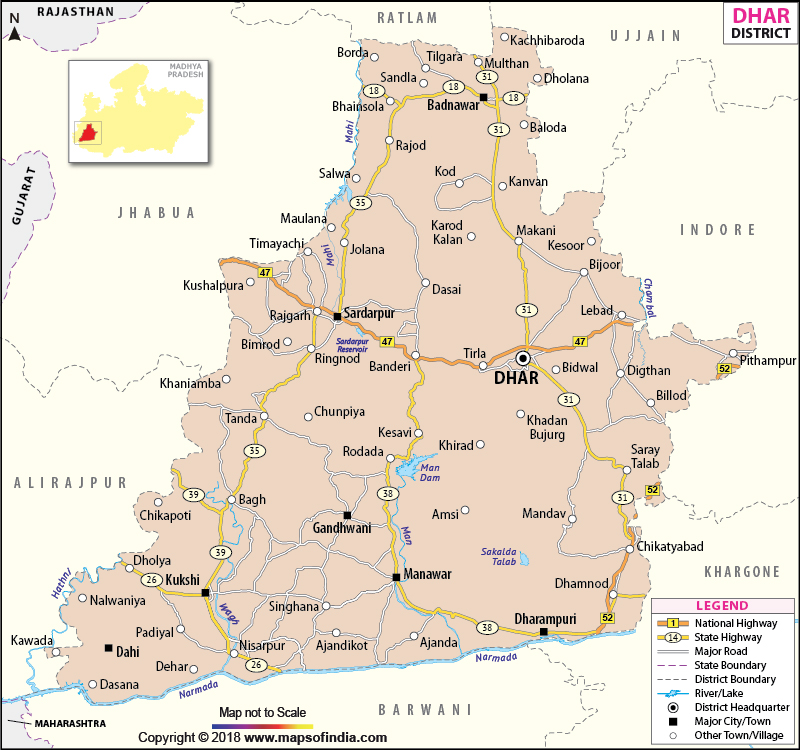
Historians and anthropologists often make use of a Dhar district map in tracking down the transformation of settlements and cultural areas. Through mapping a Dhar district, researchers can be able to figure matters of historical significance, and how cultural practices differ within a region.
Economy
The economy of the Dhar District is mainly agro-based with some input of the government institutions, government organisations and the developing services sector. The economic framework of the district indicates a change towards more diversified activities, especially with the abandonment of traditional agrarian activities.
In Government Sector, the district administration is significant in the implementation of welfare schemes, development of infrastructure, and government services. Many residents have stable livelihoods due to government employment, especially in education, healthcare, and administrative services. Rural upliftment, irrigation as well as skill development programmes have done a lot to enhance the economic growth in the district.
The cooperative institutions, public banks, and state-run enterprises represent the Public Sector. Agricultural cooperatives are very significant and they enable farmers to access credit, seeds, fertilisers and advanced farming practices. Public distribution systems guarantee food security and in rural and tribal areas in particular.
Services Sector has been enjoying consistent growth particularly in urban centres. The area has experienced significant improvements in education and healthcare provision and schools, colleges, and hospitals serve the population adequately. Other important factors of employment and economic activity are retail trade, transport services, and small enterprises.
The district is still dependent on agriculture. The most common crops are soybean, wheat, maize, gram and pulses. The black Malwa soil is very fertile, especially favoring such crops. Although irrigation facilities are limited in certain regions, they are being enhanced by the government initiatives and improvement in technology. Animal keeping, dairy farming and poultry are significant ancillary activities which bring additional earnings to rural families. Over the last few years, there has been an initiative to develop horticulture and cash crops in order to continue diversifying the agricultural sector.
Industrialisation is slowly picking up with a significant progress in regions near urban centres and heavy transport distances. SMEs such as food processing, textiles, and manufacturing are coming out as major sources of the local economy.
Dhar district map is a tool that is absolutely necessary in economic planning because it aids in the determination of agricultural zones, industrial sectors and the networks of infrastructures. A Dhar district map assists policymakers and investors to make a well-informed decision concerning allocation of resources and development strategies.
Tourism
Dhar district is a great tourist attraction area, which is full of historical sites, architectural heritage and natural beauty. The cultural heritage brought forward by the tourism industry in the district has a significant role in the development of economic activity in the district.
Mandu is the most glaring attraction also known as the City of Joy. This historic site is characterized by its breathtaking architecture, as well as picturesque location. The monuments like Jahaz Mahal, which is almost suspended between two lakes and Hindola Mahal which has a sloping wall depict the art of ingenuity of medieval buildings. Rani Roopmati pavilion is constructed with stunning views of the Narmada Valley.
Another historical site having and witholding a greater importance in this area is the Dhar Fort, which constantly keeps showing the historical significance of the district. The fort itself becomes a witness to the immensly vast strategic and administrative importance of the region across multiple centuries. The Bhoj Shala and Bhoj associated with Raja Bhoj are very significant locations to be aware about. Its complex carvings and architectural details appeals very much to the historians and visitors who are purely interested in history and art and acknowledge it.
A variety of natural features including water falls, hills and forests increase the beauty of the district especially in months of monsoon season when everything is green and beautiful. These locations allow trekking, photography and exploration of nature.
Demographics
The recent census data shows that Dhar district has around 2.1 million people. Most people have their bases in countryside and villages constitute the core of the social and economic fabric of the district.
Dhar district has a literacy rate of about 60-65% indicating the gradual improvement in education over the years. These government programs, opening up of schools and awareness programs have helped in raising literacy levels. Nevertheless, not all can be easy, especially in isolated and tribal regions where access to educational institutions might be restricted.
The languages used in the district are Hindi (which is the official language of the district) and regional languages like Malwi and Bhili. Languages spoken in tribal communities are usually different and contribute to linguistic diversity of the area.
Demographic set-up is a high percentage of Scheduled Tribes especially the Bhils and Bhilalas. They add to the cultural richness and diversity of the district.
In demography, a Dhar district map is a very popular tool to examine the distribution, literacy, and settlement patterns of the population. Investigating a Dhar district map, the researchers can obtain some insights into the socio-economic situation and geographical differences within the sphere of the district.
The process of urbanisation is on the rise and the process of expanding of the towns and new economic opportunities is coming up. Nevertheless, the district still preserves its mainly rural nature, and traditional lifestyles and agriculture take a dominant place.
Administration
Dhar district is administratively grouped into a few tehsils such as Dhar, Badnawar, Sardarpur, Kukshi, Manawar, Dharampuri etc. These tehsils are also significant units of administration where governance and provision of public services is made easy.
Every tehsil has the responsibility of keeping land records, collecting revenue, and local administration. The district administration comes under the supervision of a District Collector, who heads different departments and makes sure that the administration executes government policies and programmes.
The district also has over 1,100 villages indicating the rural nature of the district. Locally as it goes, they are being properly controlled by Panchayati Raj institutions, which acts as a vital body in the local self-government and development since a very long time. The Panchayats are constantly being involved in solving the local problem along with instituting development projects and encouraging communal involvement simultaneous across areas.
A Dhar district map is another extremely useful tool in administrative planning as it visually depicts the boundaries, infrastructure and distribution of resources. A Dhar district map is a map utilized by the authorities to manage development processes, track them, and guarantee effective management.
The district police is held totally responsible for maintaining law and order, and different departments address different and challenging domains such areas as education, healthcare, agriculture, and public works. Irrespective of these difficult challenges the system is facing and experiencing gaps in infrastructure and lack of resources although the administrative system is expected to aim at providing efficient services throughout the district with stability.
| Facts of Dhar District | |
|---|---|
| State | Madhya Pradesh |
| District | Dhar |
| District HQ | Dhar |
| Population (2011) | 2185793 |
| Growth | 25.60% |
| Sex Ratio | 964 |
| Literacy | 59 |
| Area (km2) | 8153 |
| Density (/km2) | 268 |
| Tehsils | Dhar, Badnavar, Kuksi, Dahi, Gandhwani, Dharampuri, Sardarpur, Manawar |
| Lok Sabha Constituencies | Dhar |
| Assembly Constituencies | Sardarpur (ST), Gandhwani (ST), Kukshi (ST), Manawar (ST), Darampuri (ST), Dhar, Badnawar |
| Languages | Hindi |
| Rivers | Mahi, Chambal, Narmada |
| Lat-Long | 22.601333,75.304313 |
| Travel Destinations | Rampol Darwaza, Jehangir Gate, Tarapur Gate, Jahaz Mahal, Hindola Mahal, Tomb of Hoshang Shah, Jami Masjid, Roopmati Pavilion, Bagh Caves, Phadke Museum, Bhoj Shala, Lath Masjid (Pillar Mosque), Jheera Bagh Palace etc. |
| Government Colleges/Universities | Govt College (Badnawar), Govt Autonomous PG College, Govt College (Dharampuri), Govt Degree College (Manawar), Shri Rajendra Suri Govt College (Sardarpur), Govt College (Dhamnod), Govt Girls Degree College, Govt College (Kukshi), Govt College (Pithampur) etc. |
FAQs
Q1: What is the total number of villages in Dhar district?
Dhar district has more than 1,100 villages, highlighting its predominantly rural character.
Q2: What is the population of Dhar district?
The population of Dhar district is approximately 2.1 million as per recent census estimates.
Q3: What is Dhar district famous for?
Dhar district is famous for its historical heritage, especially the monuments of Mandu, its association with Raja Bhoj, and its vibrant tribal culture.
Last Updated on : May 12, 2026
