






About
Indicatively referred to as Chhindwara district, or less commonly Chhindwara, the Chhindwara district is among the most geographically varied and diverse in culture of the state of Madhya Pradesh. It is situated in the South of the state, and is a very important portion of the plateau region of the Satpura, sharing its southern border with the adjacent state of Maharashtra. The name of the district is given, of course, by the abundance of the so-called Chhind, in whose trees a species of palm, once monarchical of the scene, was, and whose name signifies an abode, a settlement.
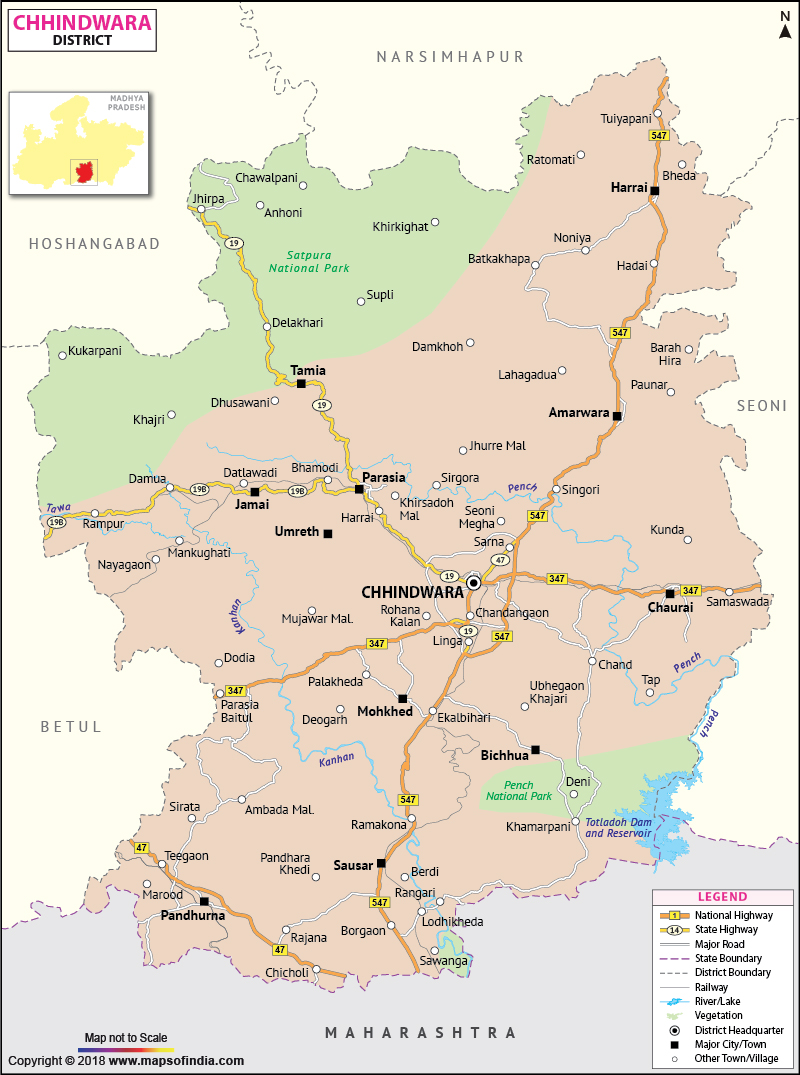
Besides its geographical and economic significance, Chhindwara is also politically relevant. It has experienced a steady development in areas like education, healthcare and infrastructure. The combination of natural resource base, cultural diversity, and plan development connoted by the district make it a major area in Madhya Pradesh. The Chhindwara district map would continue to be a critical source to study this complex area.
History and Culture
The area fell under various important dynasties, such as the Mauryas and Guptas, who helped to develop the region in the sense of administration and culture. This was the time when the trade routes and settlements expanded and these established the historical significance of the district.
In the medieval period, the district was dominated by the Gond dynasty which had a characteristic influence on the cultural development there. The Gonds provided an organized rule and a culture of local culture, most of which have persevered till today. The traditions, festivals and the art of the area still reflect their impact.
The Marathas subsequently assumed control of the district and brought about some administrative changes and linked it to a larger regional system. Chhindwara was later incorporated in the British India. The evolution of the railway systems, roads and management systems of the forests were some of the changes that occurred during the colonial period. The Chhindwara district map which was widely applied during this period was applied in administrative planning especially in the administration of forests as well as land revenue system.
Chhindwara has a tribal based culture. The Gonds, Bhils, and Korkus communities are part of the community of the district. Their nature was close to nature as evidenced by their traditional knowledge systems and rituals as well as lifestyles. Pola, Madai, and Diwali are the festivals that are celebrated with a lot of enthusiasm and normally they are marked with folk dances, music and group meetings.
Bamboo products and tribal art are also famous handicrafts of the district. Such crafts do not only serve as a source of livelihood, but also protect the culture. The Chhindwara district map frequently reveals the areas where these traditional practices are most evident, and provides an understanding of the cultural geography of the region.
Economy
The Chhindwara district economy is well balanced with agriculture, industry and services hindered with both the state and other entities. Its natural resources and strategic planning have led to the stable economic growth of the district over the years. The Chhindwara district map is significant in terms of determining the economic zones and development policies.
Administrative services, public institutions and welfare programmes are the source of employment in the government sector. The district headquarters is the center of governance and it is important to have effective implementation of policies that cover education, healthcare and rural development. Economic stability has also been facilitated by government programs to alleviate poverty and development of skills.
There is also a high level of public sector in the district especially on matters concerning energy and natural resource industries. The use of coal mining and the generation of power in the surrounding regions creates jobs and complements the local economy. On a considerable note, are the industries depending on the forests, like timber, bamboo, and small forest products. It is necessary to check the resource-rich areas in the basin and provide their sustainable development; to do this, the map is necessary, called Chhindwara district map.
The economy of the district is still based on agriculture. Wheat, maize, paddy, pulses, and oilseeds are some of the crops that are not only grown in the fertile soil but also enabled by the favourable climate. Over the last few years, there has been a rise in the significance of horticulture as more and more farmers take up production of fruits and vegetables. Increased level of income and productivity It has improved irrigation facilities and farms techniques.
Services are the highly growing area that are propelled by education, health, banking and retail increase. Smaller business and entrepreneurship ventures are being experienced in urban centres within the district. The services sector is also being boosted through tourism as it creates jobs in the fields of hospitality, transport and others. To locate the areas with the most growth potential and plan the development of infrastructures, the so-called Chhindwara district map is widely used.
Altogether, the economy of the district can be described as a balanced mix of traditionalism and modernism to guarantee the further sustainability and soundness of the economy.
Tourism
The Chhindwara district has a diverse range of tourist attraction sites that can captivate nature lovers, those who value history and cultural adventurers. Its beautiful sceneries, wildlife, and heritage sites also make it a new tour destination in central India. The Chhindwara district map is an informative tool that aids the visitors in learning the district all at once.
One of the most notable attractions is Pench National Park a part of which is located within the district. The park houses an array of wildlife such as tigers, leopards and many species of deer which are known to be visited by people who come to the park, regardless of distance, to view them. It also interrelates with Rudyard Kipling The Jungle Book giving it literary value alongside its natural beauty.
Another place of significant interest is Patalkot Valley. This valley is a deep valley, flanked by hills, and it is believed to have the biodiversity that is unique and tribal settlements. It is an eye-opener with spectacular shots and a preview of the native ways of life of the indigenous people. The Chhindwara district map is a guide that can assist a traveller to navigate this remote and intriguing area.
Tamia Hills is a tourist-friendly beautiful place, which has good climate and beautiful scenery. It is referred to as an undetectable hill resort, which can be used to relax and take walks. Trekking and photography is also a possibility in the area.
Historical sites Devgarh Fort is able to provide us with information about the history of the district. The fort is a reminder of historical importance and construction of the place. The district is also endowed with natural features such as Kukdi Khapa Waterfall that one will be amazed with during the monsoon period when the waterfall is at its full color.
There is also an element of religious tourism in which temples and religious locations draw faithful all year round. The Chhindwara district map is popular in mapping out travel routes and in studying all these various attractions effectively.
Tourism in Chhindwara is gaining momentum and with the better infrastructure and new awakenings, it is providing fresh avenues to economic growth without at the same time compromising its natural and cultural heritage.
Demographics
The population of Chhindwara district is about 2.1 million based on the latest census of the area. The population is mostly rural and a large percentage of population resides in villages and small settlements. The Chhindwara district map is a detailed visual representation of the population distribution in the district.
The level of literacy is approximately seventy-one per cent, all of which is an improvement over the years. Schools, government initiatives and being more aware have led to increased literacy. The rural and urban settings have experienced advancements in education levels.
The main language spoken in the district is Hindi, with regional dialect, and tribal languages (Gondi and Korku) being also in widespread use. This language richness draws attention to the views of the region as the place of multiculturality and the inclusive social fabric.
A large portion of the population in the district is made up of the tribal population. Such communities preserve their traditional foreways of living and lead a modern economic existence. To identify tribal-dominated regions and put some specifically designed development programmes in place, the instrument is frequently referred to as the Chhindwara district map.
Population, urbanisation, and migration trend are slowly changing the demographic picture of the district. Nevertheless, it still preserves its rural nature and culture diversity.
Administration
The district of Chhindwara is administratively split into various tehsils such as Chhindwara, Amarwara, Sausar, Parasia, Tamia among others. The administrative units contribute to efficient governance and provision of the public services in the district.
A vast size of the district is characterized by more than one thousand nine hundred villages as the reflection of so many villages. All villages have a local government and system in their individual locality, which is part of a grassroots government. The Chhindwara district map is a crucial means of administration of administrative territories and development projects.
The Panchayati Raj institutions that facilitate local governance align the rural communities and encourage participative decision-making. Municipal areas have municipal authorities that control civic services infrastructure and planning of urban areas.
The district administration concentrates on the growth in main areas including education, health, agriculture and infrastructure. Emphasis is put on enhancing connectivity, increasing the number of public services and the living conditions with residents. The Chhindwara district map is a significant tool that can be used to plan any of these initiatives and implement them.
| Facts of Chhindwara District | |
|---|---|
| State | Madhya Pradesh |
| District | Chhindwara |
| District HQ | Chhindwara |
| Population (2011) | 2090922 |
| Growth | 13.07% |
| Sex Ratio | 964 |
| Literacy | 71.16 |
| Area (km2) | 11815 |
| Density (/km2) | 177 |
| Tehsils | Chhindwara, Tamia, Parasia, Junnardeo, Amarwara, Chourai, Sausar, Pandhurna, Bicchua, Umreth, Mohkhed, Harrai |
| Lok Sabha Constituencies | Chhindwara |
| Assembly Constituencies | Juunardeo (ST), Amarwara (ST), Churai, Saunsar, Chhindwara, Parasia (SC), Pandhurna (ST) |
| Languages | Gondi, Hindi including Marathi |
| Rivers | Kanhan, Pench, Jam, Kulbehra, Shakkar, Doodh |
| Lat-Long | 22.08564,78.834686 |
| Travel Destinations | Patalkot, Chota Mahadev Cave, Devgarh Fort, Kukdi Khapa Water Fall, Lilahi Water Fall, Gotmar Mela, Tribal Museum, Neelkanthi, Anhoni, Kalyani Devi' Temple, Sharada Devi' Temple, Nagadwari Cave etc. |
| Government Colleges/Universities | Govt College (Amarwara) , Govt Autonomous PG College, Govt College (Damua), Govt College (Junardeo), Govt Science College (Pandhurna), Govt College (Sausar), Govt College (Bichhua), Rajmata Scindia Govt Girls College, Govt College (Harrai), Govt Arts College (Lodhikhera), Govt Pench Valley PG College (Parasia), Govt College (Tamia) etc. |
FAQs
Q1: What is the total number of villages in Chhindwara district?
Chhindwara district has more than one thousand nine hundred villages, making it largely rural in character.
Q2: What is the population of Chhindwara district?
The population of the district is approximately 2.1 million according to census data.
Q3: What is Chhindwara district famous for?
Chhindwara district is famous for its tribal culture, natural landscapes, agricultural productivity, and attractions such as Pench National Park.
Last Updated on : May 12, 2026
