






About
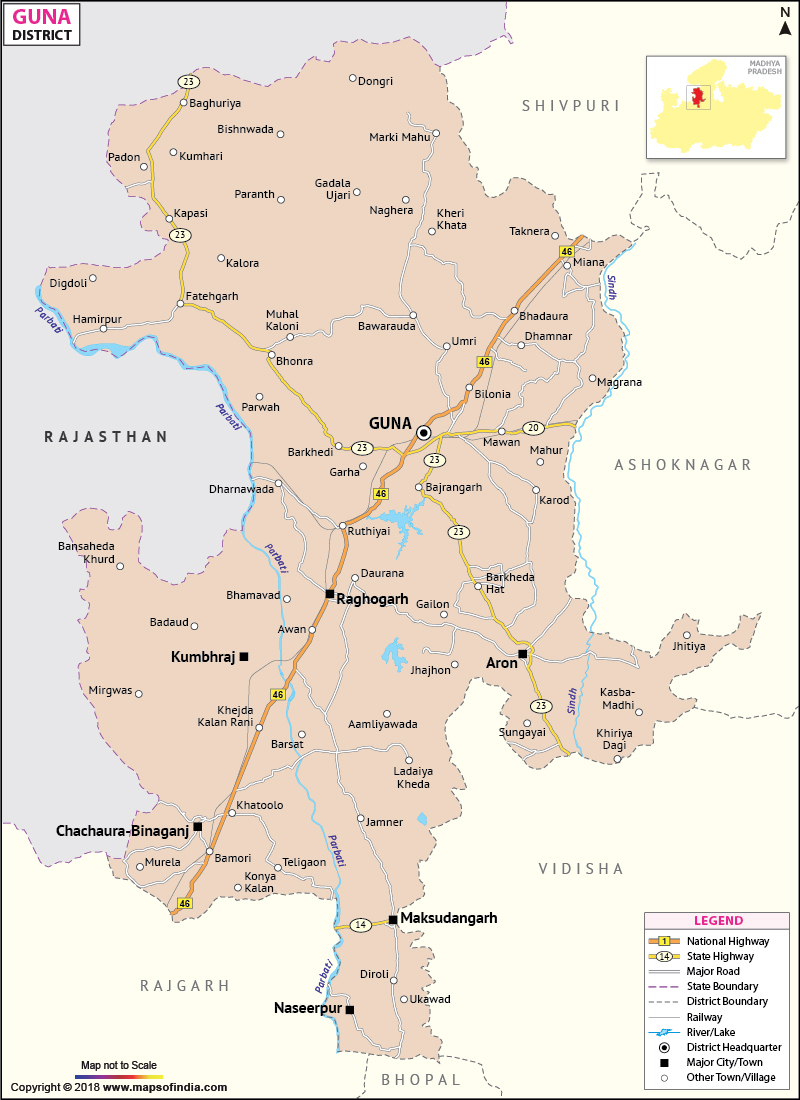
Guna district occupies central northern Madhya Pradesh, frequently named the Gateway to Malwa. Far beyond metaphor, its placement holds geographic weight - resting where Malwa’s rich highlands meet the uneven lands of Bundelkhand and the winding lowlands shaped by the Chambal River. Movement through this region has long followed these meeting points, guided less by choice than by landform patterns.
Spread across 6,390 square kilometers, it shares borders with Shivpuri in the north. Moving eastward, it touches Ashoknagar. To its southern edge lie Vidisha alongside Rajgarh. On the western flank stands Baran, part of Rajasthan. The administrative center sits at Guna town. Located along the Parbati River, this place rests near flowing waters. That river feeds into the Chambal system. Over time, these waters have shaped farming patterns here. Human habitation has grown around such resources.
Distinctive about the district is how it holds two realities at once. One rests in quiet fields, where village rhythms follow planting seasons and inherited customs shape routine days. Yet another emerges beside highways, where factories hum, tutoring centers fill classrooms, and digital offices signal change. Between these worlds runs a thread - neither fully old nor entirely new - that defines its essence. Located across northern Madhya Pradesh, the district earns recognition as an entry point into Malwa. Such labeling reflects more than imagery - it traces placement where three regions meet. A stretch of rich soil known as Malwa brushes against rocky tracts of Bundelkhand while winding streams from Chambal cut through lowlands nearby. Because of this positioning, movement flows naturally here - goods pass through, people settle after journeys, ideas cross paths without prompting.
History and Culture
Among those shaping Guna's past stands the Scindia line of Gwalior, rulers across broad stretches when principalities held sway. Position mattered - Guna sat where Malwa met Bundelkhand and paths led into Rajasthan. Decisions followed geography; movement through these lands passed this way. Long before, traces of Rajput rule could be seen alongside Maratha presence, where structures such as Bajingham fort stood firm. Not untouched by empire, Mughal marks remain visible - especially within governance frameworks and built forms. From ancient speech comes the term “Gun,” said to shape the title of this area, reflecting moral weight tied to soil and soul alike.
Once under colonial rule, it took form around a railway cantonment. With time, the British recognized strategic advantages for transport networks there; thus, rail operations enabled steady flows of goods and troop deployments. Following independence, inclusion within Madhya Pradesh redefined its status. By 2003, administrative changes led to the formation of Ashoknagar district, altering regional divisions once more. Eventually, maps were redrawn, marking subtle shifts in governance structure.
Among quiet fields, Guna holds echoes of both Malwa and Bundelkhand ways. Stories of courage, longing, and faith live on through village voices at dusk. During celebrations, movement becomes meaningful in Bhavai and Rai performances. Art here moves not in galleries but through rhythm passed from hand to hand. Families in villages continue making handmade goods. Alongside daily life, pottery takes shape on wheels, while carving shapes wood into form. Woven cloth emerges thread by thread, carrying patterns older than memory. Where one faith ends, another begins without conflict - shrines stand near each other, silent proof of long shared ground. Centuries pass, yet rituals endure beneath temple domes, within quiet prayer halls, at tombs wrapped in song.
Festivals like Diwali and Holi unfold across towns with brightness, glowing through night skies. Firelight rises where people meet, sharing food made at home. Joy spreads quietly in lanes filled with color or flickering lamps. Together, moments form without speech, built around warmth and familiar tastes. Night ends with traces of smoke, sugar, laughter left hanging. Festive nights glow under village skies during Navratri. With drums beating, circles form in open grounds. Voices rise in prayerful rhythm through evenings. Light spills from oil lamps lining courtyards. Movement flows without pause, step following step. Joy moves quietly among elders and children alike.
Fairgrounds hum at dawn when devotion meets barter, rooted deep in time. Where prayer flows into marketplace talk, old rhythms stay unbroken. With each season, villagers gather where ritual and sale walk side by side. Centuries fold into moments when offerings meet grain sacks on dusty ground. Within Guna, culture appears beyond ceremony. During planting, melodies rise without effort. Around dusk, flames draw people near. Tales unfold slowly there. Life carries tradition forward through small acts. Expression grows where routine takes place
Economy
Jobs come from schools, hospitals, along with various offices managed by public authorities. Rural areas see work opportunities through initiatives such as MNREGA. Implementation of farming support measures depends heavily on local governance structures. Welfare efforts reach communities largely due to coordination at the district level. Among India's industrial hubs, Vijaypur hosts a major facility operated by National Fertilizers Limited. Built during the 1970s, its scale ranks among the continent’s most expansive for fertilizer output - urea and ammonia being primary goods. Over time, economic activity in the district shifted markedly due to this site. Employment opportunities emerged here first, then spread outward through linked sectors.
With time, places such as Guna city and Raghogarh expanded services in finance, shopping, movement of goods, and learning. Because of available training centers, learners arrive from surrounding areas. Medical setups, meanwhile, support residents across town and countryside alike. Agriculture remains the lifeline: Among key crops grown are soybean, followed by wheat. Next appear gram and then mustard. Pulses also feature prominently in cultivation patterns across regions. Water delivery relies on canals. Tube wells serve farmland. River basins support cultivation. Farming outputs move into packaged goods, showing growth. Fabrics made from local fibers gain traction slowly. Bricks and cement see rising demand across regions.
Still, farming holds steady even as jobs shift shape. Though fields remain central, factories add quiet strength across Guna. Resilience grows where crops meet machinery, slowly reshaping daily life.
Tourism
Guna's travel appeal lies quietly beneath layers of cultural depth, yet spiritual significance shapes much of its character. While history rests subtly across the landscape, meaning emerges through quiet presence rather than display. Built during the 1500s, Bajrangarh Fort stood as a Maratha bastion before passing into Scindia control. Stories of courage and battle linger within its remains. Though silent now, the stones recall resistance shaped by time.
A hilltop shrine honors Lord Hanuman at Hanuman Tekri. Devotees arrive throughout the year, drawn by quiet devotion rather than spectacle. The site remains active regardless of season. Faith sustains its presence across months without pause. A serene location emerges through detailed stone artistry at Kachnara Jain Temple. With quiet reverence held within its walls, meaning deepens beyond mere structure. Where craftsmanship meets devotion, visitors encounter stillness shaped by time.
Along the Parbati River, steps descend to water level at certain points. There, ceremonies take place during festivals. Gatherings occur near these banks when events unfold. Ritual activity marks many of these locations throughout the year. Open countryside, woodlands, along with quiet country views, hold promise for nature-based travel. Most visitors come from within the country, drawn by spiritual sites. Yet improved roads and facilities might shift focus toward historical landmarks alongside nature-based travel experiences. What once seemed peripheral may slowly take center stage over time.
Demographics
In 2011, census data recorded Guna's population at 1.24 million. Twelve point four lakh people reside here, split nearly equally between countryside and city areas. A near-even spread defines where most live, shaping settlement patterns across regions. Approximately two out of three people can read. Males show stronger reading skills compared to females. A gap remains between genders in education levels. Across the region, Hindi holds primary status while regional expressions like Bundeli add texture. Though widely spoken, Hindi shares space where Malwi emerges naturally in daily exchange. In rural pockets, Rajasthani variants appear alongside dominant usage patterns. Each tongue persists without overt hierarchy among them.
Rajputs form part of the social structure, followed by Brahmins who hold distinct roles. Jats appear within agrarian frameworks, while access among Scheduled Castes varies across regions. Groups such as Saharias occupy tribal classifications in certain zones.
Across regions, demographic patterns reveal varied access to learning, often shaped by social norms. Differences emerge most clearly where opportunity meets restriction.
Administration
In every region, Guna's leadership aims to meet town demands alongside rural ones. Because settlements differ, methods shift slightly - yet core support stays unchanged. Where roads are few or populations sparse, delivery adjusts without altering intent. Though structure remains fixed, execution changes when needed. From dense neighborhoods to isolated hamlets, response follows context. Direction holds firm even as tools transform. Effectiveness grows not from uniformity but from fit. Stability comes through adaptation, not repetition. Each zone receives attention shaped by its own layout. Consistency lies in outcome, never just process.
One sixth of the area falls under it, another beneath Raghogarh, followed by Aron, then Chachaura, alongside Bamori, ending with Kumbhraj. Oversight in each comes from a Sub‑Divisional Magistrate, responsible for daily governance tasks and execution of state directives locally. Despite their modest size compared to broader regions, such divisions carry weight, linking distant populations while easing pressure on main administrative hubs.
Beneath the tehsils lie development blocks, each housing multiple gram panchayats.
Governance takes tangible form within these local units. Implementation of initiatives like MNREGA, village power access, and safe drinking water occurs at this level, guided more by on-ground conditions than top-down mandates. Proximity to citizens places decision-making nearer to daily life. Community influence grows when choices emerge from familiar settings.
Across the district lie over 1,200 villages, each shaped by distinct patterns of rural oversight. From the ground up, authority takes form through sarpanches alongside chosen panchayat figures, standing where community meets structure. Because of such roles, information moves toward central bodies, carrying voices from small settlements into decision spaces. Despite shifts in policy or time, their presence holds steady, forming quiet pillars beneath public order. Life in the district countryside ties to wider systems - not by force, but through consistent, unflashy links.
| Facts of Guna District | |
|---|---|
| State | Madhya Pradesh |
| District | Guna |
| Location | Gwalior, Madhya Pradesh |
| District HQ | Guna |
| Population (2011) | 1240938 |
| Growth | 21.50% |
| Sex Ratio | 943 |
| Literacy | 66.39 |
| Area (km2) | 6390 |
| Density (/km2) | 194 |
| Tehsils | Guna, Raghogarh, Aron, Kumbhraj, Chanchoda |
| Lok Sabha Constituencies | Guna, Rajgarh |
| Assembly Constituencies | Bamori, Guna (SC), Chachoura, Raghogarh |
| Languages | Hindi, English |
| Rivers | Parbati, Sindh, Kuno, Ghodapachad |
| Lat-Long | 24.686952,77.274627 |
| Travel Destinations | Bajrang Garh Fort, Temple of Beesbhuja Devi, Shri Hanuman Tekri Temple, Jainagarh, Christ The King Church, Panchmukhi Hanuman Ashram etc. |
| Government Colleges/Universities | Govt College (Aron), Govt Girls College (Chachora), Govt Kasturba Girls College, Govt College (Chahora-Beenaganj), Govt PG College, Govt College (Raghogarh) etc. |
FAQs
Q1: How many villages are there in Guna district?
There are over 1,200 villages in the district, spread across the geographical territory.
Q2: What is the population of the district?
Approximately 12.4 lakh (2011 Census) live in the district.
Q3: What is this district famous for?
It is famous for the National Fertilizers Limited plant at Vijaypur, Bajrangarh Fort, and its role as the Gateway to Malwa.
Last Updated on : May 12, 2026
