






About
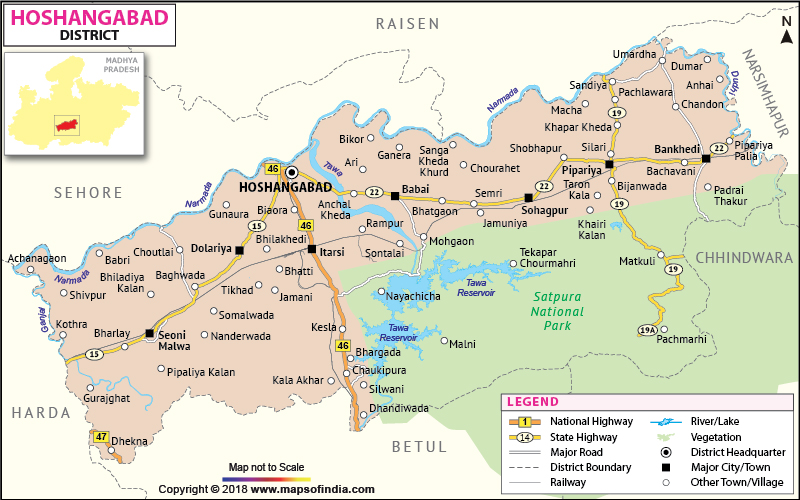
Narmadapuram, once called Hoshangabad until 2022, stands out within Madhya Pradesh, nestled beside the Narmada River's rich basin. Covering about 5,408 square kilometers, its administrative core - the town itself - has held steady as a hub for governance, commerce, and heritage. North lies Raisen; Betul marks the south; Harda borders the west; while Chhindwara and Sehore frame the eastern flank, situating the region deep in central India’s stretch.
Important due to both natural wealth and links beyond its borders, the district holds strategic value. Located at Itarsi Junction - one among India’s biggest rail intersections - Hoshangabad gains significance within national transit routes. Roads extend in many directions, joining places like Bhopal and Nagpur with steady movement. Because travel here faces few barriers, economic activity grows without sudden stops or delays. What lies behind the change from Hoshangabad to Narmadapuram goes beyond paperwork - it reflects how strongly local communities honor the Narmada River, long seen as holy within Hindu belief. Far more than just vital for farming and routine needs, the waterway stands as a core presence in inner life, quietly defining who lives here through lasting influence.
History and Culture
Beneath the surface of Hoshangabad lies traces of shifting powers and evolving cultures. Named reportedly for Hoshang Shah of Malwa, its origin ties closely to his reign. Under medieval rule, Gond leaders shaped much of daily life, a presence felt even now through local practices. Influence shifted when Mughal authority arrived, followed by periods governed by Maratha forces, each adding subtle marks upon buildings and systems. When British administration took hold, the town gained structured importance, positioned deliberately along the Narmada River.
Festivals set the pace in Hoshangabad - during Diwali, houses glow; when Holi arrives, roads turn bright. Temples echo with prayer throughout Navratri, while Eid spreads quiet joy among different groups. Above these moments stands the Narmada Parikrama: a long walk circling the full stretch of the river, forming the core of local faith. Those who travel far for this test often pause here, finding space to rest and reflect. This town becomes a still point amid motion, not by chance but through time-worn presence.
Deep within the region, tribal populations including the Gond, Korku, and Bhil contribute layers to its cultural fabric. Expressed through lively music, dynamic movement, and handcrafted objects, ancestral customs remain visible today. From forest clearings to riverbanks, life unfolds alongside creatures and trees regarded not as tools, but kin. Sustenance arises quietly - shaped by what grows near, drawn from fields, pods, grains, and green things found beyond paths.
Devotion shapes daily routines across Hoshangabad, where routine existence blends seamlessly with long-held customs. Not only festivals but also simple moments define cultural expression - residents meet near river steps after sunset, voices rising in seasonal melodies. Harvest times echo with song, while handmade objects emerge from forest resources: bamboo takes form, clay finds purpose. Stories travel through speech rather than print, carried forward as older generations speak of nature's spirits to listening youth. River waters receive silent respect; they are neither praised loudly nor forgotten easily. Meals follow patterns shaped by land and season, accompanying rhythms found in stringed instruments and prayer chants. What persists is neither ancient nor modern exclusively - it simply continues, adjusted subtly by those who live it.
Economy
Holding steady through farming, factories, and service work, Hoshangabad's livelihood unfolds across several layers. From the wide Narmada lowlands comes rich soil, turning this stretch into a leading food-growing zone within Madhya Pradesh. Wheat grows here alongside soybean; pulses follow, then sugarcane fills more fields. Mango groves thrive, banana plots spread - these fruits widen what the land yields beyond grains.
Water now flows where it once lacked - the Tawa River, held back to form a reservoir, brings wetness all year long. Because of that shift, planting does not pause when seasons change. Output climbs without depending only on rain. Old habits mix with new tools among those who farm; knowledge passes quietly between generations. Cooperative groups appear at market edges, helping move harvests outward toward buyers far from the field.
Significant activity occurs within the public administration sphere, where education institutions and office complexes support many jobs. Located here since 1968, the Security Paper Mill manufactures material used in Indian banknotes. Because of its function, Hoshangabad holds relevance at the national level - tied closely to monetary systems. Owing to this focused industrial role, work options have grown while related services gradually emerged nearby.
State-run operations cover forest management along with farming-dependent production units.
From the Satpura woodlands, materials like wood, tendu foliage, and healing herbs support local income streams. Instead of large factories, modest enterprises - processing crops, weaving fabric, crafting goods - form the backbone of village employment. These activities sustain households where alternative work options remain limited. Nowhere more than here does growth show up clearly - trade, followed by transport and learning, drives what happens. Because of Itarsi Junction, among the most active rail points across India, movement shapes daily life.
Learning centers exist at every level, some small, others large, forming networks that pull minds from nearby areas. Visitors come slowly but steadily, drawn less by promotion than by rivers, hills, old temples, ways of living different from their own. Still, farming holds strong here, yet factories add steady value alongside. Not just fields define it - offices, shops, transport shape daily work too. Where crops thrive, mills and workshops also find space. Growth does not lean on one path alone. Instead, variety becomes its base, much like the wider state around it.
Tourism
Among quiet bends of central India lies Hoshangabad, a destination shaped by landscape, memory, and devotion. Near flowing waters stands Sethani Ghat, visited often by those seeking solace or sight. Along its stone stairway, life meets current - daily routines mix with ceremonial flames. Gatherings grow dense at certain times; Narmada Jayanti brings voices together beneath open sky. Rituals unfold slowly then, carried forward through chants passed across years.
Among India's forested zones, one reserve stands near the region, favored by those who observe animals in wild settings. Covering thick woods and gentle slopes, life thrives here - striped cats stalk quietly, heavy bovines move through undergrowth, winged species call from high branches. Travel on foot, ride guided paths, explore natural systems - ways exist to experience untouched terrain without disruption.
Among older landmarks, the Adamgarh Caves stand out due to their prehistoric artwork on stone surfaces. Because of these markings, researchers gain glimpses into how people lived long ago. Such places speak quietly of deep-rooted traditions across the region. Along the banks of the Narmada River, worship spaces honoring deities like Shiva and Vishnu receive visitors regardless of season.
For this reason, travel experiences in Hoshangabad take many forms. Along riverbanks and places of worship, visitors find quiet reflection; within protected forests and water bodies, there is outdoor activity instead. Elsewhere, ancient shelters and structures allow glimpses into earlier times. Given its natural and cultural wealth, growth seems likely - should roads, lodging, and access improve over time. A stronger network may elevate its standing among regions in central India.
Demographics
In 2011, census records showed Hoshangabad district counted about 1.24 million residents. Roughly three out of every four adults can read or write, placing the region above Madhya Pradesh's general mark - a quiet sign of ongoing learning efforts.
Among the tongues used in the area, Hindi stands as the common means of communication, while local forms like Bundeli and Bagheli appear regularly. Inhabitants from indigenous groups tend to use distinct speech systems - Gondi and Korku being notable examples - enriching the range of expression present. Alongside dominant varieties, native idioms persist, showing layers of tradition shaped over time. What emerges is a pattern where multiple ways of speaking occupy shared spaces without erasing one another.
Among residents, Hindu traditions hold strong presence, though Muslim communities and tribal groups remain notably present. Celebrations and observances show layered influences, where places of worship stand separate yet nearby - temples near mosques, alongside ancestral shrines. In turn, population makeup echoes the varied heritage seen across Hoshangabad.
Administration
Now known as Narmadapuram, Hoshangabad district organizes governance so it extends into varied areas - towns, villages, isolated tribal zones alike. Within its boundaries lie multiple tehsils serving as smaller administrative units. Among them are Hoshangabad, Itarsi, Seoni Malwa, Pipariya, Sohagpur, and Babai.
At the core of each sits an administrative center led by a Sub-Divisional Magistrate alongside supporting officials. From these hubs, oversight covers public order, income gathering, along with rollout of state programs. Because authority disperses beyond just the central office, services reach further.
Below the district, more than twelve hundred villages form the base layer, each managed by a Gram Panchayat within the Panchayati Raj framework. From these small centers, progress begins - development initiatives take root, roads get built, water systems maintained, daily concerns heard. Government interaction often starts here, where services in healthcare, learning, hygiene, and jobs move toward remote homes. Where tribal populations live, efforts shift slightly - tradition remains protected even as living standards slowly rise.
Town administration falls under local bodies in places such as Hoshangabad and Itarsi. Services including water distribution, garbage disposal, road illumination, alongside city layout are overseen by these groups. Given that Itarsi serves as a key rail hub, oversight of movement flow, cleanliness standards, shelter availability grows more critical due to many temporary residents.
From this comes an administration in Hoshangabad shaped across several levels, always shifting.
| Facts of Hoshangabad District | |
|---|---|
| State | Madhya Pradesh |
| District | Hoshangabad |
| Location | Southern Madhya Pradesh |
| District HQ | Hoshangabad |
| Population | 1240975 |
| Growth | 20.25% |
| Sex Ratio | 935 |
| Literacy | 72.5 |
| Area (km2) | 5408.23 |
| Density (/km2) | 185 |
| Tehsils | Seonimalwa, Itarsi, Hoshangabad, Babai, Sohagpur, Pipariya, Bankhedi |
| Lok Sabha Constituencies | Hoshangabad |
| Assembly Constituencies | Seoni-Malwa, Hoshangabad, Sohapur, Pipariya (SC) |
| Languages | Bhunjia, Hindi |
| Rivers | Narmada, Tawa |
| Lat-Long | 22.649502,78.018608 |
| Travel Destinations | Rajat Prapat, Bee Fall, Pandav Caves, Bada Mahadev Temple, Gupt Mahadev Temple, Chauragarh, Dhupgarh, Handi Khoh, Apsara Falls, Jatashankar, Duchess Fall, Pachmarhi hill, Pansy Pool, Picadilly circus, Patharchatta, Crumps crag, Lady Robertson's view, Colletin Crag, Mount Rosa etc. |
| Government Colleges/Universities | Shri Makhanlal Chaturvedi Govt College (Babai), Govt Home Science PG College, Govt Girls PG College (Itarsi), Govt PG College (Pipariya), Govt Kusum College (Seoni Malwa), Govt Narmada PG College, Govt Mahatma Gandhi Smrati PG College (Itarsi), Govt College (Pachmarhi), Govt Girls College (Pipariya), Govt Arts, Commerce and Science College (Sukhtawa) etc. |
FAQs
Q1: How many villages are there in Hoshangabad district?
Hoshangabad district is home to more than 1,200 villages, spread across its tehsils and located within the fertile Narmada Valley and the forested Satpura ranges.
Q2: What is the population of Hoshangabad district?
According to the 2011 Census of India, the district had a population of approximately 1.24 million people.
Q3: What is Hoshangabad district famous for?
Flowing right through Hoshangabad, the Narmada River defines daily rituals and traditions here. Of equal note stands the Security Paper Mill - its role in manufacturing Indian banknote material brings quiet significance. Rather than a grand spectacle, places such as Sethani Ghat offer a calm presence beside water. Further out, the Tawa Reservoir rests between hills, drawing those who seek stillness outdoors. Nearby, within reach yet apart, Satpura National Park shelters diverse life beneath forest cover.
Last Updated on : May 12, 2026
