






About
Ratlam district is a significant administrative and cultural area located in the north-western area of the Indian state of Madhya Pradesh. The name itself has been believed to develop out of Ratnapuri or Ratilam meaning a place of good fortune and worth. It is strategically positioned with access to the borders of both Rajasthan and Gujarat, hence its better connections and cultural interaction.
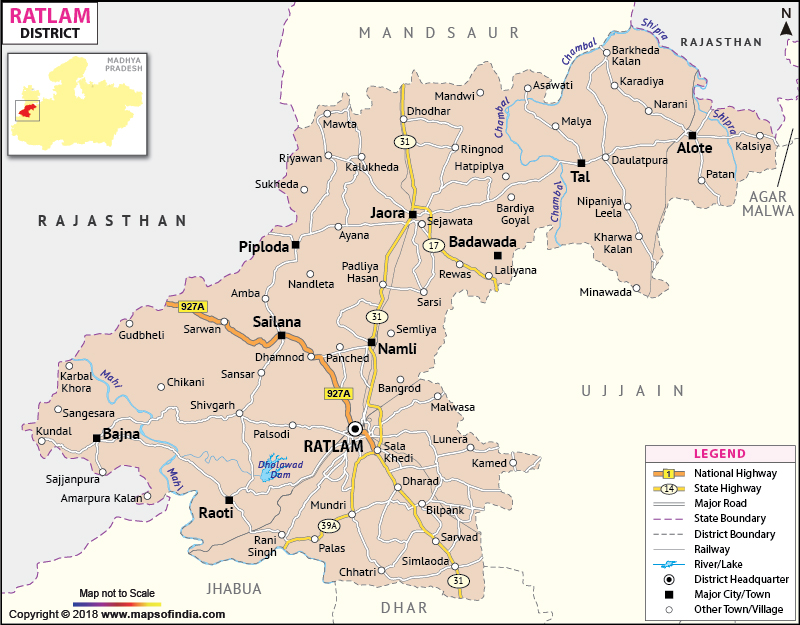
The district is a part of the Malwa plateau which is characterised with fertile black soil, moderate climate and agriculture suitability. A railroad network, spice trade and traditional food products are particularly popular in Ratlam district, especially the popular Ratlami Sev. There are three evident aspects of the Ratlam district map: the topography, the administrative units and transportation pathways. It also indicates the relationship between the district and the major urban centres like Indore and Ujjain.
The Ratlam district map also indicates a balanced development of rural and urban settlement in the district, with villages, towns and centers of economic active life spread out. It also emphasizes Ratlam as a transit and trading centre in the centre of India. The Ratlam district map also gives some idea of some of the beautiful things of nature like rivers and small range of hills that determine the geography of the district. In general, Ratlam district can be considered a place where tradition and development can co-exist in harmony.
History and Culture
The history of Ratlam district is very much associated to the history of the Malwa region as it is a centre of civilisation and a centre of political power and has been since the times immemorial. The area was originally included in the Avanti Mahajanapada, which was one of the sixteen Mahajanapadas of ancient India. It was then subdued into the control of great empires like the Mauryas and the Guptas that had role in its administration and cultural growth.
During the medieval period, Ratlam became part of the Malwa Sultanate and subsequently came under Mughal rule. The history of princely state of Ratlam in the 17 th century was a turning point. The Rathore Rajput, to whom the Mughal emperor gave the land, transformed Ratlam into a well governed and culturally rich state. Rulers of Ratlam were known to be generous in art, architecture as well as the welfare of the populace.
After India gained its independence in 1947, Ratlam became a part of the Indian Union and the Indian state of Madhya Pradesh. With the Abolishment of the reign of the princes and the birth of political democracy, there were a lot of changes in administration and development.
Ratlam district is a blend of cultures that are Malwai, Rajasthanian and Gujarati. Indian festivals like Diwali, Holi, Eid, and Navratri are celebrated with zeal and involvement of the communities. The area is especially identified with culinary, Ratlami Sev widely recognised for its unique taste and regional identity
Cultural centres, temples and traditional marketplaces, which are centres of social and economic life, are often indicated on the Ratlam district map. Folk music, dancing and local fair still maintain cultural legacy of the district. This Ratlam district map also marks the area that the tribal groups live in, which enables demonstrating the variety of traditions and ways of life in the district.
Economy
Ratlam district has a well diversified economy that is comprised of agriculture, industry, services. It has a good transport network and strategic location that contributes to its economic growth.
Government Sector is one of the key players that play a significant part in the development of the district. The policies and services are implemented by administrative offices, government institutions and welfare programmes within the region. Government run education and healthcare institutions supply most of the basic services to the population. These facilities can be observed on the Ratlam district map, which guarantees their accessibility both in the city and in the country.
Ratlam owes its excellence particularly in the Public Sector, which is represented particularly by a large division of the Indian Railways. Ratlam Junction is a busy railroad station in western Madhya Pradesh, where passengers and freight traffic is facilitated. This can make a big contribution to employment and regional connectivity. Economic activity is also supported by the public sector banks and infrastructure services. Ratlam district map indicates the railway lines, railway stations and connectivity corridors which are a core of the economy in the district.
Services Sector has been experiencing a consistent growth over the past few years. This sector is dominated by trade, transport, retail, hospitality and financial services. Ratlam city is a commercial centre where grains, spices and textile trade flourishes at the wholesale market. The map of Ratlam district is useful in revealing some commercial zones, some urban centres, where the activities which are based on service are concentrated.
Agriculture continues to be the main source of the majority of the population. The crops that are grown here include soybean, wheat, maize, gram and pulses. Rural incomes are also provided through horticulture and dairy farming. The map of Ratlam district demonstrates the irrigation sources and agricultural lands which nourish the agricultural process. Agro based industries also make the rural economy stronger.
Also small-scale industries such as spice processing and food manufacturing are of significance. The image of Ratlam, as a representative of savoury snacks, has resulted in the development of local companies, which distribute products throughout India.
Tourism
Ratlam district is home to diverse tourist attractions, which include history, religion, nature and local culture. It is not as popular as the major tourist destinations, but it has huge potential of being developed as a tourism destination.
The Kalika Mata Temple, a sacred religious place, is one of the major attractions that attracts religious people all year round. Another significant place of interest with its architectural beauty and royal legacy is found in the neighbouring town of Sailana, the Sailana Palace. These locations are pointed out in the Ratlam district map which guides visitors in the area.
A special sightseeing place is the Cactus Garden in Sailana which boasts an array of species of cactus. It is among the limited specialised gardens of its kind in India and it is a place of visit by nature lovers and researchers as well. This place is frequently a point of interest on the Ratlam district map.
All other aspects like Bilpank Mahadev Temple and Kedareshwar Temple are important religious destinations. Not only are these temples of spiritual importance, but show the architectural design of various times. In the Ratlam district map, one can easily see the layout of these locations and their availability.
Rivers, small hills and picturesque countryside are natural attractions within the district. These places provide possibilities of rest and sightseeing. Local markets such as traditional snacks, jewellery and textile to provide special shopping experience are known to be owned in Ratlam city. The Ratlam district map assists tourist in organizing their tours, plotting routes and places of interest.
On the whole, Ratlam district has a competent tourism that is slowly gaining appeal due to the development of infrastructure and advancement of cultural heritage.
Demographics
Recent estimates of the population of Ratlam district indicate that it majors 1.45 million population according to census results. The people occupy both the cities and villages with a considerable percentage of people residing in agrarian society.
The literacy level in the district is about 67 percent which makes efforts to raise the access to and quality of education. In the district, there are numerous schools, colleges and even vocational institutions which are distributed as shown in the Ratlam district map, making education accessible to various sections of the society.
The official and most used language in the district is Hindi. A regional dialect is Malwi that is mostly spoken in daily interactions. The cultural diversity of the district is also in the form of some of the other languages spoken by communities including Urdu and Gujarati.
The map of the Ratlam district suggests the information about population density and settlement patterns demonstrating the greater areas of population concentration in the territory of the urban center, e.g. Ratlam city and more dispersed population in the rural territories. The area demographic is diverse with different communities making it a rich social fabric of the district.
Administration
Ratlam district is administratively structured into a number of tehsils which aid in the administration and development at the local level. The principal tehsils are Ratlam, Jaora, Sailana, Alot and Bajna. Every tehsil is an administrative body which is charged with the responsibility of collecting revenue, law and order as well as attending to government schemes.
The district has many villages that constitute the rural economy and community. These villages have Panchayati Raj institutions which allow them to participate in local decision making and development activities. These administrative divisions are well illustrated on the Ratlam district map giving a comprehensive picture of the structures of governance.
The districts have urban centers that are governed by municipal organizations that run civic services including water supply, sanitation, and development of infrastructures. The district map of Ratlam also indicates the presence of urban centres, which is of great importance concerning their administrative role.
A District Collector heads the district administration and controls all types of departments and makes sure that government programmes are undertaken successfully. In general, the administrative structure of the Ratlam district is aimed to provide the adequate development and effective governance.
| Facts of Ratlam District | |
|---|---|
| State | Madhya Pradesh |
| District | Ratlam |
| District HQ | Ratlam |
| Population (2011) | 2365106 |
| Growth | 19.86% |
| Sex Ratio | 931 |
| Literacy | 71.62 |
| Area (km2) | 4861 |
| Density (/km2) | 299 |
| Tehsils | Alot, Jaora, Piploda, Ratlam, Sailana, Bajna |
| Lok Sabha Constituencies | Ratlam |
| Assembly Constituencies | Ratlam Rural (ST), Ratlam City, Sailana (ST), Jaora, Alot (SC) |
| Languages | Hindi |
| Rivers | ------ |
| Lat-Long | 23.33469,75.037894 |
| Travel Destinations | Bilpakeshwara Temple, Siva Temple, Veerupaksh Mahadev Temple, Shipawra Temple, Dharola Mahadev Temple, Garkhankhai Temple, Kedareshwar Temple, Amarji Temple, Ayana Mahadev Temple, Kalikamata Temple, Mahalaxmi Temple, Barbad Hanuman Temple, Gadkhange Mata Temple, Cactus Garden, Hussain Tekri, Andikalpeshwar Temple, Kharmore Bird Century, Ganga Sagar etc. |
| Government Colleges/Universities | Govt College (Alot), Govt College (Kalukheda), Govt Girls College, Govt College (Sailana), Bhagatsingh Govt PG College (Jaora), Govt Arts and Science PG College, Swami Vevekanand Govt Commerce College etc. |
FAQs
Q1: What is the total number of villages in Ratlam district?
Ratlam district has approximately 1000 villages, forming a major part of its rural structure.
Q2: What is the population of Ratlam district?
The population of Ratlam district is around 1.45 million people based on recent estimates.
Q3: What is Ratlam district famous for?
Ratlam district is famous for its major railway junction, thriving spice trade, and especially for its iconic snack, Ratlami Sev, which is popular across India.
Last Updated on : May 12, 2026
