|
||||||||||
 | ||||||||||
|





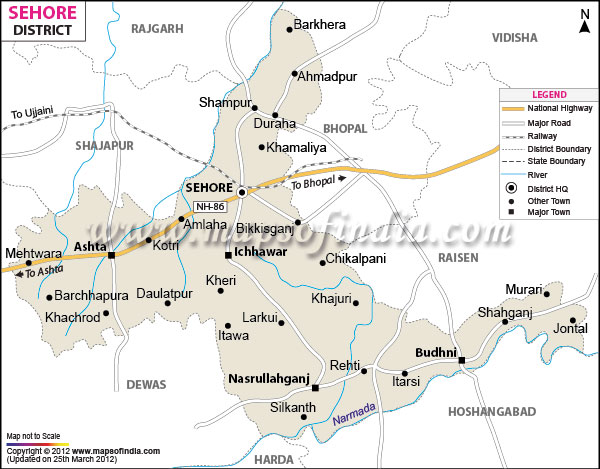
| *Sehore District Map highlights the National Highways, Major Roads, District Headquarter, etc in Sehore. |
About
Among India's central territories lies Sehore, part of Madhya Pradesh, shaped by time across eras. Its current identity traces back to older names - once called Sidrapur, transformed slowly by speech patterns shifting through generations. Rooted deeply within Malwa customs, yet touched by surrounding areas, the place holds layers built gradually over centuries. Bhopal appears nearby, positioned northeast; this proximity ensures relevance beyond mere geography. Centuries pass, but movement continues here - not loud, still constant.
Situated within the Vindhyan hill system, Sehore draws sustenance from river systems such as the Narmada, Parwati, and Kolar - each contributing to the richness of its flatlands. Across its terrain stretch rolling elevations, woodland patches, and farmland expanses, blending habitation with environmental features. Farming populations have long found support here due to land characteristics, a role the region still fulfills through output of crops including wheat, soybean, and legumes. Because it rests near Bhopal, access to city infrastructure exists alongside countryside character, allowing coexistence of township effects and rural traditions. From this positioning arises a space where urban reach meets enduring agrarian rhythm.
Once ruled by many, Sehore carries traces of changing hands across centuries. Under Mauryan and Gupta influence, then during Mughal times, each phase added quiet marks on land and life. Following those eras, the Marathas elevated its role - military focus sharpened, administration deepened. British presence brought structured learning spaces alongside military quarters, altering urban layout slowly. Among present-day streets stand places of worship, old halls, remnants speaking without words. These structures reflect shifts - not sudden breaks, but layered change over time. Identity here did not erase what came before; instead, older forms settled into newer shapes. What remains is neither frozen nor fully new - it simply continues, shaped long ago yet visible now. Through time, different beliefs lived near one another, leaving durable signs in stone and memory. Heritage does not dominate daily routine; rather, it walks beside current ways quietly.
History and Culture
Long before recorded times, Sehore took shape within ancient tales. When Rama walked these parts with Sita and Lakshmana, so the village lore goes, holiness settled into the earth beneath their feet. Far later, it was said that Patanjali, he who shaped yoga into form, sat in deep stillness at this spot. Through ages, belief systems poured into the region - not just Shaivism or Shaktism but also Vaishnavism, Jain paths, Buddhist thought, and Nath practices - all put down roots without crowding one another. Where faith planted itself, structures followed: temples rose near mathas, shrines stood close to mosques, churches formed corners of towns, each built quiet with purpose.
Once, Sehore belonged to the Bhopal estate; its path followed that of the princely state until Madhya Pradesh shifted boundaries. When Bhopal became a district in 1972, Sehore remained distinct - holding fast to roots as a center for culture and governance. Life here pulses with shared traditions. Celebrations go beyond formality - they unfold as full-hearted gatherings. During Diwali, both houses and shrines glow. On Holi, laughter rides along streets painted bright. With Eid, meals draw kin close. As Navratri arrives, melody and movement rise through neighborhoods. Folk customs, songs, and movement remain alive, carried forward across time by those who came before. What sets Sehore apart lies in its pulse - rhythm shaped by years gone by, yet felt clearly now. Not merely a place on a map, it holds echoes of the past within daily routines. Tradition here does not sleep; instead, it moves quietly through gestures, sounds, slowly unfolding. History lives not in books alone, but in steps taken each morning. Each moment becomes part of something older, wider, deeper.
Economy
Rooted in farming, Sehore's economy draws strength from rich land and steady weather. Because of these conditions, growing food remains central to daily life here. Fields stretch wide with wheat, followed by soybeans, then pulses, alongside oilseeds. Where rain falls short, canals and state-backed programs help shift what gets planted. One such effort, known as MGNREGA, quietly shapes job access across villages. Through it, labor reaches families who might otherwise go without income. Stability emerges slowly, built not on grand plans but consistent support.
Cooperative societies within public enterprises help stabilize farming economies through organized handling of harvests, including collection, holding stocks, and delivery. Instead of simple sale, crops gain worth when processed - oil extraction, grain grinding, and packaged foods create jobs along the way. Growth appears slowly in service fields, yet presence increases over time. Schools, clinics, and neighborhood shops offer work in towns, whereas closeness to Bhopal brings chances linked to movement of goods, logistics, and expert assistance roles. Artisan trades survive alongside new methods, showing how old practices fit beside current trends.
From farming through education to office work, jobs appear in many forms. Because of this variety, the local economy rests on three legs: growing crops, making goods, leaving none behind. Though fields still shape much of life here, factories gain ground slowly over years. Change moves quietly, yet it holds firm - a sign strength comes not just from roots but also from reaching forward.
Tourism
Not only monuments define Sehore's appeal - its essence lies in revealing central India’s quiet rhythm. Scattered across the land are sacred spaces, alongside stretches of untouched terrain, drawing those seeking faith or distance from noise. Worship flows through Kubreshwar Mahadev Mandir, where crowds gather under festival skies, honoring Lord Shiva in solemn numbers. Rising above flat horizons, Hanuman Tekri rests atop elevated ground, granting wide sightlines over fields and sky to visitors drawn by reverence or stillness. Elsewhere, contemplative hubs such as Siddhapur and Mathas endure, preserving knowledge passed down through generations without pause.
Among quiet hills, Sehore finds shape through nature’s touch. Rising gently, the Vindhyachal slopes invite movement - not just walking but deeper looking. Structures built long ago, some with arched entries, others with minarets, remain standing without saying much - yet their presence speaks. Faith once traveled here along different paths, settling beside one another in stone and prayer. When festivals arrive, open fields fill slowly, carrying sounds of handwork, voices, familiar scents on low firelight. Sehore offers more than sightseeing - it unfolds slowly, like stories told through stone and silence. One finds meaning where ancient paths meet quiet groves. Here, time moves differently, shaped by voices of those who once wandered these soils. The air carries remnants of hymns, verses, lives lived close to earth. Each step traces layers built long before now.
Demographics
What stands out in Sehore is how tradition blends quietly with shifts underway across central India. Backed by 2011 Census data, it counts 1,311,332 residents living within settlements ranging from compact towns to scattered hamlets. Progress shows in the roughly 71% literacy rate, yet differences persist when comparing men and women. Higher rates among males stem from long-standing educational opportunities they have held. Women's reading skills rise slowly, drawing attention from both state bodies and independent groups. Gradually, institutions - academic and job-focused - are narrowing inequality. With time, outreach efforts encouraging schooling for girls influence thinking across rural areas, then urban neighborhoods.
In Sehore, speech patterns shape part of who lives there. While Hindi holds status for government work, bringing consistency across offices, rural areas favor Malwi - a tongue filled with vivid phrases and traditional sayings. Though one enables broader communication, the other preserves intimate community knowledge. From this mix emerges a place neither fully detached nor entirely insular. Echoes of ancestors surface in melodies, wise old lines, and stories told aloud at gatherings. What survives through words stays woven into daily life without needing written records.
Young in makeup, Sehore counts many residents below thirty-five years old. Because of this, energy flows into local work life - farming, study halls, shops - and movement grows toward cities close by for jobs. Alongside age patterns, faiths mix here: Hindu, Muslim, Jain, Christian neighbors share space without tension. What holds them is shared celebration; holidays cross boundaries. Together they form ties deeper than numbers suggest.
What lies beneath Sehore’s population figures are quiet narratives - of endurance, hope, wherever lives unfold across generations. This place holds fast to heritage while moving toward new rhythms; education drives forward, young minds reach ahead, voices speak in many tongues - all shaping what comes next. Though steady in custom, change weaves through daily life without announcement or fanfare.
Administration
Governance in Sehore district operates across 6,578 square kilometers through layered yet integrated systems. Within its boundaries lie subdivisions such as Sehore, Ashta, Ichhawar, Nasrullaganj, Budni, and Shyampur - each functioning like a smaller version of the whole. Offices, marketplaces, educational institutions, and local traditions exist within these units. Beneath them spread numerous villages, holding together farming life and heritage patterns. Administration flows downward, reaching even remote areas by design. Structure supports function where rural settlements anchor daily routines and collective memory.
One thousand thirty-one villages lie within Sehore, every one governed by a local Panchayat, reflecting self-rule at the community level. Governance through Panchayati Raj allows residents to guide choices about growth, public works, yet social support. Matters such as water supply, building roads, schools, medical services form part of council discussions, where involvement shapes outcomes. From these gatherings emerges a structure shaped by citizen input, where direction comes not from above but from lived experience. In this way, authority rests close to home, guided by what communities value most.
Administration flows through tehsils, linking districts to remote settlements. From these centers, oversight extends into countryside areas, ensuring services reach far beyond urban cores. Where villages lack infrastructure, nearby towns absorb essential functions. Land documentation, income collection, dispute resolution - these duties cluster here, managed locally. Governance becomes reachable because daily needs find response close by. Offices appear alongside courtrooms, learning spaces follow, forming service clusters. Accessibility improves when people do not travel long distances.
Among daily routines in Sehore, governance shows up less in buildings than in moments that shape life. When rains fail, farmers walk miles to tehsil counters, searching for support on water access. Meetings at the village level see women voice concerns - health clinics need supplies, visits must be regular. Young adults enroll in skill workshops, hoping for steadier work down the line. During monsoon breaches or heatwaves stretching weeks, response teams shift into motion without delay. Because of such patterns, local authority feels close, woven quietly into routine struggles and small victories alike.
| Facts of Sehore District | |
|---|---|
| State | Madhya Pradesh |
| District | Sehore |
| District HQ | Sehore |
| Population | 1311332 |
| Growth | 18.22% |
| Sex Ratio | 982 |
| Literacy | 72.12 |
| Area (km2) | 6578 |
| Density (/km2) | 199 |
| Tehsils | Sehore, Ashta, Ichhawar, Budni, Nasrullahganj, Shyampur, Rehti, Jawar |
| Lok Sabha Constituencies | Bhopal |
| Assembly Constituencies | Budhni, Ashta (SC), Ichhawar, Sehore |
| Languages | Hindi, Urdu, Malvi |
| Rivers | Narmada, Parvati, Ajnal, Kolar, Utawali, Seep, Amber, Seewan, Kaliasot, Nevaj, Dudhi |
| Lat-Long | 23.213583,77.079678 |
| Travel Destinations | Ganesh Mandir, Cenotaphs Of Kunwar Chain Singh, Jama Masjid, Jain Mandir, Hanuman Phatak, Church, Gurudwara, Ramlala Mandir, Salkanpur Durga Temple, Saru-Maru Caves etc. |
| Government Colleges/Universities | Govt Degree College (Ashtha), Govt College (Budhni), Govt Degree College (Ichhawar), Govt College (Rehti), Govt Girls College, Govt College (Baktara), Govt College (Dobi), Govt Degree College (Nasrullaganj), Chandra Shekhar Azad Govt PG Nodal College, Govt College (Ladkui) etc. |
FAQs
Q1: How many villages are there in the district?
There are 1,031 villages in Sehore district.
Q2: What is the population of the district?
The population of the district is 1,311,332 (2011 Census).
Q3: What is this district famous for?
It is famous for its spiritual heritage, communal harmony, temples, shrines, and its link with Maharshi Patanjali and Lord Rama.
Last Updated on : May 12, 2026
