|
||||||||||
 | ||||||||||
|





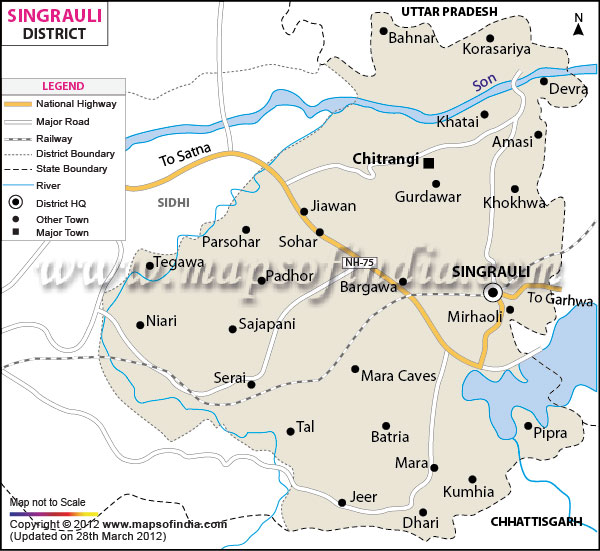
| *Singrauli District Map highlights the National Highways, Major Roads, District Headquarter, etc in Singrauli. |
About
In northeast Madhya Pradesh lies Singrauli, commonly called India’s Energy Capital. That label comes from real impact - coal deposits here fuel numerous thermal stations feeding national grids. Covering around 5,672 square kilometers, it touches Uttar Pradesh, placing it at a crossroads of terrain and trade. Waidhan serves as the main administrative center - a town transformed by waves of industry-driven growth. Factories stand beside thick woodlands, waterways weave through farmland, forming a patchwork of human effort and nature's persistence. Smokestacks rise high in some views, symbols of output and scale. Elsewhere, the calm Rihand River moves slowly, sustaining soil, crops, and lives. What defines Singrauli lies in contrast - where heavy industry meets untouched landscapes. Though known for vast coal reserves managed by Northern Coalfields Limited, it fuels much of India's power demand. Behind the mines though, live indigenous groups whose customs remain intact despite time’s pressure. Where machines dig deep into earth, forests shelter endangered species in quiet refuges. The region holds tension without breaking - factories near sacred groves, cranes beside herons. Energy flows outwards; stories stay rooted within. Not many places balance such opposing forces so closely.
History and Culture
Deep within central India, Singrauli began as part of Sidhi district before emerging separately in 2008. Long before modern borders, ancient traces linger across the land. At places such as Manda caves, stone walls carry marks left by people long gone. Because tools and pottery have been found there, researchers believe communities thrived here millennia ago. Life then depended heavily on nearby waterways and thick woodlands. Though time has worn surfaces thin, remnants still speak quietly of enduring presence. Long before modern times, people like the Baiga and Gond settled across Singrauli’s forests and hills. Their way of life persists now just as it did generations ago.
Distinct songs, ceremonies, and oral tales pass through families without fading. Celebrations shape daily rhythms - Diwali lights up homes, Holi bursts into color, yet Chhath Puja stands apart due to influences from nearby regions. Gatherings during seasonal fairs pulse with dance, handmade goods, and regional tunes. Because of its location between two states, culture here mixes indigenous roots with broader practices in quiet but noticeable ways. Though rooted in older ways, life here moves to rhythms kept alive by memory. Songs rise at harvesttime, carried on voices that learned them long ago. Stories travel quietly between elders and youth, shaping how people see themselves. Festivals bring bodies into motion, each dance step holding meaning built over time. Not merely performance, these acts weave individuals closer together. Machines arrived years back, reshaping work and daily patterns. Still, many hold tight to what came before. Old tribal habits stand beside newer routines without losing ground. This blend shows less conflict than quiet endurance. To those who study human societies, this place reveals how tradition adapts without breaking. What once was remains visible inside what now exists.
Economy
Energy production shapes most of Singrauli's economic life, leading many to call it the nation’s "Power Hub." Among India’s biggest coal deposits lie beneath this region, feeding numerous thermal stations across its land. Instead of small ventures, large-scale facilities take center stage - each producing vast volumes of electric output. State-backed groups hold strong influence; one example is NTPC, running the expansive Singrauli Super Thermal Power Station. Electricity flows outward from here, reaching homes and industries far beyond local boundaries. Beyond power firms, labor networks grow dense, offering jobs both inside plants and around them. On the extraction side, Northern Coalfields Limited operates widely, pulling resources up through organized dig sites. This arm belongs to Coal India, maintaining control over major mining zones in the north.
Activity hums steadily, linking underground wealth to national grids above. From this region, coal production supports much of India’s power supply, positioning Singrauli as central to national economic function. In addition to large public ventures, privately operated power stations now operate here, adding momentum to manufacturing growth. As factories spread, service industries follow - movement of goods, building work, shopping zones, and lodging see steady demand rise. Yet progress through industry introduced difficulties, such as harm to nature alongside shifts in population patterns. Maintaining expansion while protecting resources continues to demand attention. Even so, supplying power across India’s factories and homes defines Singrauli’s central function. The local economy mirrors today’s national path - shaped by fuel production, aided by support sectors, tied to farming roots. From governance and analysis standpoints, this place reflects potential along with layered realities within areas rich in natural assets.
Tourism
While industry defines Singrauli, quiet forests and old sites reveal a different side. Home to tigers, leopards, and more, the Sanjay Dubri Tiger Reserve shelters life beneath thick canopies. Within those woods, scientists observe patterns just as birdwatchers pause at dawn songs. Not far away, Bagdara Wildlife Sanctuary holds plants and creatures rarely seen elsewhere. Its green spaces draw people who seek stillness among trees rather than crowds. The Rihand Dam rises along the river's path, shaping water into wide views. The large water body serves farming needs along with electricity production, yet remains a quiet spot for boat rides under open skies. Ancient rock art inside the Manda caves draws attention, revealing lives long past through weathered symbols on stone walls. Green spaces surround Eco Park Jayant, built close to energy plants, offering benches and shaded paths away from city noise. Factories stand beside forests here, showing how work and wilderness exist side by side without blending fully. Visitor numbers remain low now, though signs suggest more may come when routes improve beyond current tracks. Given adequate facilities along with visibility, the region may draw people from within the country as well outside it. What sets Singrauli apart lies in how massive energy stations stand near quiet woodlands. Industrial visits coexist here alongside forest excursions, creating varied opportunities. Cultural depth emerges during community celebrations, where ancestral customs remain alive. Away from common routes, this area presents layers: manufacturing hubs, natural scenery, and traces of older times. Modern progress hums nearby ancient terrain, each shaping the character of the location differently.
Demographics
In 2011, census data showed Singrauli district counted 1,178,273 residents, placing it mid-range in terms of population size. Though schooling access has expanded due to state-run and privately operated centers, uneven outcomes persist - especially among remote villages and indigenous communities. Literacy sits at 62.36 percent, an indicator of advancement yet also lingering gaps in learning access. For every thousand men, there are 916 women, a pattern seen frequently in zones shaped by labor-driven movement favoring male presence. Most people speak Hindi, which connects different groups within the region. Still, local speech forms bring variety, shaping how culture expresses itself through words. Urban centers grow quickly where industry expands, places such as Waidhan and Singrauli changing fast. Rural areas remain rooted in farming, daily life shaped by older ways of working the land.
People arrive from nearby regions drawn by jobs linked to energy production and mining activity. These movements shift community makeup slowly over time, altering who lives here without sudden notice. Language patterns reflect these changes just beneath the surface, quietly adapting. Here comes a blend of lives shaped by movement, where varied origins meet within shared spaces. Because factories rose, so did differences in how people live, though countryside areas hold to older ways. From such shifts emerge patterns useful for those studying change - how jobs alter learning paths, reshape relationships among groups. Not fixed at all, these numbers shift slowly alongside new schools, workplaces, and wider interactions between communities. What unfolds here becomes one piece of modern India's broader transformation, seen through the lens of one changing place.
Administration
Split into several tehsils - Deosar, Chitrangi, Singrauli, Mada, Sarai, and more - the region manages local affairs through these units. Governance reaches every corner of the large district, covering numerous villages alongside urban centers. With four subdivisions, three blocks, and ten police stations, oversight matches the scale of public requirements. Key government functions operate out of Waidhan, where main administrative buildings are located. Despite its industrial profile, the region carries deep rural roots, creating complex demands for local leaders. Managing mines, energy plants, and city growth sits alongside supporting tribes, agriculture, and remote settlements. Priorities include roads, clinics, schools, and ecological balance - all shaped by overlapping pressures. State-run industries add another layer, as joint efforts between officials and factories guide planning choices. Village councils hold real influence, allowing residents to help shape outcomes through grassroots participation. Still, running Singrauli means weighing factory expansion against village needs. Though progress draws investors, people here face disruption. Each policy shift brings mixed outcomes - one step opens doors, another stirs resistance. Leaders must adapt, not just react. Solutions often emerge sideways, through listening more than planning.
| Facts of Singrauli District | |
|---|---|
| State | Madhya Pradesh |
| District | Singrauli |
| District HQ | Singrauli |
| Population (2011) | 1178273 |
| Growth | 20.13% |
| Sex Ratio | 901 |
| Literacy | 61.43 |
| Area (km2) | 5675 |
| Density (/km2) | 208 |
| Tehsils | Deosar, Chitrangi, Singrauli, Mada, Sarai |
| Lok Sabha Constituencies | Sidhi |
| Assembly Constituencies | Chitrangi (ST), Singrauli, Devsar (SC) |
| Languages | Hindi, Bagheli, Bhojpuri, English |
| Rivers | Mahan, Gopad, Sone, Mayar |
| Lat-Long | 24.166802,82.397461 |
| Travel Destinations | Rihand Dam, Tippa Jharia Dam, Rakasganda Water Fall, Mada Rock Cut Caves, Lake Park, Golden Jubilee Park, Rose Garden, Chilka Lake, Malhaar Park, Kaachan Dam, Maadi Baandh, Madwani Dam, Hanuman Mandir, Jwalamukhi Temple, Durghata Devi Mandir, Khodwa Mandir, Semra Baba Ka Mandir, Kali Mandir, Ganesh Temple etc. |
| Government Colleges/Universities | Govt College (Chitrangi), Govt College (Baidhan), Govt College (Deosar), Govt College (Baraka), Govt College (Sarai), Govt Girls College (Baidhan), Govt Girls College etc. |
FAQs
Q1: What is the number of villages in Singrauli district?
Spread out under one administration, Singrauli holds countless villages within its eight tehsils. Rural clusters fill each subdivision, shaping daily farming routines alongside local customs. Numbers shift slightly with every count or official note, yet the pattern stays clear - villages dominate here. Industry exists, certainly, but it sits beside long-standing agrarian networks rather than replacing them.
Q2: What is the population of Singrauli District?
Population data from the 2011 Indian census shows Singrauli home to 1,178,273 individuals.
Q3: What is the district famous for?
Home to massive coal deposits, Singrauli powers much of India through numerous thermal stations spread across the region. It is known as the Energy Capital of India.
Last Updated on : May 12, 2026
