






About
Vidisha district is a geographically important and ancient district in the central region of the Indian state of Madhya Pradesh. The district is named after its landmark, Vidisha, a prehistoric settlement, which has been left in the historic times as a great centre of commerce, government as well as culture. The district is located in the rich plains of Betwa and Bes rivers; it is not only a prosperous agricultural land but also has a great historical identity.
Vidisha is considered to have Sanskrit origins, and vi means apart and disha means direction and when put together, means a place where several paths or routes converge. This interpretation is much in alignment with this historic background of the district as a crossroads of trade-ways between the north and central India. The district is well connected and strategically positioned at the northeast of the Bhopal city.
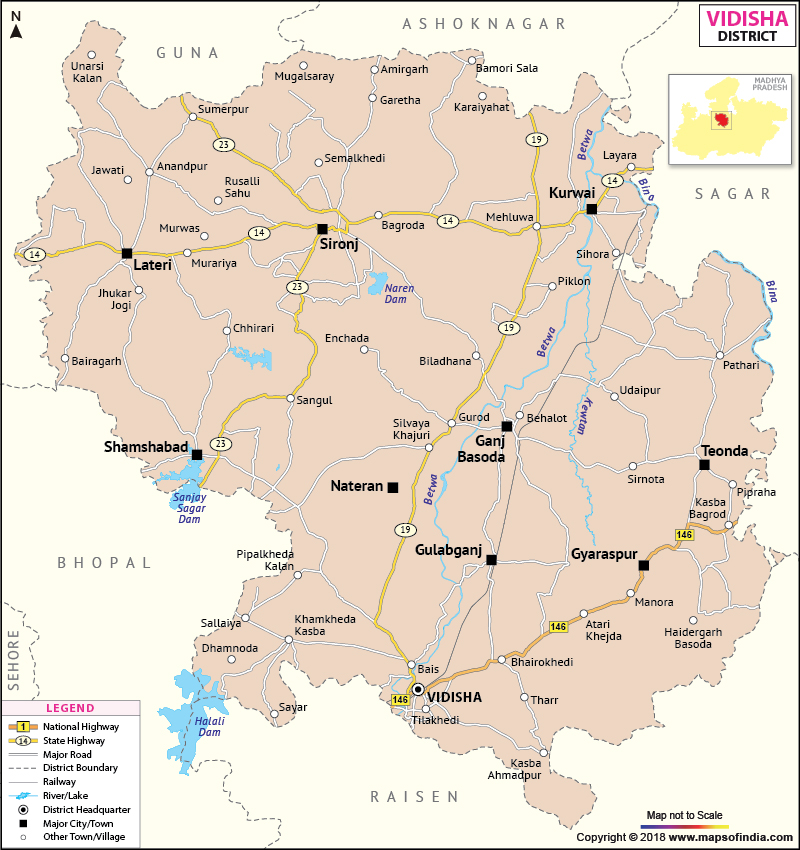
The Vidisha district map In Geography the Vidisha district map represents a topography of fertile plains with some valley and low hills interspersed by rivers. The transport infrastructure within the district, i.e., highways and railway lines linking the district with major cities is also shown in the map of the Vidisha district.
The map of the Vidisha district also illustrates its closeness to globally recognised heritage like the Sanchi Stupa and it increases its significance in the field of tourism as well as in history studies. Not only is it a centre of agricultural activity, but an archive of ancient Indian civilisation, making it an Indian region of considerable importance in the cultural geography of India.
History and Culture
The history of the area now called Vidisha is one of the most ancient in the center of India and it shows the long-standing history of human settlement and cultural development. Its area was called Besnagar in ancient times and was a prosperous city and commercial centre. Archaeological evidence tells us that it was a major trading and craftsmanship centre way pre-Common Era.
Vidisha emerged and became dominant in the reign of Emperor Ashoka during the Mauryan period. History records that Ashoka ruled this area even before he was crowned emperor and since he was related to Sanchi, a neighboring area, he was the cause of the development of some of the earliest Buddhism monuments. The map of the Vidisha district frequently singles out these locations as the important representations of ancient legacy.
The Heliodorus Pillar is one of the most outstanding historic buildings in the area as it was built in the 2nd century BCE by a Greek ambassador, Heliodorus. The pillar, which is devoted to Lord Vishnu shows early cultural interaction between India and the Hellenistic world. The site is buttressed by the Vidisha district map, which suggests that it has archaeological importance.
The district remained prosperous during the time of the Shunga, Satavahana and Gupta dynasties. The Gupta period, especially can be referred to as a golden age of Indian art and architecture and its effects are felt in the monuments of the region. One of the masterpieces of Buddhist architecture and the evidence of the artistic quality of the time is the adjacent Sanchi complex (particularly, the Sanchi Stupa). The map of the Vidisha district is also always the same; Sanchi is a key point on it.
The rural life is rich in folk traditions, music and dance. Instruments and artisans are still engaged in traditional crafts, which enrich the diversity of the culture of the district. The Vidisha district map, too, captures a great number of temples, ghats and heritage buildings that articulate the rich cultural scene of the region.
Economy
The Vidisha district economy is mainly agrarian with the fertile soil and favourable climatic conditions. With the Vidisha district map, it can be observed that agricultural land occupation is extensive thus farming is the main source of livelihood to most of the people.
Another source of employment is the government service sector, education and healthcare under the sector of administration. The district has decentralized government offices, schools and hospitals thereby ensuring that important services are accessible. Vidisha district map is also a regularly utilized map in developing and implementing development projects.
The government has a significant input in terms of building infrastructure and support of agriculture. The river-based irrigation systems which are based on the river betwa and tributaries are also very vital in crop farming. Crops such as wheat, soybean, gram and mustard are dependent on these water resources as indicated by the Vidisha district map.
The rural economies of cooperative societies and government programmes have empowered them through giving them access to credit, seeds and new farming practices. These efforts have augmented productivity and income levels in the district.
Services industry continued to grow especially in cities. Services offered in the growth of the economy include trade, retail, education, healthcare and transportation. The district headquarters is a commercial centre and the small towns are becoming a local centre of trade. These economic zones and connection are located with the help of the Vidisha district map.
Another significant source of the economic development of the district is tourism. Existence of historical sites like Sanchi and Udayagiri also brings many visitors, which helps in making the local businesses profitable. These tourism routes are clearly marked on the map of the Vidisha district, indicating their significance in terms of economic importance.
In general, an economy of the Vidisha district is an equal mixture of the traditional agriculture and the new service-based activities with the help of the government and civic sector.
Tourism
Vidisha is a large historical and cultural tourist centre in central India. The Vidisha district map is an important map that can guide the various visitors in the many attractions that it has to offer.
The most prominent tourist site where there is no doubt about this fact is the Sanchi Stupa. Being a UNESCO World Heritage Site, it is one of the best examples of Buddhism architecture all over the globe. Its historical and complex carvings appeal to both scholars and the tourists. This site is dominant in the Vidisha district map.
The other attraction worth visiting is the Heliodorus Pillar that provides an invaluable idea about the ancient diplomatic and cultural relations. This enhances its historical contexts and inscription that make it a major archeological site as evident in the Vidisha district map.
The other major attraction is the Udayagiri Caves. These are the cave rock cut caves of the Gupta period that are known to be decorated with ornate carvings such as the well known Varaha sculpture. One of the most important destinations of the ones who are interested in ancient art and architecture can be said to be Udayagiri as it could be spotted in Vidisha district map.
Vidisha town alone contains some temples and ghats of the Betwa River which contains the religious history of the region. Other adjacent areas that are covered in the Vidisha district map are Gyaraspur which contains ancient temples and sculptures.
In conclusion, the historic monuments, religious significance and natural landscape are some of the aspects that determine tourism in the Vidisha district that render the district a good tourist destination.
Demographics
The recent census estimates the population of Vidisha district to be about 1.45 million. The tangible population is largely rural and a high percentage of the population live in villages. Vidisha district map shows how the population is distributed in various areas.
The literacy rate stands at 70-71 reading the educational quality at a slow pace of improvement. Male literacy is the greatest when compared to female literacy but there have been efforts to lower this. There are learning institutions all over the district as indicated in the Vidisha district map.
The main language spoken in the district is Hindi, with regional dialects being commonly spoken in the rural countryside with Bundeli being one of the dialects. The culture is diverse with diverse populations represented by different communities and social groups.
In general, the Vidisha district demographics indicate that it consists of the traditional rural environment and slow urbanisation.
Administration
This district has several tehsils, which administratively fall under the district of Vidisha. They include Vidisha, Basoda, Kurwai, Lateri, Sironj, and Shamshabad. These departments help in good governance and development at the local level. These are well defined administrative units as seen on the Vidisha district map.
The district has over 1,500 villages which are the core of the rural economy and society of the area. The local government is executed by way of panchayats which perform a critical role in executing government schemes and the community needs.
A District Collector heads the district administration, which is assisted by officials who head different departments like revenue, law and order, education, and healthcare. The Vidisha district map is commonly applied in the administrative planning and resources distribution.
The development programs aim at enhancing infrastructure and healthcare, education and livelihood of the rural areas. The level of administration to the other level brings about coordination that promotes the proficiency provision of services. The map of the Vidisha district assists in choosing the specific areas on which it is necessary to focus when developing and planning.
In general, the administrative structure of Vidisha district supports the good administration and even regional development.
| Facts of Vidisha District | |
|---|---|
| State | Madhya Pradesh |
| District | Vidisha |
| District HQ | Vidisha |
| Population (2011) | 1873046 |
| Growth | 22.85% |
| Sex Ratio | 965 |
| Literacy | 62.7 |
| Area (km2) | 7362 |
| Density (/km2) | 198 |
| Tehsils | Basoda, Gulabganj, Gyaraspur, Kurwai, Lateri, Nateran, Shamshabad, Sironj, Tyonda, Vidisha |
| Lok Sabha Constituencies | Vidisha |
| Assembly Constituencies | Vidisha, Basoda, Kurwai (SC), Sironj, Shamshabad |
| Languages | Hindi |
| Rivers | Betwa, Bina, Halali |
| Lat-Long | 23.946096,77.836532 |
| Travel Destinations | Udaigiri Caves, Holiodorous Pillar, Vijayamandira Temple, Maladevi Temple, Hindola Torana, Bajramath Temple, Udayeshwara Temple, Gadarmal Temple, Dashavtar Temple, Sola-Kambi Temple, Girdhari Temple etc. |
| Government Colleges/Universities | Govt Sanjay Gandhi Smrati College (Ganjbasoda), Govt College (Kurwai), Govt College (Nateran), Govt Lal Bahadur Shastri College (Sironj), Govt College, Subhadra Sharma Govt Girls College (Ganjbasoda), Govt College (Govt College, Lateri), Govt College (Shamshabad), Govt Girls College etc. |
FAQs
Q1: What is the total number of villages in Vidisha district?
Vidisha district has more than 1,500 villages, forming a predominantly rural settlement pattern.
Q2: What is the population of Vidisha district?
The population of Vidisha district is approximately 1.45 million, based on recent census data.
Q3: What is Vidisha district famous for?
Vidisha district is famous for its historical heritage, particularly the Sanchi Stupa, Heliodorus Pillar, and Udayagiri Caves, which highlight its ancient cultural significance.
Last Updated on : May 12, 2026
