

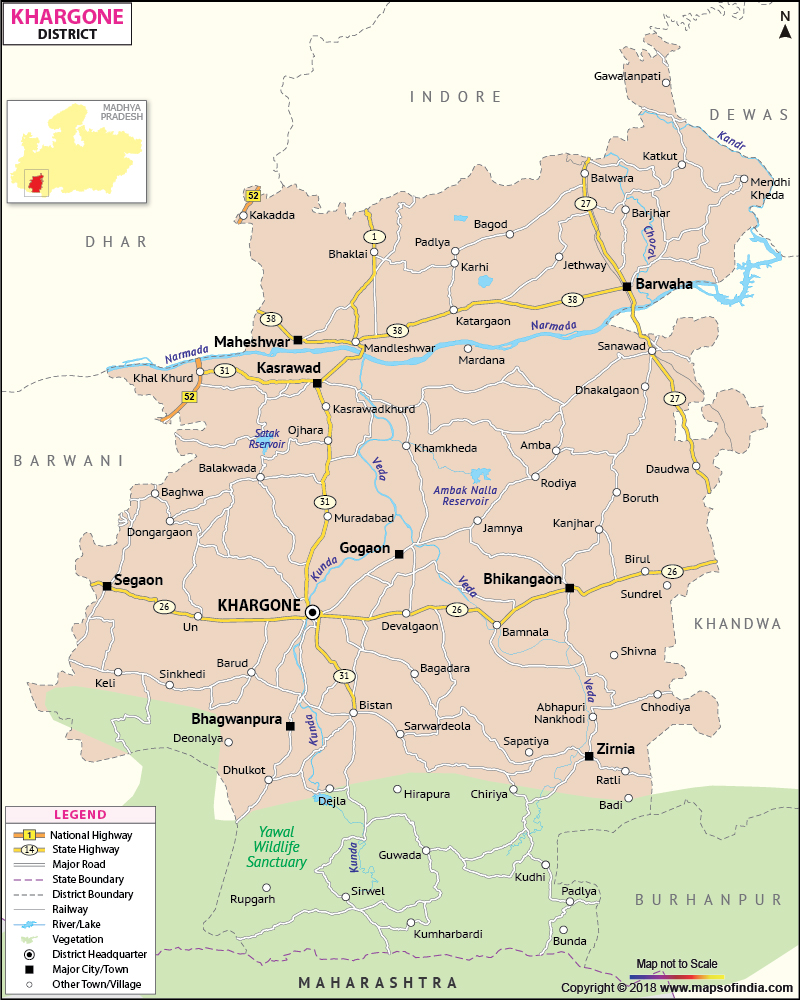





About
Khargone district of Madhya Pradesh is a fertile land in the south-western region of the state which is situated on the Narmada River banks. The region, traditionally called West Nimar, was shaped by different dynasties, such as the Marathas and British, which shaped the administrative and cultural environment of the region. It is an agricultural-based economy, the major crops grown on the black soil plains are cotton, soybean, wheat and chili.
History and Culture
Khargone district can be traced back to the rich history and culture of ancient heritage with the influence of the region and the development of the social practice deeply rooted in the Nimar region of central India. Historically called West Nimar, the region has been occupied since the early days because of its fertile land and closeness to the Narmada River that has been sustaining agriculture, trade and dwelling. Over the centuries the region fell under the rule of a number of different ruling powers, as the Paramaras, the Mughals and then the Marathas left their own mark on the administrative and cultural organization of the region.
The rule of Ahilyabai Holkar who was one of the most respected rulers of the Malwa region is associated with a great phase in its history. Through her capital at Maheshwar Fort, she encouraged temple building, dharmashalas and activities to benefit people, most of which remain today as reminders of architectural and spiritual relics. Maheshwar in particular evolved into a great cultural and religious hub, with its characteristic ghats, temples and traditional weaving.
The district is an ideal combination of tribal and non-tribal cultures. A large part of the population is composed of local tribes like Bhil and Bhilala who inhabit the region and maintain their traditions, celebrations, and lifestyle that make the region unique. Their cultural manifestations are folk dances, music, and rituals which have a close association with nature and agricultural cycles. Coexisting with the mainstream practices of Hinduism are these traditions which have led to a diverse and inclusive cultural set-up.
The presence of religious life is significant in the elaboration of the local culture. There are also popular festivals like Diwali, holi and Navratri and local fairs that unify communities. The river Narmada are the sites of religious activities, such as pilgrimages and rituals, which are part of daily life. The district has a continuity of historical temples and Shrines due to their representation of local worship.
A cultural heritage is also constituted by art and craftsmanship. The weaving of Maheshwari handlooms dates back to Maheshwar, it is especially famous for producing good quality sarees; their distinguishing features are the fine design and the light weight of the fabric. This art is a classic not only in artistic merit but also in the incomes of numerous local craftsmen.
Economy
Khargone district has a relatively agrarian economy mainly due to its rich soils and climatic conditions and the availability of Narmada River. Agriculture is the principal mode of earning a living to a big percentage of the population and especially in the rural villages. Cash crops like cotton and soybean as well as staple crops like wheat, maize and pulse are well cultivated in the region. Cotton, specifically, has a great economic value and is part of the cotton belt of central India, which identifies with the district.
The contribution of irrigation is vital in agricultural productivity and water supplied by the Narmada and canal systems supports agriculture activities. Allied industries like dairy farming and animal rearing also complement the rural incomes in addition to crop farming. Agro-based industries such as oil mills, cotton ginning units and food processing establishments have been built around agro-based products that provide employment in the region, and complement the rural economy.
The handloom industry also plays a role in bringing economic activity particularly in regions related to traditional weaving. Maheshwari sarees, with its fine texture and the unique designs are fabricated by skilled workers and are appreciated in markets outside the region. This art not only retains the cultural legacy, it also presents a form of sustainable business to most of the families found to be practicing the art of weaving and other related activities.
Local markets serve to facilitate trade and commerce within the district linking agricultural producers and consumers, as well as traders. Mandi systems and weekly markets are important in the process of exchanging goods and especially agricultural goods. The connectivity of roads has also improved with time and therefore goods transportation to the surrounding urban centers has been smooth and has improved economic integration with adjacent areas.
The service sector is slowly rising as a result of expansion in education, healthcare, banking, and retail services. Education institutions and the small businesses are also helping in generating employment, therefore, to the youth. Economic development has also been facilitated by government programs related to rural development, development of infrastructure and skill development.
Although this has developed, some challenges are still there. Reliance on agriculture exposes the economy to uncertainties in the amount of rainfall and market prices.
Tourism
The historical heritage, religious importance and picturesque landscapes along the Narmada River define tourism in Khargone district. The Maheshwar Fort that showcases the architectural and cultural heritage of Ahilyabai Holkar is one of the important places in the region.
Maheshwar is also recognized as a peaceful location and its significance in terms of religion. Ghats of Narmada river are significant venues of ritualism and day-to-day veneration and they attract pilgrims and tourists. The serene environment of the surrounding, the historical buildings and the structures of the city contribute to the town being a significant source of cultural tourism. There are temples which are devoted to different gods, where visitors can observe the traditional forms of the building and the domestic worship.
Another aspect about tourism in the district is that it is connected with the handloom weaving. Locally made, the maheshwari sarees draw attention from travelers who value regional craft and handmade goods. Because they seek authenticity, visitors often visit weaving studios - to observe techniques and purchase genuine textiles. These visits sustain artisan livelihoods, while strengthening community-based industries through direct engagement.
Across the region, seasonal gatherings often reflect deep-rooted customs and shared beliefs. Because of vibrant local heritage, events such as Navratri bring people together through dance, worship, and collective celebration. Instead of mass attractions, travelers now show interest in village experiences - drawn by open landscapes, farming practices, and indigenous ways of living. These moments, shaped by rhythm and routine, reveal what many seek: connection without performance.
Demographics
The demographic picture of Khargone district is of a diversified and rural population, which is predetermined by the agricultural nature and the tribe roots. The Census 2011 data indicate that the district has a population of more than 1.8 million with a gradual increase in population because of natural growth and gradual urbanization. A high percentage of the population stays in villages and towns like Khargone and Maheshwar are considered as local centers of trade, education as well as government.
The high level of presence of tribal populations, especially Bhil and Bhilala, is considered to be one of the major characteristics of the demographics of the district. There is coexistence of other caste and community groups, which compose a socially diverse world. The official and spoken language is Hindi whereas the common language is Nimadi. The language also speaks tribal dialects in the interior regions depicting linguistic diversity.
The age distribution of the age group is relatively young with the substantial percentage of people belonging to the working-age population. This offers economic growth prospects particularly when it is backed by education and job prospects. The literacy level in the district is improving gradually but in certain rural and tribal regions, the literacy levels are low as compared to national levels. The government efforts as well as the growth of schools and colleges has been a source of greater awareness and access to education.
The district is mainly Hindu with some smaller numbers of Muslims and other groups which form the pluralistic society. The life of the community is mostly dominated by religious practices and festivals which tend to unite individuals belonging to various classes of society.
Urbanization is also having a slow effect on demographics of rural centers as individuals move out of the regions to towns seeking improved jobs, educational institutions and health amenities. This has resulted in the growth of cities and towns and a rise in infrastructure and civic amenities. Simultaneously, a significant part of the population remains to rely on agriculture and traditional occupations to survive.
Administration
The administrative system of Khargone district has been set in such a manner that it targets efficient governance, development, and providing of the services of the government. The district administration of Madhya Pradesh is led by a District Magistrate (DM), commonly referred to as the Collector who ensures law and order in the district, carry out government policies and oversee development work carried out by the departments. The DM is the key administrator in the management of revenue, disaster management as well as the schemes of the public welfare.
Each district is divided into several tehsils and development blocks to ease management tasks. Because of these smaller units, governance spreads out, improving efficiency across villages and small towns. Local decision-making gains strength through the Panchayati Raj framework in rural regions. While handling community needs, Gram Panchayats manage nearby resources directly. Janpad Panchayats coordinate between village groups and higher authorities. At the top tier, Zila Parishads guide broader planning efforts across entire districts.
The district has urban areas governed by municipalities, such as Nagar Palika (municipal councils) and Nagar Panchayat (town councils). These organizations have the mandate of offering basic civic services like water supply, sanitation, and road network, waste disposal and the health of the populace. Elected members such as the chairperson and the members of the ward, meet with administrative officials to see that the bodies are properly functioning.
Under the supervision of the Superintendent of Police (SP), law and order is maintained with the district police reporting to him. The distribution of police stations and outposts is very strategic, making them effective to keep the environment safe, prevent crime, and respond to emergency situations. Liaison between the police and civil administration is needed in ensuring the state of stability and security.
Politically the district has both members of state and national legislators who are elected as members of the Legislative Assembly (MLAs) and Members of parliament (MPs). The district has different divisions of government that promote development programs such as the health and education, the agriculture sector and the public works department.
| Facts of Khargone (West Nimar) District | |
|---|---|
| State | Madhya Pradesh |
| District | Khargone (West Nimar) |
| District HQ | Khargone |
| Population (2011) | 1054905 |
| Growth | 17.97% |
| Sex Ratio | 1008 |
| Literacy | 66.87 |
| Area (km2) | 8010 |
| Density (/km2) | 233 |
| Tehsils | Khargone, Gogawan, Bhagwanpura, Segaon, Maheshwar, Bhikangaon, Jhiranya, Barwaha, Kasrawad |
| Lok Sabha Constituencies | Khargone |
| Assembly Constituencies | Bhikangaon (ST), Badwah, Maheshwar (SC), Kasrawad, Khargone, Bhagwanpura (ST) |
| Languages | nimadi, gujrati Bareli Palya, |
| Rivers | Narmada, Kunda, Veda |
| Lat-Long | 21.943046,75.824432 |
| Travel Destinations | Dejla - Deora, Rajrajeshwar Temple, Mahalaxmi - Narayan Temple, Great Peshwa Baji Rao 's mausoleum, Navagraha temple etc. |
| Government Colleges/Universities | Pandit Jawahar Lal Nehru Govt, Govt College (Bhikangaon), Govt PG College, Govt Degree College (Mandaleshwar), Degree College (Barwaha), Govt College, Govt Girls College, Govt Degree College (Sanawad) etc. |
FAQs
Q1: How many villages are there in the district?
1,421 villages.
Q2: What is the population of the district?
1,873,046 (2011 census).
Q3: What is this district famous for?
Maheshwar, Navgraha Temple, Sahastradhara, Raverkhedi (Peshwa Bajirao Samadhi), Oon Temples, Mandleshwar, and Sirvel Mahadev.
Last Updated on : May 12, 2026
