





| Nalgonda District Fact Sheet | |
|---|---|
| District | Nalgonda |
| Headquarters | Nalgonda |
| Population (2011) | 3483648 |
| Area ((/km2)) | 14240 |
| Denisty ((/km2)) | 245 |
| Literacy | 0.6505 |
| Forest Area under the control of Forest Department (Area in Hectares) | 83073 |
| Temple | Yadagirigutta Lakshminarasimha Swamy Temple Pangal |
| Languages Official | Telugu, Urdu |
| Mandals | Bommala Ramaram, Yadagirigutta, Tirumalagiri, Atmakur (S), Mothkur, Bhongir, Choutuppal, Narketpally, Kethepally, Mothey, Penpahad, Nalgonda, Marriguda, Nidamanoor, Garidepally, Mellachervu, Neredcherla, Peddavoora, Nampally, Gundlapay, Turkapally, Alair, Thungathurthy, Jajireddigudem, Atmakur (M), Bibinagar, Ramannapeta, Kattangur, Suryapet, Nadigudem, Vemulapally, Munugode, Chandur, Tripuraram, Chilkur, Huzurnagar, Damercherla, P.A.Pally, Chintapally, Chandampet, Rajapet, Gundala, Noothankal, Saligowraram, Valigonda, Pochampally, Chityal, Nakrekal, Chivemla, Munagala, Thipparthy, Narayanapur, Kanagal, Miryalaguda, Kodad, Mattampally, Anumula, Gurrampode, Devarakonda |
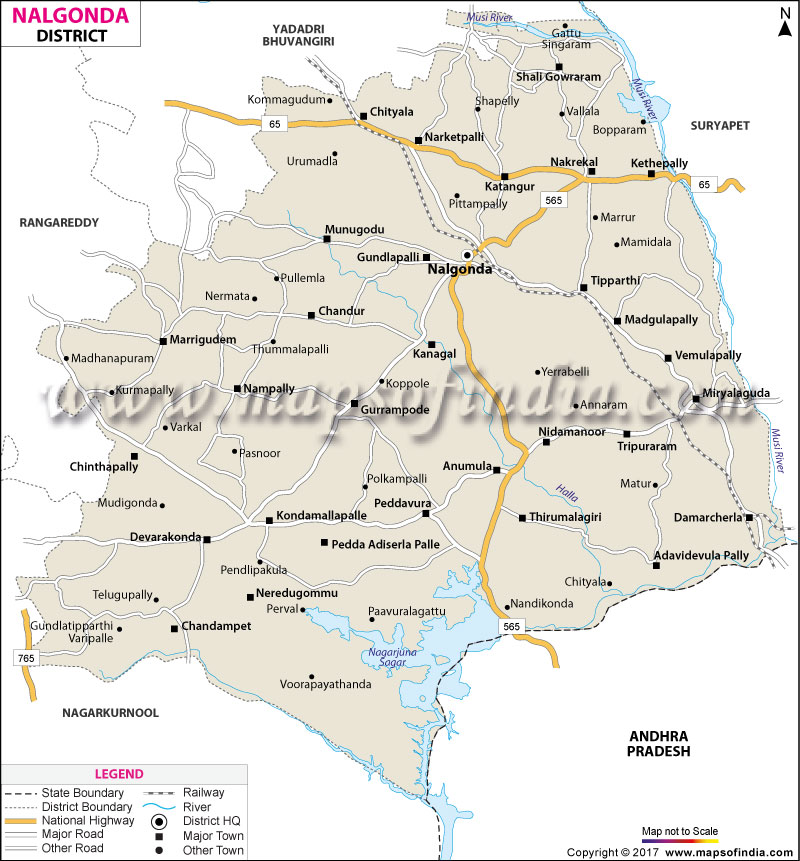
Nalgonda District Map (Telangana) |
|
||||||||||
 | ||||||||||
|
| *Nalgonda District Map highlights the National Highway, Major Roads, District Headquarter, etc in Nalgonda. |
| Districts of Telangana |
 |
 |
 |
 |
| Adilabad District Map | Nalgonda District Map | Mahbubnagar District Map | Medak District Map |
 |
 |
 |
 |
| Khammam District Map | Warangal District Map | Rangareddi District Map | Karimnagar District Map |
 |
 |
||
| Nizamabad District Map | Hyderabad District Map | ||
About
Nalgonda is located in the south of Telangana. For several decades now, this area has been one of the most recognized districts in that part of Telangana. With transport, it is a major highway connecting the Deccan Plateau and the coastal plains of South India. Beyond transport, it is also an important farming district and a center of ancient religious and historic attractions. That means, Nalgonda literally means "Black Hills", the name given to the black granite rock and tall hill formations that cover the region. In the time when this region was under the rule of local Rajput and Hindu kingship, the area was called Neelagiri which means "Blue Mountain". Measuring over 7122 sq. km area it is the second big district of Telangana after Hyderabad. The Krishna River is flowing near the southern boundary and rivers like Musi etc. tributary the main river and have created very fertile fields which are ideal for agricultural activities on a large scale.
History & Culture
Nalgonda's rich past extends from time immemorial. Paleolithic and Neolithic Age man was identified there thanks to the discovery of stone implements, microliths, and Megalithic burials (cromlechs and dolmens) - ancient relics uncovered after the archaeological excavations of the district. Old Regimes - The Satavahanas were succeeded by the Ikshvaku Dynasty. They ruled from Vijayapuri (now Nagarjuna Sagar) and made the area a center of Mahayana Buddhism. From the 6th to 12th century CE, the controllers of that particular stretch of land were the Badami Chalukyas, Rashtrakutas, and Kalyani Chalukyas which were the medieval Times. During their rule, the Later Kakatiya Dynasty between the 12th and 14th centuries made an enormous number of artistic and sacred buildings, for instance in place like Panagal. Warangal was conquered by the Bahmani Sultanate. Though the power was shared between the chief of the area (Recharla Nayakas of Devarakonda), the Bahmani Sultanate, and the Qutub Shahi dynasty of Golconda it was still the same time of transition. Asaf-jahi Dynasty's Liberation Movement: When Nizam-ul-Mulk founded a kingdom in 1724, he named it after his family, the Asafis, and this continued till India's Hyderabad Province was established as a separate dominion at the time of Partition in 1948. To put it rightly, Nalgonda was the most severely affected area during the Telangana armed resistance (1946, 1951). It is a historical truth that this movement of the people against the landlord-feudal system i.e. Vetti system + Nizam's regime has raised their problems.
Cultural Heritage & Traditions
Nalgonda reveals a mix of native Telugu and Deccani-Islamic cultures. There are many festivals - Bathukamma (a floral festival to honor Nature and Goddess Gauri), Bonalu (a festival to Goddess Mahakali), Sankranti, Ugadi Eids Diwali. Local temple jataras (fairs) such as Panagal Chaya Someswara Swamy Jathara and Latif Saheb Urs attract thousands of devotees. Arts and Handlooms: Handloom weaving traditions are the district's specialties, in particular around the village of Chandur and its neighbors, making cotton dhotis, sarees, and textiles.Cuisine: Nalgonda represents Telangana culture very well. The place has limited traditional Telangana cuisine options including Jawar Roti (sorghum flatbread), Pachi Pulusulu (uncooked hot tamarind-based soup), spicy lamb curry and a side of Gongura chutney & Kudumulu, the most popular item here.
Economy
1. Government Sector
Government has been playing an instrumental role in developing water supply, power distribution networks, and farming subsidy systems: Waterworks Development: Irrigation schemes like the Nagarjuna Sagar Left Canal, AMRP (Srisailam Left Bank Canal project), and Kaleshwaram lift irrigation extensions have helped to increase the area under cultivation in the district. Government-run Utilities: Significant government presence can be seen in the Food Corporation of India (FCI) grain warehouse, Telangana State Power Generation Corporation (TSGENCO) thermal and hydro power generation units, and an array of Rythu Bazars (agricultural market yards).
2. Industrial & Public Sector Enterprises
Nalgonda industrial corridors have industrial units which are supported by easily accessible raw materials: Cement Industry: Miryalaguda and surrounding areas have become cement production centres mainly due to the presence of high-grade limestone near the Krishna basin. Some of the top cement companies in the country have cement plants here. Agro-Processing & Rice Mills: One of the biggest parboiled rice milling clusters in Asia is found in the city of Miryalaguda. Rice is imported here from the fields in the Krishna basin and then packaged and sent across the country. Power Generation: The Nagarjuna Sagar Dam complex offers hydroelectric power while there are also thermal power developments on a large scale like the Thermal Power Station, Yadadri in Dameracherla mandal.
3. Services Sector
The service industry is, yes, one of the major economic engines of these towns - Nalgonda, Miryalaguda, Devarakonda - and a high number of their urban residents are working there. As far as commerce and logistics go: Owing to its location on National Highway 65 that connects Hyderabad and Vijayawada, Nalgonda is mostly a hub point for goods transportation between these two cities and a place to stop and refuel or rest if needed. Besides, it's definitely an excellent place for business development. So, a number of people find jobs at least partly related to transport, goods trading and services provided by the shops, stores, and eateries along the way. In other words, it is a place where businesses thrive, services are being rendered and money is being earned. Finance & Education: Employment is fostered through the existence of the various commercial banks, agricultural credit cooperatives, government polytechnics, degree colleges, and medical institutions. Retail & Services: These are the markets that deal with the distribution of goods like agricultural inputs, machinery, textiles, construction materials and Healthcare services which are very important to the needs of the entire district.
Tourism
1. Nagarjuna Sagar Dam & Nagarjunakonda: The very attractive Nagarjuna Sagar Dam, a dam on the Krishna River, is one of the most visited tourist places in India. Being a masonry dam is one of its prides, and it is 124 meters in height; apart from that, it has also been turned into a very big artificial lake. There is an excellent opportunity to observe the flow of the Krishna River from the Nagarjuna Sagar dam. One is literally situated in the reservoir area. Besides Buddhist relics, there is also an island museum housing restored Buddhist stupas and sculptures dated back to the 2nd century BC.
2. Chaya Someswara Swamy Temple (Panagal): This is, in fact, an exceptional specimen with architectural traits peculiar only to the Kakatiya style, still clearly visible in the temple even in the small nearby village of Panagal (4 km away from Nalgonda). An interesting architectural aspect of this temple is that during certain times of the day the sunlight casts a shadow (Chaya) on the Shivling without disturbing it because the Shivling remains there and it is only the sun that seems to be moving. To create this steady shade picture the light is deflected with the help of pillars so that the shade does not move due to the changing light source coming from a moving sun.
3. Devarakonda Fort: Built by the Padma Nayaka (Recharla Nayaka) kings in the years around the 13th and 14th centuries AD, the Devarakonda Fort is built over 7 encircling hills. Its walls are now crumbling, the granaries, Bastions, and stone gateways are all there to tell us a medieval military story at least through its architecture.
4. Phanigiri Buddhist site: Phanigiri is a very old Buddhist site situated on an elevated land area. After an excavation of the site, a researcher came into possession of relics like viharas or monasteries, stupas, and panels from sculpted limestone which were representations of the Buddha's life events.
5. District Heritage Museum, Panagal: A museum is situated on the outskirts of the Panagal temple that displays various stone sculptures and tools made of stone, which are remnants of the prehistoric era, old coins, copper plaques & some weapons.
Demographics
Nalgonda is one of the districts of ANDHRA PRADESH in India. The district as per Census 2011 has a population of 34,88,809 with a significant contribution to the demographic profile of the state. The population is divided into 17 59 772 males and 17,29,037 females. It continues to be the key district for the development of the region's economy and administration. 983 females per 1000 males is the sex ratio in Nalgonda district which is equal to or even somewhat higher than the national average. This measure indicates gender balance and prevailing social conditions. The demographic structure of this place has witnessed transformation throughout the different Census time periods. Nalgonda district has a literacy rate of 57.36%, which indicates the educational development at a regional level. The gender gap for literacy is 19.9 percentage points; the literacy rates of boys and girls being 74.1% and 54.19% respectively. Education in general is the focus area for the government at this local level as well. The district has been further subdivided into 59 talukas (townships), each functioning as a unit of Administration, Governance, and Data Collection. The district is spread over an extensive geographical area and population densities change drastically from one area of the district to the other.
Administration
Local government is carried out in Nalgonda district at revenue divisions and mandals (tehsils) levels. Nalgonda Division mandals list: Chityal Kanagal, Kattangur, Nakrekal, Nalgonda, Narketpally, Shaligowraram, Thipparthy, Kethepally and Ammanabolu.Miryalaguda Division: Dameracherla, Muryalaguda Vemula Pally, Anumula (Haliya) Nidamanur, Peddavoora Tripuraram Madugulapally, Thirumamalagiri Sagar, Adavi Devulapali. Devarakonda Division: Chandampet Chintapally Devarakonda Gundlapally Kondamallapally, Pedda Adiserla Pally Neredugommu Gurrampode, Gudipally. Chandur Division: Chandur Munugode Gattuppal, Nampally, Marrigudo.
| Facts of Nalgonda District | |
|---|---|
| Official Name | Nalgonda |
| Location | Telangana |
| Area (km2) | 293.87 |
| Population | 34,88,809 |
| Language | Telugu, Urdu |
FAQs
Q1: What is the population of Nalgonda district?
The district has a population of 34,88,809 people as per 2011.
Q2: How many villages are in Nalgonda district?
It has 23 inhabited villages.
Q3: What is the literacy rate of Nalgonda district?
The literacy rate is 57.36%.
Q4: Which language is mainly spoken in Nalgonda district?
Telugu is the main spoken language.
Q5: What is Nalgonda district famous for?
Nalgonda district is famous for the engineering landmark Nagarjuna Sagar Dam and the Chaya Someswara Swamy Temple.
Q6: Which major highways pass through Nalgonda district?
National Highway 65 (NH-65), which connects Hyderabad and Vijayawada, passes directly through the district.
Last Updated on : September 01, 2026
