






About
One of the oldest but geographically important districts in the central Indian state of Madhya Pradesh is Jabalpur district. It is widely assumed that the name Jabalpur was coined out of the word Jabal which translates to mean rocks or stones and when one looks at the symbolic marble structures and the rough topography of the district, the meaning becomes clear at the very outset. Jabalpur is a major administrative, cultural, and economic centre found in the Mahakoshal region of the state.
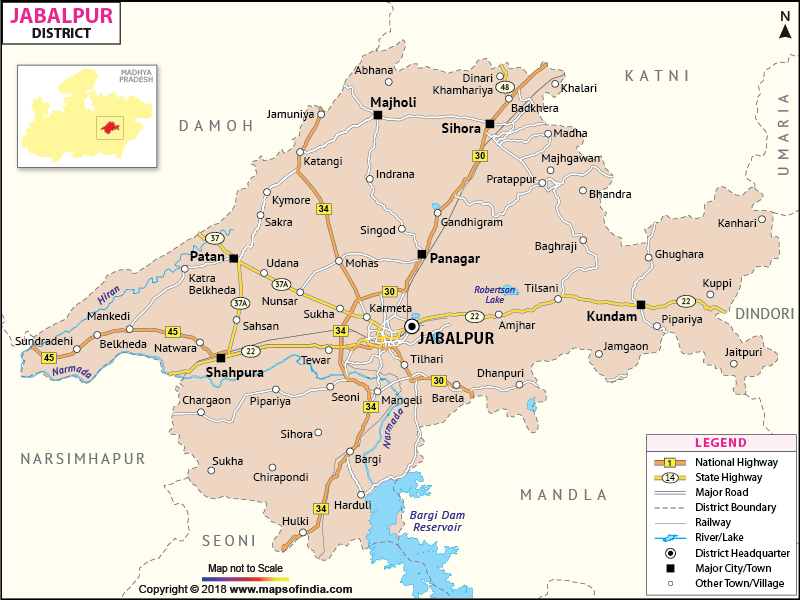
The district is located in the most strategic places on the banks of the river Narmada which is an important natural resource as well as economically. The river is also the one that determines the landscape as well as affecting agriculture, tourism and livelihoods of the locals. A glimpse at Jabalpur district map shows that it is centrally connected as it is connected to Mandla, Seoni, Katni and Narsinghpur district. Trade and Movement has traditionally rendered it an object of trade and movement.
The area is also famous in regard to picturesque beauty most prominently the marble rocks of Bhedaghat and the Dhuandhar Falls which are a tourist attraction among the country. Further Jabalpur is well endowed with institutions such as the defence establishments, learning institutions, and administrative offices. Its vast rail and road network, as illustrated in the Jabalpur district map, also supports the fact that it is a transportation hub.
All in all Jabalpur district is a unique mixture of natural beauty, historical heritage and contemporary growth that is why it is one of the most noticeable districts in Madhya Pradesh.
History and Culture
The history of Jabalpur district is interwoven with the ancient, medieval and colonial influence. In historical contexts, the land belonged to Gondwana kingdom and the Gond rulers ruled the land making a memorable impact on the culture of the land. Rani Durgavati is considered to be one of the greatest personalities of Jabalpur who had become a brave queen of Gond opposing the expansion of Mughals in the 16 th century. Her heritage is greatly imprinted on a local consciousness.
In the medieval times, the district fell under the control of the Mughal Empire and Marathas. At some point of time, it was incorporated into British India where it was used as a key administrative centre. The British created cantonments and brought in modern infrastructure and this was the basis of the current development of the district. Even the Jabalpur district map as per the historical records indicates its importance with regard to strategic location.
Tribal society, especially Gond and Baiga tribes, cannot but impact the life of the art, music, and rituals in the district. The folk songs and dances commonly tell a story of nature, courage and everyday life. This is because, in the Jabalpur district map, geographical boundaries are expressed, but in a symbolic way, they reflect cultural diversity that is diffused through the villages and towns of the district.
Moreover, Jabalpur has played a significant role in literature and education, and a number of institutions provided intellectual development. The culture in the district is, therefore, a rich seminary plate made out of the experience in the past and the diverse communities in the district.
Economy
Jabalpur district has a well balanced economy with contribution by the government, public sector and the services sector. Its central location as depicted on Jabalpur district map is instrumental towards supporting economic activities.
As an administrative centre, Jabalpur holds a great significance on the government sector. It contains offices of different government agencies; high courts and departments in different regions. These institutions provide employment to a large number of people and contribute to the district’s economic stability.
Jabalpur has a great strength of the public sector. The area hosts a number of military institutions such as military bases, ordnance factories, etc. These facilities are considered to be within the top employers in the region and significantly contribute to the defence infrastructure in the country. Such institutions are obviously indicated in the Jabalpur district map with spatial intensity.
There is an expression of a significant growth in the services sector in Jabalpur in the past few years. Two key contributors are education and healthcare. There are universities, colleges, and specialised training institutes in the district which appeal to students throughout the region. On the same note, the hospitals and health facilities do not only cater to the district, they also cater to neighbouring regions.
The local economy also involves the trade and commerce. The picture in the city of Jabalpur is quite active in its market, with agricultural products, textile, and consumer goods. The connectivity reflected on the Jabalpur district map further boosts trade whereby the district is connected to the major cities and markets.
Rural people continue to rely on Agriculture as a means of a living. Wheat, paddy, pulses and oilseeds are common crops. The river Narmada and its tributaries offer vital irrigation to the region and hence the productivity in the agricultural sector. Jabalpur district as a whole is an economy that is characterised with a strong institutional base, diversification and stability in growth.
Tourism
One of the most promising characteristics of Jabalpur district is tourism due to its unusual nature of intertwining of nature and history. The Jabalpur district map is a frequent guide to the traveller as he/she visits its many attractions.
Bhedaghat is one of the most well known sites as it is home to the beautiful marble rocks lining the Narmada River. These rocks present a spectacular view more so when one rides a boat. Close to this is the Dhuandhar Falls, where the river cascades down creating a misty spectacle which is worth its name, translating to smoke cascade.
The other notable place of interest is the Madan Mahal Fort that is a reminder of the Gond legacy of the region. The fort is built on a hill therefore gives an overall view of the locality like it has been shown on the Jabalpur district map.
There are also many temples and religious places in the district, including the historically and architecturally valuable Chausath Yogini Temple. The temple gives a peaceful feeling and it is an insight into the ancient religious habits.
Parks, museums and shopping areas are the types of places of interest that can be found in the city of Jabalpur to provide the visitor with a balanced experience in the city. Jabalpur district map assists tourists to have an easy time exploring these varied places. Simply put, Jabalpur district is a guaranteed vacation spot, with an eclectic mix of natural attractions in addition to its cultural and historical locations.
Demographics
Jabalpur district has a diverse and dynamic population. This is based on the available statistics that show that the population in the district is near about 2.46 million. This renders it to be among the most populous districts in Madhya Pradesh.
The literacy percentage of Jabalpur district is quite high as compared to most of the other districts in the state and its literacy is about 81 percent. It is an indicator of a high level of educating the district and having a great number of educational institutions.
The language used in the district is Hindi which is the major language and the medium of communication. Moreover, there is also speaking in regional dialects and tribal languages, showing the diversity of the cultural background of the district.
There is a good balance in the distribution of population within and outside urban and rural areas with a large number of people living in Jabalpur city. The Jabalpur district map reflects such distribution as there are urban centres with a great population and the rural areas with the low population density. In general, demographics of the Jabalpur district portrays the region in terms of its educational development, cultural diversity and equal population distribution.
Administration
The Jabalpur district is well administered with several subdivisions and tehsils in order to enhance proper governance. The district is further divided into a number of tehsils which include Jabalpur, Sihora, Patan, Shahpura among others. Each of the tehsils is entrusted with the local administration and collection of revenue. The district contains a huge amount of villages, each of which is governed by a local self-government. All these are important agricultural and cultural villages of the district.
It is accompanied by a government structure that has a wide array of government offices and government departments scattered all over the district. These administrative units are briefly presented in the map of the Jabalpur district and can be useful in the planning and administration. District government is focusing on development projects, infrastructure development and welfare programmes to its citizens. A good relationship between different administrative units implies that they will go hand in hand and provide services.
Besides its tehsil based system, Jabalpur is also mainly supported by the well established system of local self-governance in form of Panchayati Raj system. Gram Panchayats work down to the village levels where there is a participation of the grassroots in decision making and implementation of development programmes. These local bodies are the key component of solving problems that include sanitation, rural infrastructure, water supply and social welfare schemes among others that enhance the democratic control of the bottom level government.
Moreover, the legal system and judicial bodies are highly represented in Jabalpur district. The district has an organised system of police stations, courts and regulators which provide law and order and deliver justice. The district is a significant part of the legal system of Madhya Pradesh as it harbors major courts of justice. This is a management effectiveness, which aids with the general growth and assists with the stability of both urban and rural regions.
| Facts of Jabalpur District | |
|---|---|
| State | Madhya Pradesh |
| District | Jabalpur |
| District HQ | Jabalpur |
| Population (2011) | 3276697 |
| Growth | 32.88% |
| Sex Ratio | 928 |
| Literacy | 80.87 |
| Area (km2) | 5210 |
| Density (/km2) | 472 |
| Tehsils | Jabalpur, Kundam, Majholi, Panagar, Patan, Shahpura, Sihora |
| Lok Sabha Constituencies | Jabalpur |
| Assembly Constituencies | Patan, Bargi, Jabalpur Purba (SC), Jabalpur Uttar, Jabalpur Cantt., Jabalpur Paschim, Panagar, Sihora (ST) |
| Languages | Bagheli, Hindi, Bharia |
| Rivers | Narmada, Son |
| Lat-Long | 23.382598,80.033798 |
| Travel Destinations | Madan Mahal Fort, Rani Durgavati Museum, Pisanhari Ki Madhiya, Chausat Yogini Temple, Tripur Sundari Temple, Dumna Nature Park, Bargi Dam, Dhuandhar, Bedaghat etc. |
| Government Colleges/Universities | Jawaharlal Nehru Govt. Agriculture University, Rani Durgavati University, Govt Modal Science College, Govt M H College of Home Science & Science for Women, OFK Govt College (Khamaria), Govt College (Majholi), Govt College (Patan), Govt Shyam Sundar Agrawal College (Sihora), Govt Mahakaushal Arts and Commerce College, Govt Autonomous Mankunwar Bai Arts and Commerce College for women, Govt College (Kundam), Govt Arts College (Panagar), Govt Girls College (Ranjhi), Govt College (Barela) etc. |
FAQs
Q1: What is the total number of villages in Jabalpur district?
Jabalpur district has over 1,400 villages, forming a significant part of its rural landscape.
Q2: What is the population of Jabalpur district?
The population of Jabalpur district is approximately 2.4 million people.
Q3: What is Jabalpur district famous for?
Jabalpur district is famous for its marble rocks at Bhedaghat, the Dhuandhar Falls, and its historical and cultural heritage.
Last Updated on : May 12, 2026
