






About
Surrounded by a barren laterite ground that flows into majestic ravines that the wind has carved out, and Sal trees weaving together like arms between the bushes, is the essence of rural Bengal. This area, accounting for the Midnapore district which was unified prior to the bifurcation of the same in administrative format on 1st January, 2002, has significant historic importance in the area covered by it. Even the term ‘Medinipur' comes from the word ‘Medini' which means ‘the earth' or ‘mother soil', and shows the agricultural heart that is the blood-pulse of millions residing in these plains. Almost 9,295 km² of land area is bounded and has appreciable geographical significance in the southwestern segment of West Bengal.
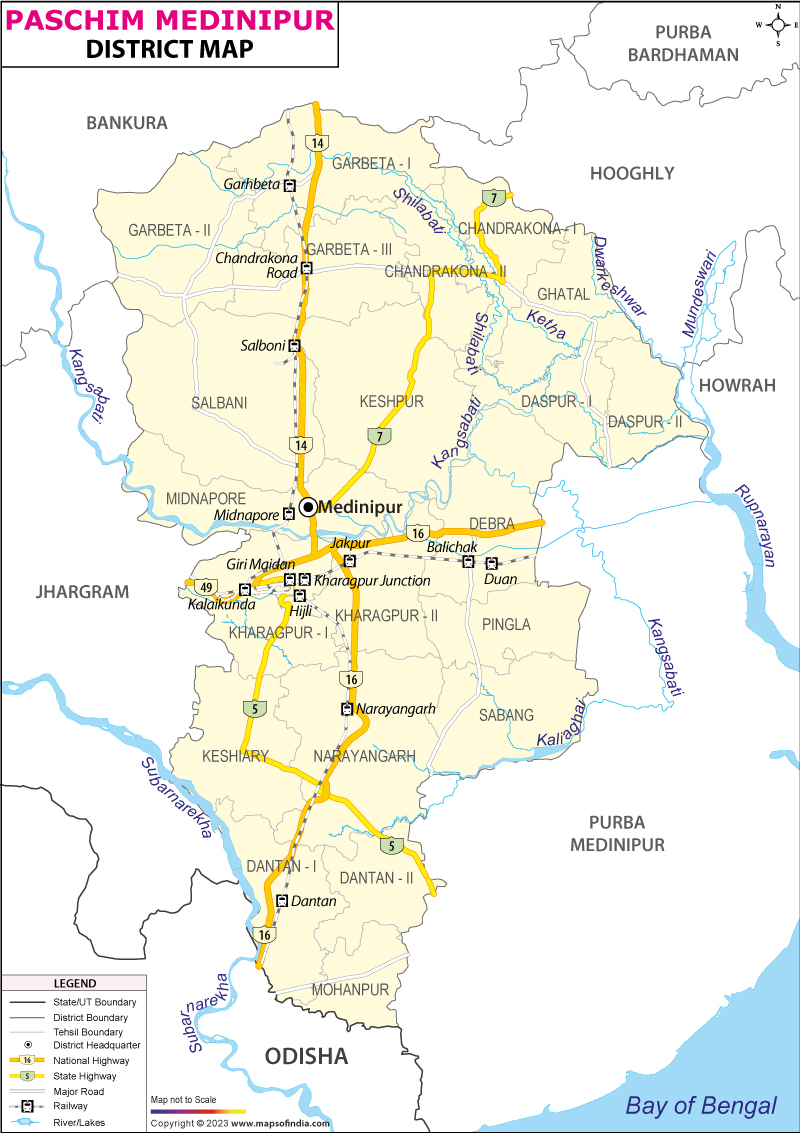
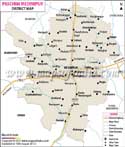
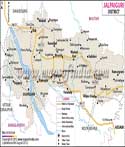
The district is found in a strategic location and is bounded by Bankura district in the northeast, Purba Medinipur district in the east, Jhargram in the west and in the south by Mayurbhanj and Balasore district in Odisha. The district is a mosaic of cultures, high academic standards, successful businesses and historic sites. These geographical along with cultural features are clearly represented in the Paschim Medinipur district map.
History & Culture
History is not just a drum in the worn, faded pages here; it's a drum that stirs feelings of war shaking through long ages. By studying the outline of a historic Paschim Medinipur district map, one can gain insights into the colourful activities of travellers and pilgrims from throughout the world who led the way and propelled the ancient trade roads. Also, through the historic Paschim Medinipur district map, one can get to know the activities of travellers and pilgrims from all over the world who sailed the ancient trade roads with their presence.
The dark times of Bengal were clouded by the darkness of colonial rule and Paschim Medinipur rose like a defiant volcano. In the western tracts, where the forest was terrorised by wild animals and the forest native tribesmen fought for their ancestral rights against the British East India Company. Later on, Paschim Medinipur became the undisputed hot spot of the Indian freedom movement.
The names of those martyrs who laid down their lives in the fight for the Indian national flag during the Quit India movement and those young firebrands like Khudiram Bose went down in golden letters in the national consciousness. An analysis of the Paschim Medinipur map during the era of the freedom struggle would throw light on how the tiny villages in the rural areas emerged as revolutionary strongholds, such as the parallel administration of the people.
Culturally, the district exuded an unrivalled folk genius to captivate art enthusiasts from around the world. The core of this artistic history is the Patuas, or scroll painters, who unroll their artful length-long scrolls illustrating epic legends and contemporary social events, and recite narrative ballads of folk art called Pater Gan. To this visual legacy is added the thunderous energy of the Chhau dance, in which masked performers jump up and down through the air in martial acts while the Tusu and Bhadu folk songs, full of soul and haunted, resonate into the rural villages. Books of the district's socio-religious schedule are filled with great gaiety during Durga Puja, Kali Puja and Ras Yatra, when rare type of lighting and traditional music makes the quiet towns glitter and open open-air theatres for traditional cultural activities.
Economy
The economy of Paschim Medinipur is a unique three-part mix of tradition in agriculture, extensive trade, and a growing corporate services business. The primary sector plays an important role in the rural economy of this part of Bengal, which is one of the most important agricultural breadbaskets in the Bengal region, with the fertile alluvial basins yielding unparalleled crops of rice, potatoes, oilseeds and betel leaves. The district has been mostly economically divided from west to east of the district with the agricultural hinterland in the west and high-density industrial nodes.
In the Government Sector, there's massive state and central civil employment, educational institutions, health care networks and public works projects. The district headquarters provide leadership for the extensive rural development programmes, forest conservation projects and systems of support to farmers of scale, all of which employ thousands of local people.
In terms of the Public Sector, public sector undertakings are of critical importance to the economy of the area. Furthermore, employment levels and the growth of ancillary industries are enormous in the state-controlled, enterprise-led major refineries, fertiliser production companies and large-scale steel manufacturing plants.
From the point of view of the services industry, it is flourishing in the wake of a very fast urbanisation of the educational corridor. On the other hand, some premier institutes like the Indian Institute of Technology, Kharagpur bring foreign research and development, incubation of technology and consultancy services into the local economy. At the same time, information technology, banking, and hospitality, logistics, retail, and healthcare services are all still growing at a strong pace and see the former crossroads of yesteryear develop into vibrant urban trading hubs.
Tourism
When one unfolds a Paschim Medinipur district map, there are a number of shocking ancient ruins, wonders of terracotta, and restful sanctuaries of forests. The pictures of every landmark are carved in stone, clay, or old tree bark and they bear a story.
Gangani is often called the Grand Canyon of Bengal and is located in Garhbeta. Incredible fiery orange and deep crimson Sunset colours are seen in dramatic cliffs and the cavernous gorges which stretch through hundreds of years of the Silabati River's formation from erosion. Visited and experienced as if on an alien planet, these rugged clay canyons are interesting.
The magnificent fort built by Gajapati king Kapilendra Deva sometime in the fifteenth century was converted into a mosque in Mughal times. It is the huge stone arcades encircling its outer limits and ancient carvings on the courtyards, each of which recounts an old story of medieval conquests lost.
On the Paschim Medinipur district map, seeing the historic town of ‘Chandrakona’. Here, beautiful 17th and 18th-century temples made of terracotta remain as a legacy of classical temple architecture of Bengal. The Malleshwar Temple and the vast ruins of the complex of the Shobhabati Fort house embedded in the brickwork some very complicated scenes depicting the battles of the Ramayana and Mahabharata.
Hijli Detention Camp was set up by the British in a peaceful town called Hijli near Kharagpur, where then Several freedom fighters were taken prisoner. Today, this authentic historic site is dedicated to the martyrs and freedom fighters from the land of India and is now a part of the campus of IIT Kharagpur.
Exploring the Arabari thick forest areas of Paschim Medinipur offers a tranquil green zone for nature lovers, tracing the Paschim Medinipur district map. It was here that ‘Joint Forest Management’ took root in India and pioneering forest conservation experiments were born. Enjoyers of art come to the village of Naya in Pingla to see all the houses made into an outdoor art gallery with self-made natural dye scroll paintings. Together, these features create a distinctive regional identity that can be explored through the Paschim Medinipur district map.
Demographics
A Paschim Medinipur district map is used to depict demographic indicators which reveal a rich, diversified and rapidly growing population. Official census data shows there are almost 5.94 million people residing in the district. The demographic balance shows a high rurality and the villages extend out along the undulating contour lines of the forest and river going through valleys. The area also has a large proportion of indigenous tribal population, mainly Santhal, Munda, Lodha and Bhumij.
All walks of society have made significant advances in the field of education. The overall district's literacy rate is very high at 79.04%. Male literacy rates and female literacy have been steadily improving towards transformative growth with targeted rural education programs and increasing school infrastructure.
An understanding of a linguistic heritage can be acquired with the aid of a Paschim Medinipur district map featuring high level of harmony and depth of cultural heritage. The primary language of the population is 'Bengali' which is also the official language for governance, literature and daily use. The language of the Santhali is very prestigious in the tribal community and is used in writing Ol Chiki.
Administration
Serving a territory with such a population density, history, and size will require a strong and well-structured system of governance. In the year 2002, the undivided area was divided into two administrative areas— Purba Medinipur and Paschim Medinipur- for easy administration. Upon examining the administrative Paschim Medinipur district map, one can see a hierarchical organisation that allows for the delivery of civic services and development projects to all citizens of thousands of villages in the rural areas and blocks in the urban areas.
There are three sub-divisions and twenty one community development blocks in the district. This system of such large size consists of thousands of villages in the countryside, and the number of townships administered under municipal management is large. District Magistrates form the backbone of the system, who oversee civic works, police, revenue and social welfare matters under the Sub-Divisions and Block Development Offices. Every community in the village has its own Gram Panchayat which is responsible for democratic governance at the grassroots level and comprises thousands of these community Panchayat members.
Digital governance projects have been vital to modern civic management practices thanks to their ability to improve public services, land registries and disaster management activities. Clean drinking water works, rural electricity and shelter developments for disaster risk reduction have had inevitable expansions thanks to the state's ongoing investment in infrastructure that's sorely needed there. When law is required, district collectorates work closely with local police networks, both urban and forest reserves, to ensure order and peace in the district.
FAQs
Q.1: What is the population of Paschim Medinipur?
The district has approximately 5.94 million residents.
Q.2: How many villages are in the district?
It comprises 8,694 villages in total.
Q.3: What is the literacy rate?
The overall literacy rate is 79.04%.
Q.4: What is the district headquarters?
Midnapore town is the administrative headquarters.
Q.5: What languages are spoken here?
Bengali, Santhali, Odia and Hindi are spoken.
Q.6: What is the "Grand Canyon of Bengal"?
It is the Gangani laterite gorge in Garhbeta.
Q.7: How many subdivisions are there?
There are three: Medinipur Sadar, Kharagpur, and Ghatal.
