






About
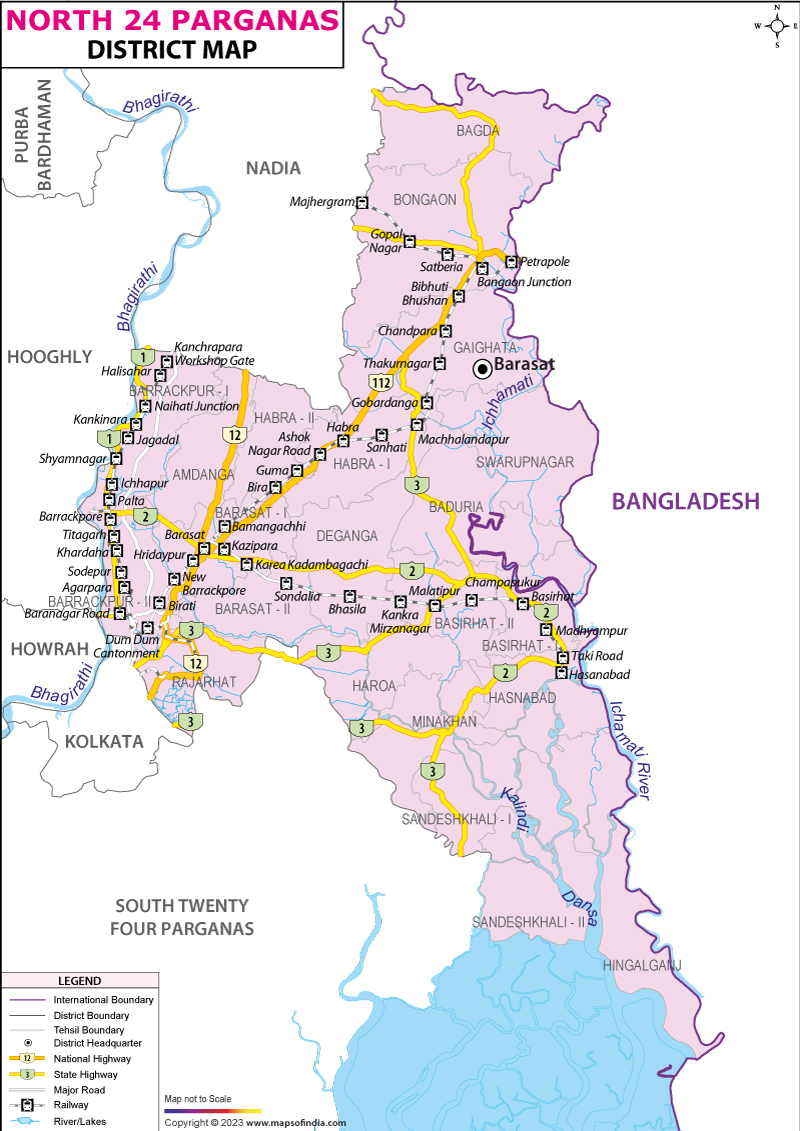
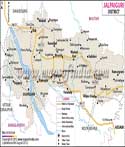
If we look at the district map of the area, it goes from the busy city of Kolkata, including roadways, railroads, industries, houses, offices, and densely populated areas, to the peaceful countryside fields, marshes, and rivers of Taki. The district is really exciting because it shows the variety of different terrains.
It has some of the densest urban areas of West Bengal as part of it, and yet it is largely rural.
It has rich historical culture and background, and is famous for the Durga Puja celebrations. It's home to the famous Bankim Chandra Chattopadhyay. Its exposure to Kolkata has, as expected, influenced its growth, yet the region's history predates the development of the modern city.
History & Culture
Many of history's pieces reside in the rivers, old settlements, temples, archeological sites, and border towns. Barasat is the district headquarters, and the five subdivisions are Barasat Sadar, Barrackpore, Basirhat, Bangaon, and Bidhannagar - these units together make up the whole administrative system of the district.
The history of North Twenty-four Parganas is built around that of the much larger historical district, the Twenty-four Parganas. In the later Mughal period, this area was under the jurisdiction of Satgaon (the old Saptagram), in association with which, of course, it also was in the early Mughal period, and then with Hooghly Chakla under Murshid Quli Khan.
As the British became the administrators of Bengal, they started restructuring the Province. In 1751, the position of zamindar was occupied by John Zephaniah Holwell. In 1759, the Company handed over the region as a personal jaghir to Lord Clive. Then, the region went back to the Company. These borders did not remain static for long. The British administration divided and redivided the Province of Bengal by taking out or adding districts to it.
In 1793, the Sundarbans were annexed to the area of Twenty-four Parganas. Over the years, the boundaries of this district experienced a series of alterations. A new collectorate was constituted in 1814, and afterward, a number of territories from surrounding places were added to the district. Another change was that the district center was shifted from Kolkata to Baruipur in 1824 and to Alipore later in 1828. During a few months in 1834, Alipore and Barasat were divided.
In the twentieth century, some other changes also took place. Some pockets of the Sundarbans were segregated in 1905 and integrated with Khulna and Barishal. The partition of India in 1947 brought a complete change in the eastern part of the country. The makeshift line between the two India-East Pakistan, and after 1971, India and Bangladesh, transformed the lives and settlement patterns of thousands of people. Migration from former East Pakistan largely assisted in the development of a few towns and localities in the bygone North Twenty-four Parganas.
This former Twenty-four Parganas remained one district for a long period of time because administrations were not divided into local administrative structures. The division of the Twenty-four Parganas district into two districts of North and South Twenty-four Parganas was recommended by an administrative reform commission under the chairmanship of Dr. Ashok Mitra. On 1 March 1986, the Twenty-four Parganas district was officially divided into North and South Twenty-four Parganas districts.
North Twenty-four Parganas district was set up with Barasat as its administrative headquarters, initially comprising five administrative subdivisions. In fact, apart from the administrative division, the district is also of a wonderful historical importance in regard to archaeology and religion. For example, Chandraketugarh is an archaeological site with an occupied, settled ancient human habitat since the ancient period. Artifacts of porcelain clay sculptures, coins, and pots coming into the light of the Chandraketugarh exhibit the ancient trade and urban civilization of the place. Also, many believe the site was formed by the Gangaridai, a country mentioned by ancient Greek historians. Yet, its assumption can not be held by 100% surety. Another important religious monument that has a significant historical value of history is the Adyapith Temple in Dakshineshwar.
The culture and history of the Twenty-four Parganas district are rich and have been preserved beautifully still today. Far from only preserved, the cultures and history in the Twenty-four Parganas district are also subject to continuing development. The residents observe many festivals in the year, like Durga Puja, Kali Puja, Saraswati Puja, Rath Yatra, Janmashtami, and so on. Besides, many museums and research centers are kept in preserves today to record and keep the culture and history of the area.
For example, the new city, New Town, in the Twenty-four Parganas District has the memorial to Rabindranath Tagore, Rabindra Tirtha. The strange topography of North Twenty-four Parganas has played an important role in evolving the economy of this region. Agriculture and fishing continued to be the mainstay of the rural pockets while an urban belt emerged around the axis of industry, trade, information technology, and services. More often than not, the economy of the district seems to be an extension of a shift from the old Bengal to the new Kolkata metropolitan. A significant rural community still relies on farming.
Economy
Throughout the district, farmers grow rice, vegetables, and other crops, while fishing is mostly prevalent in areas close to rivers, wetlands, and water features. Farm-based markets serve the smaller settlements and connect to neighboring towns, providing a system of small-scale trade and agro-based enterprises. Barrackpore is situated on the Hooghly-side belt, where there is a long industrial history.
Jute engineering, manufacturing, and other enclaves got developed in Barrackpore because of its closeness to Calcutta and the transport networks. Rail and waterways assisted the industrial cities, and the labor supply strengthened the manufacturing zone.
Bidhannagar and New Town present the latest chapters of the economic saga. Salt Lake Sector V has evolved into one of the leading IT and ITES hubs in the Kolkata metropolitan circle.
Workplaces of domestic and foreign companies have drawn a considerable working community in the area and have also helped in the spread of banking, restaurants, retail stores, hospitality, transportation, and other supporting sectors. New Town is playing new angles in this development story.
Parts of North 24 Parganas are now considered as substantial parts of Kolkata's urban economy where planned residential areas, commercial complexes, tech firms, and modern infrastructure can be found.
Travel and Tourism
When it comes to North 24 Parganas, it is the variety of different experiences you can get by moving along the landscape that is really attractive. Chandraketugarh is all about its history under the modern ground.
The archaeological remains of the ancient settlement from several thousand years ago and the relics obtained from the area confirm trade and cultural exchange. Adyapith Temple appears to create a spiritual aura around.
This shrine is exclusively dedicated to Adya Ma, and a large number of pilgrims visit the place at any time of the year. The association with the worship of Sree Annada Thakur makes it a very important site. What you can see at the new town, Rabindra Tirtha, is entirely different.
It is not an ancient temple or archaeological remains, but the contemporary way of life of the region. The complex is devoted to Rabindranath Tagore, and it includes a gallery, a library, a seminar hall, and a music room.
Taki is a border town with the Icchamati River being the main attraction. We can take a nice walk along the riverside and also the place is famous for its durga puja celebration.
A peaceful riverside trip can be a nice change from the hustle and bustle of nearby big cities. The Kali Temple at Dakshineswar is arguably still one of the most popular sightseeing spots in the country. Its strategic position on the banks of the Hooghly, a very picturesque temple complex, as well as the temple's connection to Rani Rashmoni and Sri Ramakrishna, make this holy spot infinitely more important for visitors.
Population
The district covers an area of 4094 sq Km with a population of 10009781 as per 2011 census. The population density is around 2959 per square km. The literacy rate stands around 87.66 in percentage after efforts by government to increase literacy in the area. The sex ratio is also very distinctive of 982 females per 1000 males. If we look at the report then the 88.91% of the population spoke Bengali, 7.69% Hindi and 2.28% Urdu as their first language.
Administration
North 24 Parganas was the most crowded district in the State. It had a population of about 10 million people, and this population figure as 2011 census. The district has a particularly high rate of population density, with over two thousand four hundred and forty-five people per square kilometer. These statistics become clear when you look at the terrain characteristics of the region.
There has been rapid development in the northern and western portions of the district, which are quite close to Kolkata. Areas such as Dum Dum, Baranagar, Barrackpore, Bidhannagar, and New Town house. The northern and eastern parts of the district are predominantly agricultural with villages.
Bengali is the main language of the district. Yet, Hindi and Urdu, plus other languages, are also used, mainly in the commercial, urban, and industrial sections.
Barasat is the headquarters of a district in the West Bengal Presidency Division. This district has 35 police stations, 22 development blocks, 27 municipalities, 200 gram panchayats and 1599 villages. The local units of the district are divided into 5 subdivisions: Barasat Sadar, Barrackpore, Basirhat, Bangaon and Bidhannagar.
Barasat Sadar includes the municipality of Barasat. Plays a key role in the development of the district. It is an area that is closely connected to the planned expansion of Salt Lake and the surrounding metropolitan region. Because of this the district administration has to manage two different situations at the same time.
On one side there are the populated city areas and industrial towns. On the side there are rural farming communities, marshy lands and border settlements. These two sides of the district present different needs and challenges. The district administration must balance growth with rural development. It must support urbanization while also taking care of agricultural livelihoods and remote areas. The work is complex. Necessary, for the overall progress of the district.
FAQs
Q.1: What are the major subdivisions of North 24 Pargana?
There are 5 maor subdivisions.
Q.2: What is the male-to-female ratio of the district?
The ratio is 982 females per 1000 males.
Q.3: In what languages do people mainly speak in Uttar 24 Pargana?
People mainly speak in bengali over here with some people speaking hindi.
Q.4: Which festival is very popular here?
The Durga Puja is a very popular celebration here.
Q.5: When was Uttar 24 Pargana district formed?
It was formed in 1986.
