






About
Perched in northeastern Rajasthan, India, Churu district earns its nickname as the entry point to the Thar Desert. Movement through Churu blends commerce, tradition, and passage across regions. Reaching deep into desert realms from northern zones passes inevitably through here.
Founded centuries ago, the name "Churu" traces back to regional tales and historical records. Believed to have taken shape in the early 1600s, it emerged through the efforts of a Jat leader called Chuhru, whose modest outpost eventually expanded into a recognized township carrying his identity. Although vast - covering nearly 16,830 square kilometers - the landscape reveals itself through drifting dunes, sparse thorny vegetation, alongside stretches of stony flatlands shaped by time.
Churu stands out across the region because of its wild weather patterns; winters plunge to near-zero levels while summers soar past 50°C, making it one of India’s most climatically intense zones. Though small in size, the area holds weight through its central hub - Churu town - which governs clusters of older settlements known for ornate havelis, long-standing trade dynasties, and landscapes rich in both history and ecology.
History & Culture
Long before maps marked its borders, Churu belonged to shifting sands and defiant lineages. Ruled under the umbrella of Bikaner's royal domain, it remained restless at heart. Power sat not in palaces alone but across scattered strongholds held by Thakurs who valued self-rule above allegiance. Their control persisted through careful alliances - broken only when conflict arrived from within neighboring forts. In 1814, tension erupted into open confrontation: troops marched from Bikaner, surrounding key outposts in a prolonged standoff that shaped what followed. While fighting continued, those holding Churu Fort had nothing left to make bullets. With little warning, families and traders handed over heirlooms - spoons, trays, coins made of pure silver and gold. Melted fast by forge hands, these treasures turned into round projectiles; some even reached enemies mid-charge. Even today, elders speak of it without exaggeration - it matters deeply to them. Later in the century, Churu sheltered many Marwari traders whose journeys stretched across colonial cities. Their success abroad shaped quiet streets here, brick by stone built with distant earnings.
What stands out in Churu is how desert endurance merges with elaborate artistry, evident in its buildings, speech, and local traditions. Distinct from standard Marwari, daily talk carries a brisk rhythm shaped by Shekhawati influences. Frescoes shape much of what meets the eye across the region. During their time abroad, affluent traders earned wealth in urban centers such as Calcutta and Bombay. Once home, they raised vast homes called havelis, each surface adorned without pause. Every wall space holds detailed artwork painted in vivid tones. Scenes range from legends and regal parades to images of new machines - trains appear beside automobiles and gramophones.
Deep within Churu’s villages, folk music flows like a quiet river, shaped by stringed sounds and desert melodies shared at evening meetings. Because of long-held customs, festivals unfold with steady warmth among neighbors. During Gangaur and Teej, color rises in waves - women appear in bright garments, walking slowly while holding finely sculpted figures. In place of silence, Holi brings motion: men strike wide frame drums, their voices rising in old songs that stretch past midnight. Though time passes, these rhythms remain fixed, passed quietly from one age to the next.
Economy
Now shaped by shifting trade patterns, Churu's economy transformed gradually. From its origins as a resting stop for caravan routes emerged varied livelihoods. Resilient agriculture persists alongside compact production units. Growth in services follows new rhythms of demand. Change arrived without announcement, yet remains visible everywhere.
Government Sector
Stability in jobs comes through institutions backed by the state, forming a core part of life in Churu. Employment flows into many homes via roles within district governance, legal offices, law enforcement units, and city-level administrative bodies. Given its broad countryside reach, agencies managing water beneath the surface, tree cover in arid zones, and infrastructure projects maintain constant operation.
Public Sector
In harsh climates, foundational support comes from government efforts. Electricity distribution relies on state-run entities, confronting challenges during scorching summers when farms and industries demand more power. Despite pressure, supply lines remain active thanks to structured oversight. Water access in far-flung arid zones depends on coordinated pipeline operations, drawing resources from distant canal projects. Efforts by dedicated departments ensure consistent delivery even where terrain proves difficult.
Services Sector
Growth in Churu’s service industries follows rising activity in property markets, alongside shifts toward organized commerce and expanding education networks. Not far behind, finance and banking see strong momentum - this stems partly from long-standing merchant capital, combined with regular money transfers sent home by residents employed in large Indian cities or abroad in Gulf nations.
Tourism
Among Rajasthan's lesser-traveled corners, Churu stands apart through its untouched character. Not merely old walls but living stories shape the lanes where time slows. Instead of polished exhibits, visitors encounter raw history etched into haveli facades. Wildlife here thrives beyond fenced parks - spreading across arid stretches with quiet resilience. Spiritual depth emerges not in grand temples alone, but within everyday rituals observed for generations. Away from common routes, a different rhythm holds sway - one shaped by dust, devotion, and faded frescoes.
The Havelis of Churu and Ratangarh
Within Rajasthan’s arid stretch lies Churu, an old fortified town surrounded by places such as Ratangarh and Ramgarh. Hundreds of grand residences rise there, constructed long ago by prosperous traders. These homes - known as havelis - often contain several open yards arranged across vast footprints. Notable among them stands the Kanhaiya Lal Bagla Haveli, alongside the Surana Haveli, recognized due to countless entryways and panes. Each building reflects careful design, shaped over the years without haste.
Salasar Balaji Temple
Among temples in northern India, few hold such deep respect as the Salasar Balaji Temple, visited by countless individuals each year. Standing apart is the figure of Lord Hanuman - his appearance marked by a full beard and mustache, differing sharply from common portrayals found in other regions. This form arises from a particular regional custom, shaping how the divine is seen within this community. Inside this small yet active pilgrimage site stands the temple, central to daily life. Massive community kitchens - called langars - serve meals without pause, supported by calm lodging spaces nearby. Group prayer unfolds within wide halls, steady and uninterrupted.
Sethani Ka Johra
One late afternoon in 1899, construction finished on what would become known as Sethani Ka Johra - a quiet lake shaped from necessity. Not far beyond Churu's edge, it rests now, built originally to ease hunger during lean years. Stone cenotaphs rise above its frame, each carved with care typical of that era’s masons. Arches line the pathways instead of railings, guiding movement without restriction. Steps descend gradually into the holding area meant for collected rainfall. Function merges subtly here with form, though no signs declare this fact outright. Locals arrive often near dusk, drawn less by history than stillness.
Demographics
In Churu, lives unfold through varied rhythms. Though employment draws increasing households toward urban centers, traditions rooted in village life remain strong. The area hosts close to two million residents when figures are tallied. Most - nearly seven of ten - are spread across scattered desert dwellings rather than concentrated zones. Town clusters hold fewer, yet stir more noise and motion. A notable detail stands apart: females appear nearly equal in count compared to males, unusual in this part of Rajasthan, where roughly 940 women exist per thousand men recorded.
About education, the area's reading and writing level stands below 67 percent. A notable difference remains across sexes: close to 79 percent of males show basic literacy, while only around half that share among females do. Still, due to consistent efforts by neighborhood learning centers and civic groups in recent times, improvement has taken place each year since then.
What stands out most is how speech shifts across settings. In homes or near market stalls, voices carry in Rajasthani - often Marwari, sometimes Shekhawati. Step inside schools or administrative buildings, and Hindi takes over completely. Spoken word turns to English only within guesthouses, digital workplaces, or during traveler interactions. Religious life shows similar layers. Hindu beliefs shape daily routines for nearly everyone. Yet Muslim families hold long roots here, their presence woven through generations. Smaller circles of Jains, Sikhs, and even Christian neighbors add further texture, each holding space without blending in.
Administration
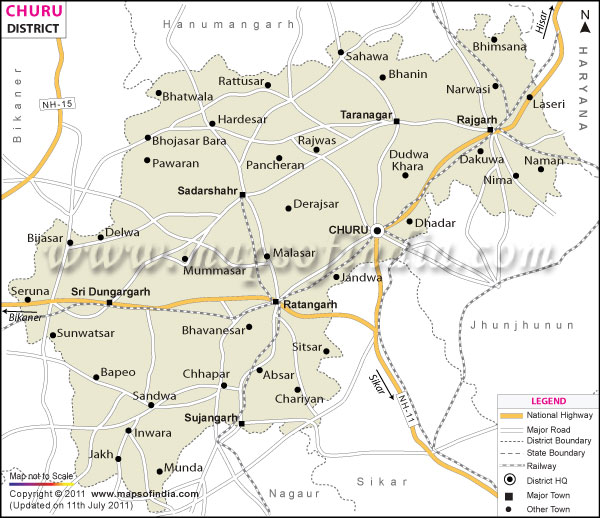
Churu district belongs to the Bikaner administrative region within Rajasthan. Oversight of civil affairs, management of land records, and delivery of community services rest primarily with the District Collector and District Magistrate (DM).
To guarantee effective income gathering alongside seamless service distribution throughout an expansive arid region, the Churu district is split into eight governing subdivisions. Under each subdivision functions a regional officer known as a Tehsildar. Administration flows through these designated zones where oversight supports coordination. The structure allows management of remote areas without central overload. Eight units share responsibility across uneven landscapes. Authority disperses to match geographic challenges. Local leadership handles tasks suited to immediate conditions. One official leads per zone with focused jurisdiction.
Located at the core, Churu Tehsil serves as the primary hub for governance, hosting key offices alongside judicial facilities and principal library services. While administrative functions dominate, court operations proceed under centralized oversight within this sector. Main civic duties align here, complemented by access to essential legal resources and documented collections. Governance structures stand integrated with public service points, ensuring operational cohesion across departments.
A central hub for trade and tradition, Sujangarh Tehsil sits in the south of the district. Its presence shapes local life through quiet influence rather than grand display. Activity flows steadily here, shaped by routine more than spectacle. The area speaks through rhythms of daily exchange, not announcements. Location matters, yet subtlety defines its role most.
A center of ongoing production and movement, Ratangarh Tehsil gains recognition through skilled handwork alongside rail connections. Its role in transit grows quietly beside traditions shaped by local making. Notable for links across regions, it holds steady where goods shift, and tracks meet. Craftsmanship persists even as trains pass through at regular intervals. Industrial activity continues without pause near crossings used daily.
| Facts of Churu District | |
|---|---|
| Official Name | Churu |
| Location | Rajasthan |
| Area (km2) | 13858 |
| Population | 2,039,547 |
| Language | Hindi, Rajasthani, Marwari |
FAQs
Q1: How many villages are there altogether in Churu district?
There are around 892 towns and villages in the district.
Q2: What is the population of the district?
2,039,547 people live in the district according to the 2011 census.
Q3: What is the district of Barmer most famous for?
Churu district is world-famous for the stunning, colorful fresco paintings covering its historic merchant havelis. It is also highly renowned for the Salasar Balaji Temple, the Blackbuck sanctuary at Tal Chhapar, its unique wooden handicraft industries, and its extreme weather.
Last Updated on : August 18, 2026
