






About
Sikar district is one of the most highlighted districts in the Indian state of Rajasthan. The district headquarters is situated in the state of Rajasthan in the city of Sikar, which is a prominent headquarter on educational, commercial and administrative perspective.
Sikar, now the name of the town, developed during the time of Shekhawat Rajputs settling in the historic town of Sikar; it is a historic centre of administration and trade and grew to become a great centre of the state during the 15th century. Today, the district is known for its farming and agriculture heritage, religious constructions, historical sites and especially for these constructions, its school.
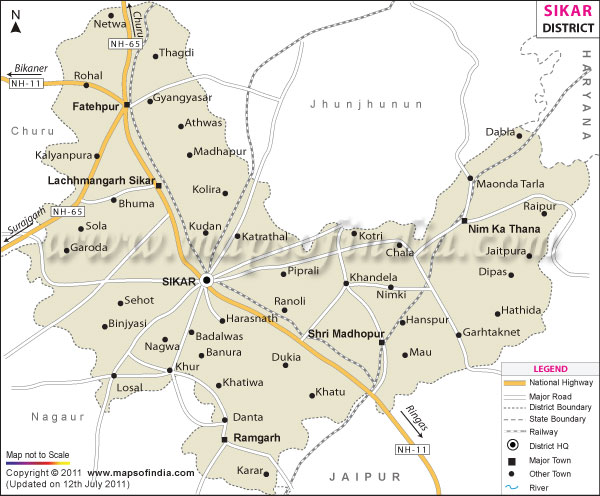
Using the Sikar district map can explain the strategic situation of the district between the cities of Jaipur and the northern parts of Rajasthan. The district occupies an area of about 7,732 sq.km, this area can be found to be surrounded by the districts of Jhunjhunu, Churu, Nagaur and Jaipur. Subsequently, the Sikar district map can be widely utilised for geographical and developmental studies for students, researchers, tourists and administrators.
A mix of traditional rural lifestyles, education and commercial growth. Agriculture continues to be the mainstay of the local economy, and educational institutions have been nationally recognised as the emerging learning hub of Sikar. A Sikar district map also shows the presence of a very large road network along the major towns of Sikar district like Fatehpur, Lachhmangarh, Neem ka Thana, Danta Ramgarh and Sri Madhopur.
History and Culture
Historically, it was well located on trade routes that opened the roads to Western Rajasthan coming from the Northern parts of the country. City's nobles and merchants were rich in trade and were able to erect large houses elegantly painted with highly polished frescoes. Surprisingly, these architectural achievements are still standing there and are cultural possessions in the district.
It is more clearly visible in the map of the town of Sikar that was drawn out having some of the historic towns that flourished during the princely period. This area remained under the administrative jurisdiction of the Jaipur State of the British Rule and was also a part of the state of Rajasthan in 1947. On the map of the state, when the reorganisation of Rajasthan state happened, Sikar District was identified as an administrative district.
Sikar and Shekhawati, in general reflects the culture of Sikar. The folk songs, dances and folk costumes are still playing a significant part in their daily life. Men wear a turban on their head, which is a common head dress in various colours, and women wear traditional dresses and jewellery in bright colours.
The district has numerous festivals which are very celebrated. The major festivals of the area are festivals like the Teej festival, Gangaur festival, Holi festival, Diwali festival, Makar Sankranti and Navratri festival. Every year, thousands of pilgrims from across the globe come to the fair of Khatu Shyam Ji to pay homage to the devotion and to remind him of his maya, one of the highest religious fairs of Rajasthan.
The district has always been a region of variety and tolerance towards everything that has to do with religion. There could be several different temples, religious shrines and locations on the premises; some are visible on a map of the Sikar district. It is especially renowned for pilgrimage sites of the famous temples such as Khatu Shyam Ji Temple and Jeen Mata Temple.
A reference is made to the contribution of the district to the armed forces and public service. The military tradition is deep within the district residents; the community is a trusted one for being patriotic and disciplined. The Sikar district map is commonly used in the region to help travellers find these cultural and historical wonders in the district.
Economy
Sikar district has an economy which is mixed, featuring agriculture, trade, educational and services. In the course of the years, it has evolved from a farm-based to an important educational and commercial hub.
The agriculture industry is still the primary provider of jobs. The farmers grow crops like bajra, wheat, mustard, gram, barley and guar. The rearing of livestock is also an important activity here. A Sikar district map shows that the fertile plains are utilised for intensive farming and are an important source of income for the rural economy of the district.
Government Sector
The government holds a prominent role in terms of employment and economic development. Thousands of jobs are in District administration offices, educational institutions, health units, police and public welfare units.
Economic opportunities are improved throughout the district through investment in roads, irrigation, rural development and educational infrastructure systems by the government. On a Sikar district map, the administrative centres are indicated as the starting points of the implementation of various schemes of the state and central government.
Public Sector
The public sector contributes via banking services, electricity distribution, telecom and transport infrastructure. The public sector banks have wide networks across the district to give out loans for individuals as well as corporations.
Increased electrification of rural areas has helped in improving productivity in both agriculture and industries. The public sector organisations also have a significant contribution to make in the fields of social welfare as well as infrastructure development in the district.
Services Sector
The service industry has grown to become one of the dynamic growth areas. Sikar is famous for the educational value-adding system, which welcomes students from a diverse geographical area comprising various parts of Rajasthan and neighbouring states. There are a number of employment and economic activities being created by the coaching institutes, schools, colleges and related education services.
The sector of retail trade, healthcare services, both hospitality and transportation, has also grown significantly, with banking and real estate being equally so. The commercial activities are well entrenched around Sikar city and Fatehpur, as shown in the Sikar district map.
There are also small-scale industries and agro-based industries which also support the local economy. People also get opportunities to work in the processing of agricultural products, the handicraft industry, construction activities and the trading business.
The transformational advantage of its strategic location adds to its commercial significance. The transport corridors, which can be seen on a Sikar district map, enable the transportation of goods and people from the main centres of trade in Rajasthan and the neighbouring states.
Tourism
Tourism is another aspect which imparts vitality to the district's cultural significance as well as its religious importance. The district has many traditions and attractions for pilgrims, history and culture tourists.
Another important place of pilgrimage is Jeen Mata Temple. The temple is located in the middle of the Aravalli hill and is devoted to Goddess Jeen Mata, where on such a day as Navratri, a lot of devotees visit the temple.
Also, there is a great historical significance to the Harshnath Temple, which is situated around Sikar. The temple complex is a construction of the tenth century and is endowed with architectural and sculptural features, outstanding examples of early medieval Indian crafts. It can be easily located on a Sikar district map and is one of the prominent religious centres of Rajasthan.
The havelis with frescoes, which are a speciality of Fatehpur, are famous. These visitors can appreciate the exquisite paintings with mythological scenes, historical events, and social life. To indicate the presentation location of these structures throughout the town visitor can see on the Sikar district map.
Ganeshwar archaeological site is one of the most significant sites of the Ancient Ganeshwar Civilisation. Lachhmangarh Fort is located on the top of a rock-strewn hill and has panoramic views of the landscape. The fort is an important tourist attraction of the district, and is still used to mark the district's Rajput heritage.
The map of Sikar is more helpful to tourists who want to see many places in the district of Sikar. The Sikar district map is used to make planning of Heritage trails, pilgrimage routes and historical circuits efficient as that of travelling the distance between every touristic spot. The district map of Sikar is still a valuable guide for tourists exploring the area's various attractions.
Demographics
The population of Sikar district was 2,677,333, as per the Census of India 2011. The district was one of the most densely populated and was upwards with its population growth in Rajasthan.
Literacy rate for Sikar district was 71.91 per cent, which demonstrated remarkable development in literacy and human development. There has been a significant contribution from education establishments in the district's Literacy improvements.
Hindi is the official language and the basic medium of communication. The Rajasthani languages (Shekhawati in particular) are used extensively in rural and urban areas. Education, administration and business are the uses of English.
The urban centres are continuing to expand from the rural influence, but the district continues to be mainly rural. The map of Sikar district offers an insight into the population distribution and the pattern of their settlement in the district.
Administration
Sikar is under the jurisdiction of the District Collector and the other Government departments which deal with governance, development and public services.
It is the old district that previously had 6 tehsils: Sikar, Fatehpur, Lachhmangarh, Danta Ramgarh, Neem Ka Thana and Sri Madhopur. Though there has been administrative change and reorganisation, these still represent the typical tehsils of the district, albeit more recent years have seen more subdivisions and tehsils emerge within the district.
It has approximately 1167 villages in this district and can be said to be one of the largest administrative districts of the rural areas in the state of Rajasthan. The villagers of the district: They form the base for the farming activites and social conditions in the district.
The district map is used regularly by the administrative staff of the district for their planning and development uses, and to track the connections between the various locations in the district. Similarly, a Sikar map might help planners ensure efficient and effective distribution and/or allocation of urban and rural development in the area.
| Facts of Sikar District | |
|---|---|
| State | Rajasthan |
| District | Sikar |
| District HQ | Sikar |
| Population (2011) | 2,677,333 |
| Growth | 17.03% |
| Sex Ratio | 947 |
| Literacy | 71.91 |
| Area (km2) | 7732 |
| Density (/km2) | 346 |
| Tehsils | Danta Ramgarh, Fatehpur, Lachhmangarh, Neem Ka Thana, Sikar, Sri Madhopur |
| Lok Sabha Constituencies | Sikar, Jhunjhunu |
| Assembly Constituencies | Dantaramgarh, Dhod, Fatehpur, Khandela, Lachmangarh, Neem Ka Thana, Sikar, Srimadhopur |
| Languages | Hindi, Rajasthani including Shekhawati |
| Rivers | ----- |
| Lat-Long | 27.581329,75.057793 |
| Travel Destinations | Gopinath Temple, Rathore ji ka Raghunath Temple, Chhoti Lal Sagarmal Sodhani Haveli, Digamber Jain temple, Raghunath Temple, Bawri (Stepwell), Devi Singh Cenotaph, Laxman Singh Cenotaph, Maji Sa ka well, Laxmangarh Fort, Ram Lal Murlidhar Ganeriwala's, Sanwat Ram Chokhani Haveli, Shiv Naraian Mirja Mal Kyala Haveli, Bal Mukund Bansidhar Rathi Haveli, Ram Vilas Sanganeria Haveli, Keshardeo Sarraf Haveli, Multan Chand Kedia Haveli, Nawabi Bawri, Gharwa Johra, Jagan Nath Singhania Haveli, Nand Lal Devra Haveli, Ram Gopal Poddar Cenotaph, Shani Dev Temple, Ganga Temple, Baij Nath Ruhia Haveli, Khatushyamji Temple etc. |
| Government Colleges/Universities | Government Law College (Sikar), Govt. Girls College (Hod), Govt. Girls College (Sikar), K.M. Government Girls College (Neem Ka Thana), R.N.R. Government College (Ramgarh Shekhawati), S.K. Government P.G. College (Sikar), S.N.K.P. Government College (Neem Ka Thana) etc. |
FAQs
Q1: How many villages are there in Sikar district?
Sikar district has 1,167 villages according to the Census 2011 administrative records.
Q2: What is the population of Sikar district?
According to the Census of India 2011, the population of Sikar district was 2,677,333.
Q3: What is Sikar district famous for?
Sikar district is famous for its Shekhawati heritage, educational institutions, Khatu Shyam Ji Temple, fresco-painted havelis, agricultural production and rich Rajput cultural traditions.
Last Updated on : June 22, 2026
