






About
Bhilwara is one of the important districts in the state of Rajasthan and is renowned as the textile centre of Rajasthan. Headquarter of Bhilwara is a pivotal aspect of industry, commerce & administration. Bhilwara is also famously referred to as “Textile City of Rajasthan”, which makes it very popularly known all across the country, hence also following the development of its textile sector that explicitly includes synthetic fabrication, yarn production and its booming textile processing industry.
The District's geographical area is approximately 10,455 sq km, while the Districts which form the boundary of the district are Ajmer, Rajsamand, Chittorgarh, Bundi and Tonk. There are plains of undulations, low ranges of the Aravalli mountain system and rich agricultural soil. It is an agricultural land comprising rivers of irrigation, Banas, Kothari, Menali and Khari, etc.
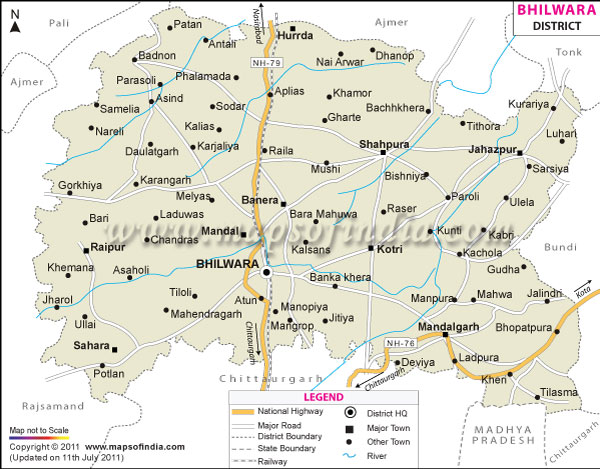
The Bhilwara district map indicates various important sites on its map and the other districts connected in Rajasthan State, and how all of them are interconnected with one another. The district also hosts historical monuments and religious sites, has educational institutions and cultural traditions. Besides, a Bhilwara district map is helpful for the visitors to be able to identify the places for tourists, etc., the path of transportation and other various towns present in the district in detail.
History and Culture
Bhilwara is a link in the ancient Mewar region. Within the district, there is archaeological evidence of habitation for many centuries around the District. Stone artefacts and tools have been collected around the area, showing that prehistoric people lived in the area. The district takes its name from one of the most ancient indigenous civilisations of western India – the Bhil tribe. The Bhils lived in the forests and hills around the area and were an influence on the local culture and traditions. The origin of the name “Bhilwara” has been attributed to being related to the Bhil by many historians.
During the ancient and medieval ages, it was a part of various Rajput Kingdoms. The rulers of Mewar had a good deal of influence on this region, and many forts, temples and settlements were built during their rule. In the struggle between the north-western fighting of the Rajput and the intruding people in that area, the district had also witnessed significant changes in its political landscape.
The Bijolia Peasant Movement is one of the most important historical events in the district. The movement began in Bijolia in the early 20th century and is one of the earliest organized uprising by peasants in India against oppressive tax policies and feudalism. This movement got the attention of the nation and became significant in the freedom movement of India. Historically important sites like Bijolia and Mandalgarh are often marked on the Bhilwara district map as they played an important role in the region's past. The Bhilwara district map is also useful to the historians and tourists to get the architecture of the settlements as well as the heritage sites of ancient times located.
It is a common belief that Bhilwara is one of the recognised and developed districts in the state of Rajasthan. The Bhilwara district map can be helpful in indicating and estimating a high level of urban settlements, the presence of paved roads and railway tracks in Bhilwara town. All these factors have contributed to the industrial and trade development. Industrial strength, along with the historical relevance, has made this town a part of the development paradigm for Rajasthan and is one of the important aspects involved with Bhilwara.
The festivals that are observed in the district are greater in magnitude, such as Diwali, Holi, Dussehra, Gangaur, Teej and Makar Sankranti. The religious fairs are typically attended by people from the neighbouring area, and sometimes are attended by people from adjacent states. In addition, the district is renowned for its ashram, spiritual spots and temples that still manage to keep up to the traditions of centuries. The Bhilwara district map can definitely be used for cultural studies when needed in order to identify the important heritage centres of the area.
Economy
Rajasthan's Bhilwara district boasts a really good economic stature. It has a diversified industry, agricultural, trade, service and government-based economy. Its strategic location, high transportation and entrepreneurship have helped the district to boost its economy.
Government Sector
The government sector is crucial for district development in administrative and education, healthcare, public works and rural development programmes. Other significant employment includes District administration offices, courts, Police, government schools and hospitals.
Governments of the country initiate a variety of agricultural support schemes, irrigation projects and rural development initiatives, which promote better living conditions in the villages. The Bhilwara district map is often referred to by the government while developing the various infrastructure projects, administrative management and transport development schemes.
Public Sector
The activities of the public sector in Bhilwara are Electricity Distribution, Water supply, Transportation activities, and other infrastructure activities supported by the government. The district, along with its public institutions play a significant role in supporting the development of its industries and agriculture.
Services Sector
In the last few decades, the service sector has grown tremendously in number and volume. The district has also become a major economic force in the banking and finance field, the health and education industries, and the retail, logistics, and information technology services sectors. Bhilwara city has acted as a commercial centre offering services to not only the Bhilwara residents, but also to those from the surrounding neighbouring districts as well. New job and investment possibilities have emerged in educational institutions and private health care organisations.
The textile is still a main pillar of the economy of the district. The town of Bhilwara is famous for the production of synthetic fabrics, polyester yarn, suiting fabrics, and textile products in the world. The district is home to many textile mills, processing units and manufacturing units. Due to the concentration of this industry, the district has been rightly called the textile capital of Rajasthan.
Tourism
There are many types of attractions present in Bhilwara for the tourists that include Historical sites, Temples, Forts and Cultural sites. Tourists can look at these maps/points and make their travel plans to Bhilwara.
Harni Mahadev temple is one of the religious spots of the district. The temple is dedicated to Lord Shiva and is located in a beautiful area, and is visited by devotees all year round. Mandalgarh Fort is one of the historic monuments which presents the military architecture of Rajasthan.
The historic temples and reservoirs are renowned in Bijolia. It has a number of extraordinary buildings from the medieval period. Historians, archaeologists and tourists love the architectural elements in the temple. One of the popular tourist sites of the district is Menal. Menal is also known as the “Mini Khajuraho of Rajasthan”, adorned with impressive temple buildings and an amazing waterfall during the monsoons. The site is both beautiful and architectural.
Shahpura is another site of significance due to its history, heritage and art traditions. The town is also linked with the renowned Phad painting technique, which is one of the distinctive painting methods of Rajasthan, by means of scrolls. Meja Dam is a vital water reservoir and recreation site. It's surrounded by nature and is popular with nature watchers, photographers and picnickers.
Badnore Fort and numerous ancient temples throughout the district add to the district's tourism. The Bhilwara map is conveniently used by travellers to navigate these locations efficiently and schedule extensive tours of the area. Another impetus to traffic in religion, too, is religious tourism. Many temples and pilgrimage centres are visited by devotees all year round, especially during festivals and religious fairs.
Demographics
Drawing reference as per the Census of India 2011, the population of Bhilwara district is near about 2,408,523. Also, here the ratio of females to males is around 973:1000. Additionally, the overall literacy rate of the district was 61.37 per cent. The male literacy was observed to be higher by a great margin as compared to the female literacy previously, but the gap has been gradually narrowed throughout various educational initiatives pushed by the government.
The Hindi language is the main language of the district. In addition, the regional dialects, particularly Mewari, are used extensively in daily life in the form of dialogues of the Rajashtanis. English is used extensively in the school, in administration and in business. The district has both urban and rural people, and most of them reside in villages. Agriculture, industry & services are the source of livelihood. The Bhilwara district map is very helpful to analyse the distribution of the towns, villages and population centres of the district.
Administration
The district is organised and known to function under an administrative framework which directly comes under the Government of Rajasthan. The headquarters of the district can be located in Bhilwara city, which subsequently serves as the principal administrative and commercial centre in the region. References drawn regarding administrative info as per the Census of 2011, the district consists of 12 tehsils namely: Bhilwara, Asind, Banera, Bijolia, Hurda, Jahazpur, Kotri, Mandal, Mandalgarh, Raipur, Sahara and Shahpura.
The Bhilwara Map is a key mapping tool for administration, land administration and infrastructure planning and development programs. The Bhilwara district map is used by the officers in various instances, and a number of developments are taking place in the district. Apart from that, there are regular visits to the regions by officers.
Moreover, the Bhilwara district map helps in the identification of boundary of tehsiles, ways of transports and settlement density. The Bhilwara map can be utilised in a variety of ways like: For spatial analysis, which can be used by those researchers who are interested in rural development, and for navigation, which can be utilised by tourists who want to visit different attractions or heritage sites. The Bhilwara district map could also be utilised for educational purposes in educational institutes.
| Facts of Bhilwara District | |
|---|---|
| State | Rajasthan |
| District | Bhilwara |
| District HQ | Bhilwara |
| Population (2011) | 2,408,523 |
| Growth | 19.60% |
| Sex Ratio | 973 |
| Literacy | 61.37 |
| Area (km2) | 10455 |
| Density (/km2) | 230 |
| Tehsils | Asind, Banera, Beejoliya, Bhilwara, Hurda, Jahazpur, Kotri, Mandal, Mandalgarh, Raipur, Sahara, Shahpura |
| Lok Sabha Constituencies | Bhilwara |
| Assembly Constituencies | Asind, Bhilwara, Jahazpur, Mandal, Mandalgarh, Sahara, Shahpura |
| Languages | Hindi, Rajasthani including Mewari |
| Rivers | Bedach, Kothari, Khari, Seasonal River - Banas |
| Lat-Long | 25.463115,74.769745 |
| Travel Destinations | Sawai Bhoj Temple, Gangabai Cenotaph, Mandakini Temple, Ramdwara, Mandalgarh, etc. |
| Government Colleges/Universities | Government Law College, Govt. College, M.L.V Government College, S.C.M. Government College, S.M.M. Government Girls College, S.P.S.B. Government College etc. |
FAQs
Q1: How many villages are there in the district of Bhilwara?
As per Census 2011 Administration records, Bhilwara district comprises a total of 1834 villages.
Q2: How many people live in the Bhilwara district?
Based on the data from Census 2011, the total population of Bhilwara district is 2408523 people.
Q3: Which places are well known in the Bhilwara district?
There are many historical places like Menal, Bijolia, Mandalgarh Fort and a rich textile Industry in the district.
Last Updated on : June 22, 2026
