






About
Once just barren dunes, Sri Ganganagar now blooms with crops under open skies. Not long past, winds shaped this land more than people did. Yet slowly, through steady effort, life took root where none thought possible. Fields stretch wide today because someone once believed water could follow willpower. Orchards stand tall where only sand used to shift beneath feet. Canals cut across what desert once claimed without challenge. Now called the Food Basket of Rajasthan, though it earned that name drop by drop. The Green Granary of the Desert isn’t poetic flair - it's what grew from dust and design. A hundred years changed everything, not by chance but choice after choice. What seemed impossible then feeds thousands now, quietly, every season.
History & Culture
A desert today, yet water once carved life here. In antiquity, the prosperous lifelines of the legendary Saraswati and Drishadvati rivers forged paths across this terrain, nurturing prehistoric settlements that thrived long before recorded history began. Time changed everything; slow climate swings stole the flow, leaving dust where crops had grown. What remained by the 1400s? A forgotten stretch at Bikaner's border, scorched and ignored. Only wanderers moved through, tending sparse herds under open skies. Then came a ruler whose stubborn dream refused the sand. Out of hardship came a shift no one saw coming. When famine ripped through the land near the turn of the century - called Chhappanja ka Kaal - it left scars deep enough to change minds. Ruling since 1887, Maharaja Ganga Singh watched his people suffer under dry skies and empty fields. That pain lit something stubborn inside him. Fixing water problems wasn’t just talk after that point. By force of will, slow progress started where drought once held power.
Economy
Farming shapes most of life here, rooted deeply in canals slicing through the land. Water routes arrived long ago, then came bigger ones- the Gang Canal first, after that the huge Indira Gandhi project, also Bhakra’s lines weaving in. These flows shifted everything, quietly remaking how people earn, one field at a time.
Government Sector
Most jobs here come from public offices, keeping things running day to day. Courts, schools, and paperwork systems form part of this backbone. Yet another big piece shows up when looking at how water moves across farmland. Managing canals, reservoirs, and local flow zones takes legions of workers. Paychecks tied to these efforts make up a large share of income streams. Development units focused on irrigated tracts drive hiring more than many notice. Right where the line crosses between nations, this place holds steady lines of soldiers and armed guards year-round. Not far off, bases and checkpoints stretch across the land, run by the Indian Army and the Border Security Force.
Public Sector
Deep in the northwest of India, Sri Ganganagar holds a key piece of infrastructure - the Suratgarh Super Thermal Power Station. Run by RRVUNL, it powers much of Rajasthan through several live generating units. This government-run site feeds essential energy into the regional network. One after another, its turbines keep turning, feeding demand across the state.
Services Sector
Out here in Sri Ganganagar, work lives mostly through farm trade, buying and selling stuff, moving goods, along with shop-based business. Right at its heart sits Dhan Mandi - an open marketplace that pulses hard during harvest seasons, handling big volumes of cash crops across northern India. From sunrise onward, money moves fast, pulling in lenders, brokers known locally as arthiyas, trucking crews, plus companies covering risks on long hauls. Out here, banks and local lending groups have grown strong, built mostly around farmers who’ve done well. Cars move fast off lots, just like big machines for fields - tractors roll out weekly.
Tourism
Though farming and factories shape much of Sri Ganganagar’s identity, quiet corners hold stories worth seeing. Some places pull you in with prayerful stillness, others stand silent near old frontier posts. Scattered traces whisper of lives lived long before machines took root. Over there, past the city, roughly twenty-five kilometers away, sits Hindumalkot Border - a stop many tend to make. Named after Hindumal, a key minister long ago in Bikaner’s royal setup, it holds history quietly. You reach it and find the border between India and Pakistan laid out ahead, lined with fences, towers standing guard . While sunlight lasts, gates stay open, letting folks walk up and look through. On clear days, homes and guard stations on the far side come into view. Standing there brings more than sights - history settles in quiet moments too. Near Dabla village, tucked into Rai Singh Nagar tehsil, stands Sri Buddha Johad Gurudwara. This sacred site ranks among Rajasthan’s most honored Sikh temples. A vast johad sits right beside it, shaping its name and setting. Back in 1740, courage took form through two men - Bhai Sukha Singh and Bhai Mehtab Singh. They ended Massa Ranghar’s life after his desecration at Amritsar’s Golden Temple. Inside, old paintings hang alongside aged weapons used long ago. People arrive daily, not just Sikhs but others too, drawn by memory and meaning. Each month, under the dark moon night, crowds swell for a gathering that fills the air with chant and silence alike. Down a quiet stretch between Anoopgarh and Ramsinghpur sits Bror Village, an archaeological spot that pulls attention without making noise. Dug deep into its soil, researchers found traces left behind by people who lived long before records began - part of what history now calls the Harappan world. What turned up? Houses built with baked bricks, their rooms laid out like puzzles across time. Shards of old pots appear often, alongside small clay decorations shaped with care, tiny beads smoothed by hand, also bones resting where they fell centuries ago. Water once moved through this land freely; the dried-up bed of the Ghaggar River tells another story - one of green growth and settlement under open skies. Life stood firm here, busy and ordered, when most of this region wore fertility like skin. Out here, where flat green fields suddenly give way to towering waves of sand, lies something raw.
Demographics
There is a balance between the urban and rural population, and agriculture still plays an important role in supporting a significant proportion of people within the district. Better educational development, migration and entrepreneurship have helped to lead the socio-economic indicators as compared to many districts of the region.
Located near the frontier, Sri Ganganagar's population makeup tells a story shaped by history and place. Its people mirror years of growth tied closely to where it sits on the map. Some time ago, before boundaries shifted, records showed Sri Ganganagar held nearly two million people - about 1,969,168 to be exact. After splitting off part of its area into a new district called Anupgarh, what remains of Sri Ganganagar now numbers around 1,270,690 souls. Out here, city folks mix evenly with those living on farmland - about a third stick to urban zones while most settle across open country where farming shapes daily life. What stands out is how many people belong to Scheduled Castes - more than three in ten - a presence that quietly steers community rhythms and power lines across the area.
Literacy Rate
Sri Ganganagar district shows a solid literacy level -69.64% - clearly ahead of Rajasthan's general mark. In cities, learning levels climb, nearing 80%. Yet when it comes to gender, differences stand out; men reach about 79%, women settle near 60%, though efforts now aim to shrink this gap. Scattered through the area sit well-regarded colleges, schools focused on farming knowledge, and places teaching engineering, pulling learners from much of north Rajasthan. Out here, where fields stretch wide, folks speak Bagri - its rhythm shaped by village life. Not quite Hindi, nor fully Punjabi, it slips through the spaces in between. This tongue ties communities together without trying too hard. You’ll hear it in morning greetings, market talk, stories passed down. Rooted in Rajasthan’s soil, it moves like conversation carried on the wind. Across schools, markets, government offices, also routine exchanges between different groups - these tongues turn up without fail. While one holds sway in classrooms and paperwork, the other thrives where people.
Administration
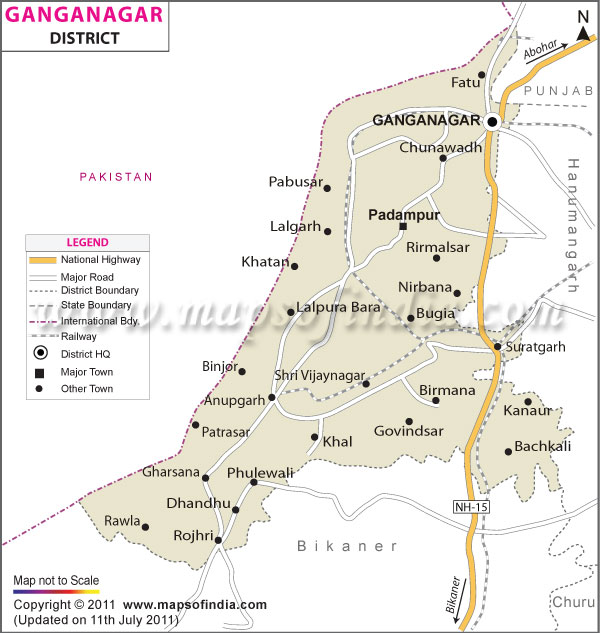
From an organizational standpoint, Sri Ganganagar runs on a clear structure built for handling clusters of farms and nearby villages without slowdowns. Sitting within the Bikaner division, it answers to officials who work out of a central office located in the city itself. Leading things day-to-day is someone wearing two hats - one focused on records, the other on law - both roles based at that same government building. One way to handle money matters, growth projects, and legal oversight is splitting the area into key administrative zones called Tehsils. These main sections take charge of what remains across the region. Each carries responsibility for its stretch of land, shaping how things run locally. Sri Ganganagar (Headquarters), Suratgarh, Sadulshahar Padampur ,Sri Karanpur, Raisinghnagar, Vijainagar. Down below the tehsil tier, more than four hundred Gram Panchayats make up the village governance setup across the district. Each one operates within a tightly organized framework meant to manage local affairs directly at the community level. Among Indian districts, few match the rural spread seen in Sri Ganganagar. Its landscape stitches together an unusual number of small communities. One detail stands out when looking closely - this place hosts more villages than any other district across Rajasthan. The count reaches 3,061, a figure that includes everything from bustling country hubs to quiet farming clusters tucked between fields.
| Facts of Ganganagar District | |
|---|---|
| Official Name | Ganganagar |
| Location | Rajasthan |
| Area (km2) | 10990 |
| Population | 1,969,168 |
| Language | Hindi, Seraiki, Sindhi, Punjabi, English, Bagri |
FAQs
Q1: What is the total Number of Villages in Sri Ganganagar District?
Jhunjhunu district has 927 villages according to the Census 2011 records.Besides stretching across northern Rajasthan, Sri Ganganagar District hosts more villages than any other district - exactly 3,069 dot the landscape. Some grow into sizable rural hubs, others stay small, quietly tagged with letters and numbers near irrigation canals.
Q2: What is the Population of Sri Ganganagar District?
Back in 2011 , census data showed the whole area held close to two million people - about 1,969,168 to be exact.
Q3: What is Sri Ganganagar Known for ?
Out here, fields stretch wide where sand once ruled, thanks to canals breathing life into barren ground. Crops now rise in waves - golden wheat, fluffy cotton, sharp mustard - fed by water taming the arid edge. Not far, orchards drip with Kinnows, those juicy hybrids that found perfect soil in this unlikely spot.
Last Updated on : August 18, 2026
