






About
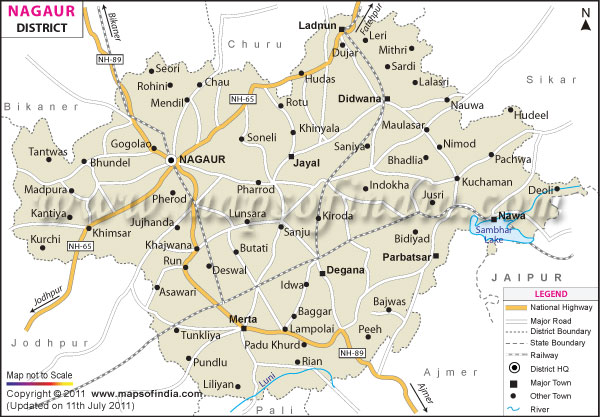
Nagaur is also one of the largest and most important districts in Rajasthan, India. It is located in the central western part of the State and is a major link between Marwar and Shekhawati areas. The city of Nagaur has always been considered a centre of trade, cultural and administrative activities. The district headquarters is Nagaur town, which was for long considered for great trade and administration. The district has a wealth of history, agriculture and livestock.
Nagaur, regarding its intense reputation, also has its strategic position and the part it played in the history of Rajasthan. The area has been lastly linked to the Rajput rulers, historic forts and bustling trade lanes for centuries. Today, it remains a key part of the State's economy and culture. The Nagaur district map is used by all students, researchers, and travellers to gain knowledge about the geographical location of the district, the transportation of the district, and the settlement distribution over the district. The Nagaur district map is useful for the study of the relation between rural settlements, agricultural belts and urban centres as the area of the district is very large.
History and Culture
The history of Nagaur and the district traces back to ancient & medieval times. Tradition indicates that, throughout several dynasties, they were never content with control merely in the area. Nagaur has derived its name from “Nagapura”, which means the city of serpents. Eventually, the district passed into the hands of several ruling powers such as Nagavanshi rulers, Rajput kings and thereafter came under the Mughal Empire and the Delhi Sultanate.
Nagaur Fort or Ahhichatragarh Fort is one of the most visible historical places. The fort has been in the middle of countless political and military affairs over time. In the Middle Ages, Nagaur was a key border city of north India, which also served western trade routes. The Nagaur district map gives an understanding of why, or rather, how the strategic position, which is one major reason for its historical importance.
Nagaur's cultural identity is representative of the general Marwar tradition. Folk music, folk dance and other traditional art forms never went out of fashion in villages or urban areas. Vivid clothes and intricate jewellery, colourful handicraft etc., are still part of daily life in this region. In addition, the district is famous for its fairs and religious gatherings that call in visitors from all around Rajasthan.
Nagaur Cattle Fair, which is one of India's largest animal fair here among the best known cultures. Every year, thousands of traders, farmers and tourists take part in the event. At the fair, livestock trading, folk performances, handicrafts and traditional sports are held. Visitors in the fair season usually refer to the Nagaur district map for visiting different types of exhibition grounds and nearby sites.
Religion makes up an integral part of the district's social structure. Many temples, mosques and shrines of Arabic origin, in addition to the Jains, are found throughout this region. The religious histories of the diverse districts have coexisted for a long time, and cultural diversity has its origins in this tradition. Such celebrations as Diwali, Holi, Eid, Gangaur and Teej have caused people to find it easier to start their spirit of communal harmony.
Economy
Naguar district's economy is mainly composed of agriculture, animal husbandry, trade and mineral resources. The district is also known for its agricultural productivity in spite of the semi-arid climate, and it also plays a significant role in the economy of rural Rajasthan.
The Government Sector contributes a lot towards employment generation, especially in administrative services, education, and healthcare, although rural Development & public infrastructure projects also plays major role. Various central and state government institutions operate in the district, providing various services, creating a significant workforce of thousands of inhabitants. Planning authorities in the Nagaur district use the map of Nagaur for various purposes, including infrastructure planning, regional development, and land resource management.
The Public Sector makes its contribution through various state-supported programmes and institutions. Public spending in infrastructure like roads, schools, hospitals, water and agricultural support systems has strengthened the economic architecture of this district. And trade itself will be facilitated as well by cooperatives and agricultural marketing boards. The Nagaur district map becomes a tool that carries great importance while also acting as an efficient administrative tool for the monitoring of various development projects and allocation of resources in different regions.
Mentioning the local economy, it's very vibrant and still relies heavily on agriculture for itself. There are various crops that one can find grow here are bajra, wheat, barley, mustard, gram and cumin. Also talking about animal husbandry, it plays a critical part with animals one can find there, like cattle, camels, sheep and goats that form an inclusive part of rural life and a livelihood for the people living there. Nagaur is famous for its Nagauri breed of cattle that is well known for its strength and endurance.
Over the years, its Services Sector has been growing steadily. Growth sectors within the district, including banking, education services and healthcare, are currently seeing a boom. Retail trade, hospitality, transport, among others, are contributors to District Income. The urban centres like Nagaur, Makrana and Merta have developed as the major commercial hubs. The utilities of the Nagaur district map are majorly applicable for businesses and investors who can use regional maps to plan transportation routes, market access, and business opportunities in towns/ villages.
Tourism
Nagaur district offers a special combination of historical monuments, religious spots and cultural draws that people find very exciting to visit. The district is a tourist attraction for heritage lovers, for architecture, for people interested in Rajasthani culture.
One of the most visited and liked tourist places of the district is Nagaur Fort. It's seriously well known for the great eye cathing architecture, palaces and courtyards which also keep highlighting the splendour of the Rajput and Mughal influences of that time. The map of Nagaur district is a very useful item that could become popular, helping tourists to know the location of various attractions for people who want to visit the fort and other historical sites in the area efficiently.
The place is well known in the world for its marble quarries. People from other places as well come here to know about and learn about Makrana marble. This Nagaur district map can enlighten the tourists with its sites, & furthermore, it relates Makrana to various other major cities in Rajasthan.
Merta City is another historical place, well-known for the saint-poet Meerabai. Pilgrimage sites and other heritage areas that draw visitors interested in medieval devotional literature around the Meerabai Memorial. Kuchaman Fort is one of the best sites as well. Located on a hill with views of the landscape surrounding it.
It is a tourist centre in itself for the annual Nagaur Cattle Fair. Visitors will see the very traditional cattle trading, some cultural shows and typical handicraft displays alongside local food. The Nagaur district map comes in handy when the fair is taking place, as it helps tourists to be around many event venues and nearby spots.
The district is also enriched with a significant number of temples, stepwells and historic structures, which can provide added advantages for cultural tourism. Even rural tourism is becoming more in vogue because people desire authentic village life, folk culture and local craftsmanship, whereas the modern man can experience all this.
Demographics
According to the 2011 census, Nagaur district has a population of around 3,307,743 people. With a population density of approximately 187 inhabitants per square kilometre. The agro-based nature of the District, coupled with landlessness and an overwhelming population living in rural residences.
The literacy ratio of the district is about 62.8 per cent. The educational system has expanded significantly through the years, but there are still many challenges regarding literacy improvements in rural settings. In fact, the Nagaur district map has been very frequently used by geographers to understand demographic spread and population density between various regions as well.
Hindi is the official language for administration and education. The most spoken local language is Marwari, an Indo-Aryan language that also acts as one of the important constituents of regional identity and other Rajasthani dialects prevalent in this district. Demographers also use the Nagaur district map to determine how the population is distributed and investigate language patterns as well as settlement structures.
A diverse group of communities make up the district and add to its social fabric and joyfulness. A huge part of the population continues to rely on agriculture, livestock rearing, trade and handicrafts.
Administration
For the convenience of administration, better governance and service delivery, Nagaur district has been subdivided into several tehsils. The major tehsils of this district are Nagaur, Degana, Deh, Jayal, Kheenvsar, Merta, Mundwa, Riyan Badi, Sanjoo and the rest of the districts as recognised by the district administration.
The district has around 1589 villages, thus one of the largest rural administrative units in Rajasthan. Nagaur District map is an administrative map used for the governance, planning and census operations of these tehsils and villages.
Major roads and railway lines connect the district with Jaipur, Jodhpur, Bikaner and Ajmer for administrative purposes, which enables socio-economic activities.
All administrative work of the district is being conducted by a District Collector under whom Nagaur district would come under his jurisdiction; he would head all the practices of the district as well as implement the Government policies in relation to revenue administration and development schemes. Various work performed by the department of civil services under the district administration in the areas of education, health, agriculture, area development and social welfare.
| Facts of Nagaur District | |
|---|---|
| State | Rajasthan |
| District | Nagaur |
| District HQ | Nagaur |
| Population (2011) | 3,307,743 |
| Growth | 19.20% |
| Sex Ratio | 950 |
| Literacy | 62.8 |
| Area (km2) | 17718 |
| Density (/km2) | 187 |
| Tehsils | Degana, Didwana, Jayal, Kheenvsar, Ladnu, Makrana, Merta, Nagaur, Nawa, Parbatsar |
| Lok Sabha Constituencies | Nagaur, Rajsamand |
| Assembly Constituencies | Deedwana, Degana, Jayal, Khinvsar, Ladnun, Makrana, Merta, Nagaur, Nawan, Parbatsar |
| Languages | Hindi, English, Rajasthani including Marwari |
| Rivers | ----- |
| Lat-Long | 27.2009,73.741508 |
| Travel Destinations | Nagaur Fort, Tarkeen Dargah, Jain Temple, Saiji ka Tanka, Bansiwala Temple, Nath Ji ki Chhatri, Khinvsar Fort, Dadhimati Temple, Meera Bai Temple, Bhanwal Matta Temple, Kuchaman Fort, Makarana etc. |
| Government Colleges/Universities | Bangur Government P.G. College, Government College (Merta City), Government Girls College (Nagaur), Government Law College (Nagaur), Govt. College (Jayal), S.B.R.M. Government P.G. College (Nagaur) etc. |
FAQs
Q1: What is the total number of villages in Nagaur district?
Nagaur district has approximately 1,589 villages, making it one of the largest rural districts in Rajasthan.
Q2: What is the population of Nagaur district?
According to the Census 2011, the population of Nagaur district was about 3,307,743 people.
Q3: What is Nagaur district famous for?
Nagaur district is famous for Nagaur Fort, the Nagaur Cattle Fair, the internationally renowned Makrana marble industry and its rich cultural heritage.
Last Updated on : June 22, 2026
