






About
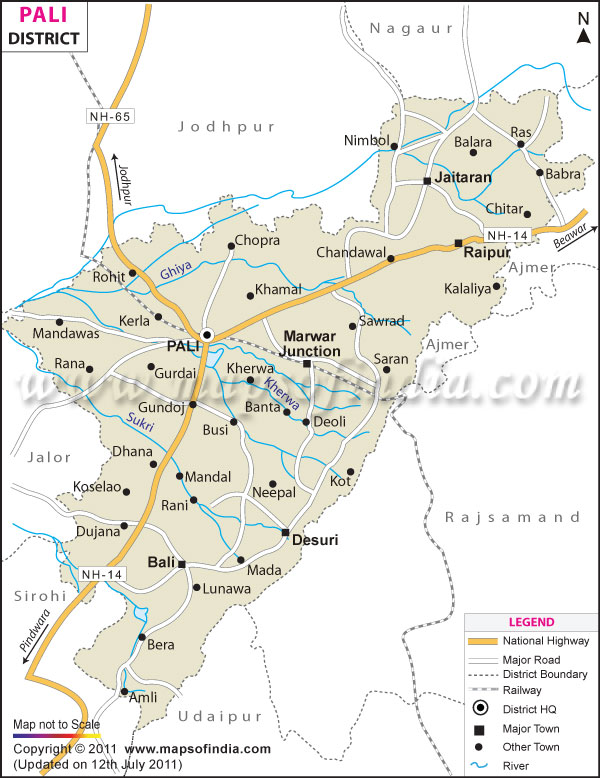
Pali district forms a distinct part of Rajasthan’s landscape. Nestled within the west-central section of the region, it bridges two contrasting terrains - the old, rugged summits of the Aravallis ease into the wide stretches of the Thar Desert. Viewed on a map, it rests surrounded by eight neighboring areas: Jodhpur, then Nagaur, followed by Ajmer, with Rajsamand nearby, Udaipur beyond that, and close links to Sirohi, while touching Jalore and reaching toward Barmer. Because of this location, movement through here shaped patterns of exchange across western India over many generations. Its title, "Pali," reflects long-standing ties to the past.
History & Culture
Starting out as a hub shaped by riches and conflict, Pali's past winds through rising and falling royal lines. Positioned squarely along ancient trade trails linking Gujarat’s bustling harbors to Delhi’s rich fields, the town drew constant attention. Wealth flowed in, carefully handled by the Paliwal Brahmins who turned profits into protected settlements. Their skill brought smart ways to catch rainwater - making farming possible despite little rainfall. Yet change came hard when power moved westward near the end of the 1100s. From this shift emerged the Rathores, Rajput warriors claiming new ground. At that moment, Rao Siha planted his first base - the beginning of Marwar’s ruling line - right within Pali’s borders. Back then, this step set down roots for a realm that eventually grew into Jodhpur's vast dominion. Across medieval times, Pali stood wedged between clashing giants - Mewar in Udaipur and Marwar centered on Jodhpur - its rugged highland corridors forming natural barriers to advancing forces.
Pali breathes Rajasthan’s culture through every gesture, rooted deeply in shared life, tradition, and vibrant folk expression. Spoken here, Marwari flows gently - its soft cadence reveals how kindness shapes desert living. Tera Tali dance emerged from this soil, a legacy nurtured by Kamada women who balance earthen pots while striking thirteen small cymbals fastened across their limbs. Craft in the district includes artisans who dye cotton by hand. This has helped transform the economy of the district.
Festivals are celebrated with great pomp and show. Entire villages are part of the celebrations. Gangaur, Teej, Holi, or Diwali are some of the famous festivals. The spring season draws the maximum crowds when the Parshuram Mahadev Fair is held. Amid these devotional moments and bustling livestock markets, a rich social weave forms - different beliefs interlaced through custom. Old desert traditions thrive here, passed on not by decree but by presence, season after season.
Economy
Pali's economy mixes old and new in surprising ways. When rain comes, fields thrive under small-scale cultivation. Where crops rely on seasonal downpours, factories hum without pause nearby. Though agriculture bends with weather shifts, manufacturing pushes beyond borders steadily. One part grows from soil and sky; the other thrives on machines and global links.
Government Sector
Most households in the district depend on income tied to government operations. Jobs in offices such as civil administration, courts, police command, and land records draw strong interest due to their reliability. Although Pali is now known for manufacturing, public agencies remain central to growth. RIICO, for instance, shapes large industrial zones by organizing infrastructure - electricity, clean water, road access - for factory needs. Employment flows steadily from publicly funded projects, including Bangur Hospital and several degree-granting centers nearby. These bodies do more than hire workers - they strengthen community services over time.
Public Sector
Running the infrastructure in this semi-arid region falls to government bodies. Power supply relies on state-run utilities maintaining an extensive electricity network, vital for urban factories as well as rural water pumps. Oversight of the Jawai Dam - a major feat of public construction - belongs to the irrigation authority; it delivers water for crops and daily use across Pali and sections of nearby Jodhpur. Transportation stays active through RSRTC buses, while the rail hub at Marwar enables a steady flow of labor and goods without interruption.
Services Sector
Nowhere has growth been more visible than in services, fueled by earnings from factories alongside an uninterrupted flow of tourists. Credit flows freely today, thanks to banks reaching out to entrepreneurs in manufacturing, shipping, and property. Along highways, roadside eateries thrive beside upscale urban accommodations and restored palaces turned lodges. Movement defines much of this activity - trucks carry loads nonstop, linking production hubs to markets nationwide. Each day, massive volumes of finished products shift through networks managed by freight specialists.
Tourism
Pali gives travelers a quiet charm, different from typical destinations. Instead of bustling hordes seen in Jaipur or Jodhpur, it reveals grand marble buildings that catch the eye. Along its roads stand peculiar shrines, modest yet striking.
Ranakpur Jain Temple
Buried deep within a hushed, tree-covered basin of the Aravalli range rises the Ranakpur Jain Temple - a wonder shaped entirely in stone. Constructed during the 1400s under the guidance of a rich trader, Dharna Shah, with support flowing from King Rana Kumbha, its vast frame emerges in luminous white marble. Known far beyond India's borders, it holds an intricate web of sculpted patterns, along with a striking interior made up of twenty-nine separate chambers held aloft by one thousand four hundred forty-four pillars - each chiseled differently from the next. Not even a single pair repeats itself. Thoughtful planning guides sightlines across space; wherever someone may stand inside, their gaze reaches toward the central idol without full obstruction, while daylight filters gently through openings, spreading evenly as hours pass.
Jawai Leopard Hills
Loved by wildlife enthusiasts, Jawai in southern Pali stands out as a must-see place. Billions of years have shaped its bold terrain - vast stretches marked by rounded granite boulders. Uniquely, it's home to a flourishing community of wild leopards. Remarkably, these animals share space with Rabari herders, forming quiet harmony across the land. Deep in the hills, locals see leopards as protectors of ancient stone shrines - peace between people and animals has held firm for generations. As morning light spreads, spotting one stretch lazily over cold rock during a slow jeep climb stays fixed in memory long after.
Om Banna Temple Bullet Baba
Right beside the Jodhpur-Pali road sits a small shrine unlike any other. Not built for a saint or deity, but for a 350cc Royal Enfield Bullet bike. Once owned by Om Singh Rathore, a young man killed in a crash there in 1988. Afterward, officers moved the wreck to their station - only for it to show up again near the spot where he fell. Fuel gone, untouched locks, no signs of movement. Each time they removed it, the machine returned overnight. Eventually, people took this as meaning something beyond explanation.
Demographics
Of those counted in the Pali district, just under three-quarters live in countryside settlements tied closely to farming traditions. Slightly more than one in four now call small cities or developing industrial zones their home. The census figures from 2011 record a combined population of 2,037,573 individuals across these areas. Males account for 1,025,422 of that number; females, meanwhile, total 1,012,151. That balance results in 987 girls and women per thousand boys and men - a figure above Rajasthan’s broader norm, then.
About 62.39% of people in the district can read and write. Yet beneath this figure lies a sharp divide between genders - men reach 76.81%, but women only achieve 48.01%. Progress has emerged slowly since new schools opened in rural areas. Girls now benefit from targeted financial aid, thanks to initiatives funded by nearby enterprises. Walking through local markets, one hears Rajasthani spoken widely - most often the regional Marwari variant - that quietly holds social threads in place.
Government matters proceed in Hindi; every resident knows this well. Corporate spaces and places crowded with visitors rely on English instead. Most identify as Hindu - about 88.22 percent - with Muslims forming a visible minority at roughly 7.25 percent. Jains make up nearly 3.90 percent, particularly notable in Pali due to long-standing presence and influence.
Administration
Under the Jodhpur division in Rajasthan, Pali district is governed as part of a larger administrative structure. Day-to-day civilian oversight, along with land revenue tasks and public order, rests mainly with the District Collector and District Magistrate (DM). Close coordination happens between the DM and the Superintendent of Police (SP), since maintaining regional security requires joint effort. Law enforcement functions rely heavily on this partnership to remain effective across local areas.
Running smoothly here means dividing the Pali district into ten parts, each called a tehsil. One reason behind this split lies in the region's wide geography. Every section operates with its own leader, known as a Tehsildar. These officials handle daily community tasks along with property records. Oversight at this level helps respond faster to village-level demands. Local governance gains strength when decisions happen closer to residents. Administrative reach extends further through these smaller units. Land ownership matters often move more quickly under this setup. People find it easier to access services within their area. The system supports consistency without central overload.
| Facts of Pali District | |
|---|---|
| Official Name | Pali |
| Location | Rajasthan |
| Area (km2) | 12,387 |
| Population | 2,037,573 |
| Language | Hindi, Rajasthani |
FAQs
Q1: How many villages are there in Pali district?
There are 1030 villages in the district.
Q2: What is the population of the district?
The population of the district is 2,037,573 according to the 2011 census.
Q3: What is the district famous for?
Pali hosts the breathtaking Ranakpur Jain Temple, a 15th-century marvel carved entirely from marble. Its fame grows not just from stone but from producing top-grade Sozat Mehandi, sought across India. Textile factories hum here at scale, turning raw fabric into regional livelihoods. Beyond industry, Jawai draws visitors seeking rare leopard encounters amid rugged hills. Along highways, travelers pause at Om Banna’s memorial - known widely as Bullet Baba - a marker of folk reverence etched into daily routes.
Last Updated on : August 18, 2026
