






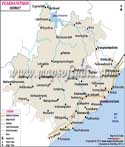
About
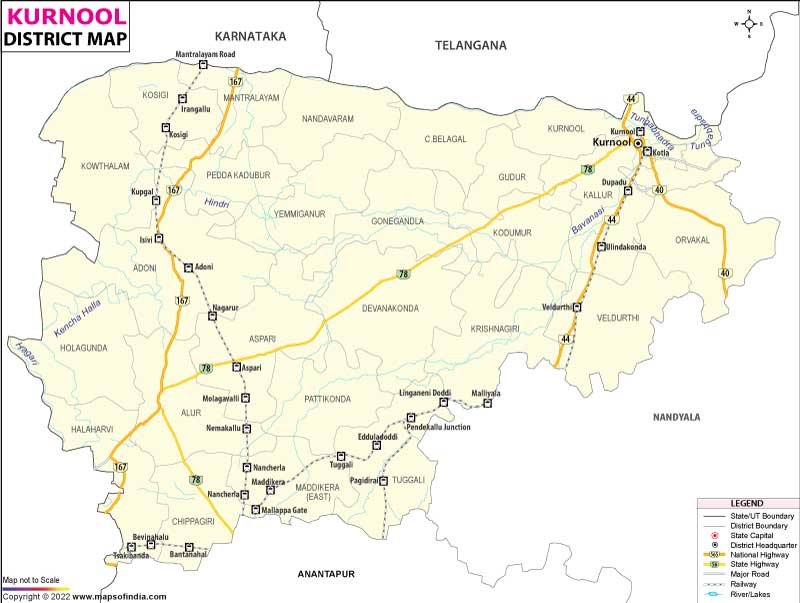
Kurnool district is one of the most strategically significant and culturally rich districts of Andhra Pradesh, India and historically known as the gateway for the royal region Rayalaseema. This is an ancient district lying on the banks of the majestic rivers Tungabhadra and Krishna, which span the wide expanse of the Deccan Plateau and the coastal plains of the state.
The meaning of Kurnool is embedded in traditional history and the evolution of language. The modern name is a direct translation of the ancient historical name Kandanavolu or Kandena Volu. The Telugu word for grease or lubricant for cartwheels is kandena. Local historical records show that in the medieval period, the bullock cart-driver and the royal caravan used to stop on the rocky banks of the Tungabhadra River to grease the wooden axles of their heavily laden supply wagons before crossing the rolling waters of the river. This important stopping point and distribution centre came to be known over the centuries as Kandanavolu. The district has been recently reorganized under the State administrative system and covers an area of around 7980 sq.km. The topography is a beautiful contrast of large black cotton soil plains and rolling limestone fields with ancient granite rock formations.
History & Culture
Historically, the Kurnool District has a very rich history and a layered history, which goes back to the prehistoric period and continues through various periods of dynastic dominance, colonial adversaries, and nationalistic movements. The district has also incredible prehistoric values: the rock art paintings of the famous rock shelters in Ketavaram, and the Belum ancient paleolithic caves, are testaments to the human civilization that has blossomed in this river valley over thousands of years. In ancient times, Kurnool was a part of the mighty Maurya Empire, which is confirmed by the historic minor rock edicts of Ashoka, the emperor of the Mauryas, that are inscribed on rocks at Jonnagiri. After the Mauryas, it was ruled by the Satavahanas, the Badami Chalukyas, and the Rashtrakutas, the first to create early rock-cut shrines and administrative systems.
The Medieval period saw the district becoming a heavily fortified strategic asset, which was fought over by the Western Chalukyas, Cholas, and the Kakatiya Dynasty. During the direct rule of the glorious Vijayanagara Empire, Kurnool entered into an absolute golden era of prosperity and architectural development in the fourteenth century. The mighty Sri Krishnadevaraya built strong fortifications at important centres of the district and built magnificent stone edifices at religious centres. On the failure of Vijayanagara, the area came under the rule of an independent Islamic principality called the Nawabs of Kurnool, suzerained by the Adil Shahis of Bijapur and subsequently by the Nizams of Hyderabad. The Nawabs walled up Kurnool City and built large bastions such as the famous Konda Reddy Buruju, a formidable military barrier to the invading armies.
After the historic Mysore Wars and treaties, the Nizam handed over the whole area to the British East India Company in the late eighteenth century, placing it under the historic Ceded Districts. The local people could not be silent under foreign rule. In 1846, the legendary chieftain of the region, Uyyalawada Narasimha Reddy, fought a battle of armed rebellion against the British oppression and made Kurnool a legend, as it was the first armed revolt before that of 1857 in Indian history. After the independence of India, Kurnool became the focus of regional politics, proudly playing the role of the Capital of Andhra State from 1953 to 1956 before it was shifted to Hyderabad.
The community has been a rich cultural tapestry, and with the centuries-long living together of Hindu dynasties with Islamic Nawabs, the community has embraced traditional temple architecture, classical Carnatic music, and Sufi mystical traditions equally. The festivals organised in Kurnool District are a very active community celebration. Harvest festival Sankranti and the spring festival Ugadhi are celebrated with great pomp and show in the traditional manner with stone lifting competitions and rural fairs.
Millions of Hindu devotees ride huge, elaborately decorated wooden chariots during the annual festival that takes place at the main temples of the region, called the Brahmostavams. The regional cuisine of Kurnool is known for its rich repertoire of traditional dishes, such as Uggani Bajji, a distinctive dish of puffed rice with hot gram flour fritters; fiery peanut chutneys; and the local millet-based sweets.
Economy
The economy of Kurnool District is very dynamic and is driven by a unique triad of substantial mineral mining, significant heavy industry manufacturing, and specialty agro-commercial businesses. The district is underlain by large quantities of high-grade limestone, quartz, barytes, and good-quality granite. This incredible geological wealth has turned Kurnool into one of the biggest cement manufacturing towns in India, with its expansive, technologically advanced cement manufacturing factories employing giant companies such as UltraTech, India Cements, and Panyam Cements, generating astronomical employment and state revenue.
The government sector is a large operating weight on the economic development and employment of the district. Kurnool City is an important administrative center in the west of Andhra Pradesh, where a lot of judicial, civil, and security facilities are available, such as the grand AP High Court benches and administrative tribunals across the region. There are many agencies working for the development of industrial corridors at the district level, like Andhra Pradesh Industrial Infrastructure Corporation, which has been actively promoting the local economy by establishing large industrial complexes, providing extensive industrial power grid, and offering structured industrial subsidies to private manufacturing enterprises to expand on the district level.
The public and state utilities are a vital component of the economic framework of Kurnool. Thousands of people are employed in large-scale public works, such as the Irrigation Department's huge water governance projects and the South Central Railway's major regional workshops. State-run companies are also dominating the power sector, and they are using the vast canal system of the Srisailam project and the new public-private large wind and solar energy farms spread throughout the windy plateaus to pump clean energy straight into the state's primary electrical grid, so Kurnool is becoming a vital net producer of green energy.
Kurnool District has witnessed rapid urbanization and the services sector has grown at an unprecedented rate. Mining and huge agro-industrial trading operations are funded by the intense financial services, retail banking and commercial insurance networks active in the district. The district's logistics, warehousing and bulk cargo transportation services are very vibrant as it is a hub of the main National Highway 44 connecting the economic hubs of Hyderabad and Bengaluru. Moreover, tourism services, hospitality networks and private educational institutions have developed significantly, leading to the formation of a modern service economy that is robust.
Tourism
Kurnool District is a wonderful and vast tourist destination with a perfect combination of world-class geological wonderland, ancient spiritual centres, historical military fortifications, and an exceptional wildlife reserve.
The district is also home to historic temple complexes with high value for the spiritual heritage of pilgrims. The temple of Ahobilam is the very center of the Lakshmi Narasimha Swami devotion in India and is located deep in the scenic hills of the Nallamala forest range.
Divide into Upper Ahobilam and Lower Ahobilam, the sacred pilgrimage site with nine different shrines being beautifully carved directly into a rocky cliff and dense jungles. The other reverent and spiritual place is Yaganti Uma Maheswara Swamy Temple, which is known for its architectural beauty and a huge naturally grown monolithic Nandi in the temple, which has been growing in size as per archaeological research.
The Old buildings are an important part of the district’s tourist attractions. Konda Reddy Buruju is an imposing medieval stone bastion, built by the rulers of the Vijayanagara Empire and later strengthened by the Nawabs in the heart of Kurnool City. The tower of this historic fort is one of the region’s historic milestones and offers a stunning view of the historic city centre.
Moreover, the district brags stunning natural wonders such as the Rollapadu Wildlife Sanctuary, which is home to one of the world’s most endangered species of bustard, the Great Indian Bustard, and is a vast grassland ecosystem that draws wildlife, birdwatchers, and eco-tourists from around the globe.
Demographics
The population of Kurnool District is a culturally rich and educated populace with a progressive attitude, and is growing at a reasonable rate with very balanced social development indicators. The total population of Kurnool District is about 2271686 people based on the official census data adjusted carefully with the post-reorganisation territorial limits of the district. The population is spread out and has a moderate average density of 281 persons per km2, with a fast-growing urban population in Kurnool City and Adoni, as well as a large agrarian and mining population in the rural areas.
The average literacy rate of the district is high at 60.65%, and in the last few decades, the educational infrastructure and public literacy campaigns have seen an explosive growth. The male literacy rate is around 71.35%, and the female literacy rate is 50.15%, leading to special initiatives by the government for targeted girl-child education programs and women's welfare institutions in the region.
The linguistic situation is that Telugu is the principal language of over 82% people who speak it fluently, the official language of daily governance, public education, and local trade. The Urdu language is the biggest minority language and is widely used in big cities such as Adoni and Kurnool City, because of the rich cultural heritage of the Nawabs in the past. Kannada is also used in the western border region, and English is widely used in the corporate offices, advanced higher education, and mineral trading areas. The sex ratio is close to 1000 girls per 1,000 boys, which suggests good social development and a gradual increase in the availability of health care within rural areas.
Administration
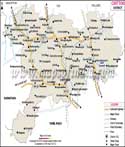
The Executive leadership of the district lies with the District Collector and District Magistrate at the Collectorate of Kurnool, which has a very synchronized network of civil services, police departments, rural development boards, etc. The district administrative layout is the three revenue divisions headed by Sub-Collector/Revenue Divisional Officer for administrative convenience and efficient revenue governance.
Kurnool Division: Controls the very urbanized heartland, major industrialised mining areas, and major transport corridors.
Adoni Division: Textile-rich with a major concentration on western agrarian communities in the historic commercial town of Adoni.
Dhone Division: Coordinates the large limestone quarries, cement plants, and associated rural areas.
The three revenue divisions are broken down into 26 Tehsils (also called Mandals in the local language), the main decentralized administrative and delivery units for citizens' services. Each mandal is administered by a Tahsildar, who is responsible for local land records, coordination of the public distribution system, and monitoring local development. At the bottom of this administrative structure is a network of highly structured local Gram Panchayat structures, with a total of 493 inhabited revenue villages. The villagers' panchayats liaise directly with the mandal and the divisional offices to make sure grassroots development is perfectly in sync with the district's fast industrialisation, and to build up infrastructure, to put into practice agricultural welfare policies, and to manage the resources in the villages.
| Official Name | Kurnool |
| Location | Andhra Pradesh |
| Area | 7977 sq. km |
| Population | 2271686 |
| Language | Telugu |
FAQs
Q1: How many villages are there in Kurnool District?
There are 519 villages in the district.
Q2: What is the total population of Kurnool District?
The population of Kurnool according to the 2011 census is 2271686.
Q3: What is the district famous for?
Kurnool District is known for the world's largest open cave system in Belum caves and sacred temples at Ahobilam and Yaganti. It has been industrialized with huge limestone deposits and cement making processes, and historically known for its signature culinary dish 'Uggani Bajji' and fort bastion 'Konda Reddy Buruju'.
Last Updated on : July 22, 2026
