






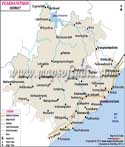
About
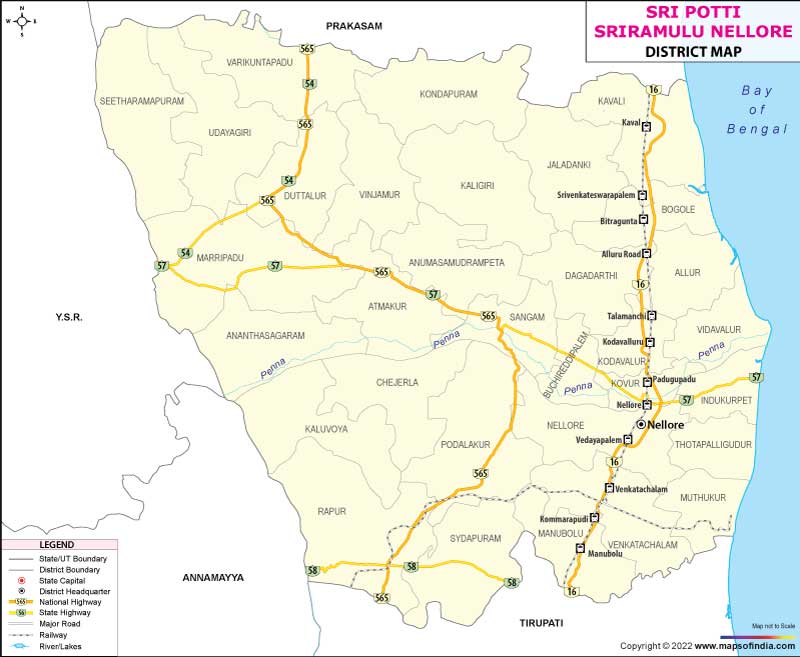
Nellore District is one of the most prominent cultural, coastal, and economic powerhouses in the southern part of the Coastal Andhra region of Andhra Pradesh in India. This ancient land is bathed by the tranquil waters of the Bay of Bengal and is also fed by the perennial life-giving streams of the Pennar River, and is a significant geographic link between the central centres of Andhra Pradesh and the sprawling industrial centres of Tamil Nadu.
Historical records also inform that the region was proudly named Vikrama Simhapuri, which translates to City of the Lion of Victory, in honor of the martial valour of its old royal rulers till the thirteenth century. The state government officially prefixed the district’s name to honour the legendary freedom fighter and linguistic martyr Sri Potti Sriramulu, who started his historic fast unto death, which directly led to a separate linguistic state ever becoming a part of the district’s name, a commitment of sacrifice and pride that is always remembered by the region’s Telugu speakers.
History & Culture
The cultural and historical story of the Nellore District is very rich and deep, extending across a number of millennia, and it was a major maritime epicenter where millennia-old spiritual philosophies, coastal kingdoms, and world merchant guilds all played a role. The old age of the district is vouched for by the numerous archaeological excavations made in the valley of the river Pennar, which have revealed Paleolithic tools and megalithic burial structures. In ancient times, Nellore was an important eastern region of the mighty Satavahana rulers, who had established early trade links with the Romans.
After the Satavahanas, the early Pallavas of Kanchi and the Western Chalukyas built early stone-cut temples and introduced the agrarian administrative system throughout the coastal plains. By the medieval period, Nellore was a coveted geopolitical prize, fought for by the Imperial Cholas, the Kakatiya Dynasty of Warangal, and the chieftains of the region, the Telugu Cholas of Nellore. King Manumasiddhi II of Vikrama Simhapuri was a benevolent king, and his rule in the thirteenth century was an absolute golden era of literary renaissance and cultural flourish.
In the late eighteenth century, the Nawabs transferred the administration of the region to the British East India Company, and in 1792, the Collectorate of Nellore was established. The people were ardent supporters of the Indian Independence Movement and had very active branches of the Home Rule League in the district, and they carried out large-scale protests during the Salt Satyagraha on the coastlines of the district.
Nellore district culture is a beautiful blend of deep Vedic culture, marine culture, and historical Islamic culture. The festivals are celebrated with great enthusiasm and grandeur. Sankranti is celebrated with great pomp in every agricultural parish with elaborate rangoli art and large-scale community feasts, and traditional cock fights. The annual festival known as Rottela Panduga or Roti Festival at the historic ‘Bara Shaheed Dargah’ on the banks of Nellore Tank is a splendid display of religious harmony, where millions of people from all over the world visit from diverse faiths to exchange rotis, fulfilling spiritual vows.
Nellore’s culinary culture is celebrated uniquely across India for its robust flavors and the use of locally sourced ingredients, where iconic dishes, such as the renowned, wonderfully tangy, fiery fish curry, ‘Nellore Chepala Pulusu’, traditional spices, ‘Molagapudi’, and an exquisite range of breakfast delicacies utilizing the local rice varieties, shape regional gastronomy.
Economy
Guntur District and the Krishna District, both with a mostly production-oriented economy, are reflected in the economic structure of Nellore District, which has a highly dynamic economy with an exceptional mix of advanced maritime logistics, intensive coastal aquaculture, and large-scale public and private industrial zones. The world-class Krishnapatnam Port is a large, deep-water private-public sea port serving millions of tonnes of bulk cargo such as coal, iron ore, and automated container traffic. This huge port facility has made Nellore a hub for industrial activities, with hundreds of manufacturing units, thermal power plants, and global logistics companies setting up large-scale operations along its exclusive coastal economic corridors. The Government Sector is a big employment anchor and also a development anchor for regulating the activities in Nellore District.
Nellore City serves as one of the main administrative centres of the south coastal belt, with large-scale operations of state and central government establishments, such as the massive complexes of the Nellore Municipal Corporation, the District Collectorate, and the major judicial establishments. The government is actively pushing the regional economy through the massive Andhra Pradesh Industrial Infrastructure Corporation-managed Sri City industrial enclave in the outer boundary of the district, and the specialized National Investment and Manufacturing Zones, which attract sustained investments in regional infrastructure.
The district is also quite stable for its secondary sector of industry, thanks to the public sector and heavy state support of the utilities. Thousands of skilled local technicians and labourers work in major public installations like the very large Sri Damodaram Sanjeevaiah Thermal Power Station at Krishnapatnam, as well as large-scale engineering projects under the Indian Railways. In addition, there are strong offices of the state-managed agricultural boards and the Marine Products Export Development.
Moreover, Nellore is also becoming a top medical and healthcare services city with world-class super-specialty hospitals and diagnostic centres serving the surrounding blocks of the coastal region. Also, the private retail, hotel, and educational services industry is in a state of expansion, as constant urban growth and the steady flow of corporate workers, port employees, and international traders into the modernising city limits continue to fuel demand.
Tourism
Nellore District has a splendid and richly varied tourist terrain. It is skillfully designed to integrate ancient rock-cut architecture, multi-faith holy destinations, and world-renowned ecological preserves. Sri Ranganathaswamy Temple, magnificently perched on the peaceful banks of Pennar River in Nellore City, is a primary focus for spiritual enthusiasts. This ancient temple complex has a towering and intricately carved seven-story Gopuram (tower). The breathtaking Galigopuram, which represents the zenith of medieval Dravidian architecture and houses a majestic deity of Lord Ranganatha, attracts pilgrims from all over the world.
The world-famous Nelapattu Bird Sanctuary is an oasis for those who want to experience ecological wonders and see wildlife. The protected sanctuary is a huge freshwater swamp and covers dense Barringtonia mangrove forests, and is home to one of the biggest breeding grounds of rare migratory birds in Southeast Asia, especially majestic Spot-billed Pelicans. Thousands of eco-tourists and international bird-watchers visit each winter to watch the amazing natural nesting of pelicans, painted storks, white ibises, and open-billed storks, which is highlighted annually by a fantastic Flamingo Festival organised by the State Government. The historic Bara Shaheed Dargah or sacred mausoleum for twelve martyred Sufi saints is another very interesting spiritual landmark; it is the birthplace of the world-famous festival of Rottela Panduga, signifying absolute cross-cultural peace and spiritual unity.
The district’s extensive tourism profile is complemented by historical fortifications and beautiful beach resorts. Rising above a picturesque hill range more than 3000 ft high, the magnificent Udayagiri Fort is an elite heritage tour spot for History buffs and heritage trekkers as it has ancient stone walls, historical temples, and ruined royal palaces with breathtaking panoramic views of the green valleys around. Moreover, visitors often unwind on the untouched sands of Mypadu Beach and Koduru Beach, which have been modernized by the local tourism department with water sports facilities, eco-friendly tracks, and modern beach resorts for families and foreign tourists to enjoy.
Demographics
Nellore District has a highly progressive, well-educated, and socially balanced population with stable growth and advanced socio-economic development indicators across all urban and rural blocks in the district. The total population of Nellore district is about 2,469,712.
The overall literacy rate is at an excellent level in the district, averaging 69.15%, owing to the huge network of top-notch public schools, advanced technical engineering colleges, and the best medical universities in the region. As analyzed by gender, the male literacy rate is about 75.74, and the female literacy rate is about 61.99%, showing a consistently reducing gender gap in education due to special interventions such as heavy government welfare measures and locally organized programmes.
Telugu is the absolute primary language of the district, used as the main language of administration, corporate, and domestic life by 87.96% of the population as their main language. Urdu is the biggest minority language used by 9.91% of the population, especially in historic urban centers; Hindi, English, and Tamil are also well used in higher education, international port logistics, and interstate food trading networks for seafood. A highly balanced sex ratio of 986 females to 1,000 males shows that the social health indicators are improving, the social health is good, and there is an equitable delivery of healthcare.
Administration
The administrative system of Nellore District is highly precise to give decentralized governance, a flawless revenue system, and quick implementation of public welfare schemes from the central collectorate to each of the rural hamlets. The district executive is based at the Nellore Collectorate, with the District Collector and District Magistrate acting as the executive head, who is responsible for coordinating with a well-organised cadre of civil officers, municipal commissioners, and officers in charge of regional development.
The district is divided into four big revenue blocks, each under the supervision of a revenue divisional officer (RDO) or a Sub-collector (Sub-col.) for efficient land administration and revenue governance:
- Nellore Division: Controls the densely urbanized region, business hubs, and urban amenities.
- Kavali Division: In charge of the northern coastal territories, with the centre being the major education and trade centre of Kavali.
- Gudur Division: oversees the large-scale aquaculture operations, mineral mines, and transport routes to the south.
- Atmakur Division: Regulates the governance within the interior agricultural valleys, historic hill ranges, and forest regions.
The four revenue divisions are further broken down into 36 Tehsils (officially known as Mandals), which are the basic decentralised units through which public services are delivered. There are Tahsildars for each mandal who keep the local land records, coordinate the public distribution system, and keep a check on the development of rural infrastructure. The basic level of this administration structure is 735 revenue villages with a well-established network of 722 Gram Panchayats.
| Facts of Nellore District | |
|---|---|
| Official Name | Nellore |
| Location | Andhra Pradesh |
| Area (km2) | 10440 |
| Population | 24.69 lakhs |
| Language | Telugu |
FAQs
Q1: What is the population of the district?
According to the 2011 census, the population of the district is 24.69 lakhs.
Q2: How many villages are there in Nellore?
There are 735 villages in the district.
Q3: What is the district famous for?
Nellore District is considered the Aquaculture Capital of India, where a huge commercial shrimp production and international seafood export is achieved. It is also known worldwide for the historic Sri Ranganathaswamy Temple, the world-famous bird sanctuary at Nelapattu and the multi-faith festival of Rottela Panduga at Bara Shaheed Dargah.
Last Updated on : July 22, 2026
