

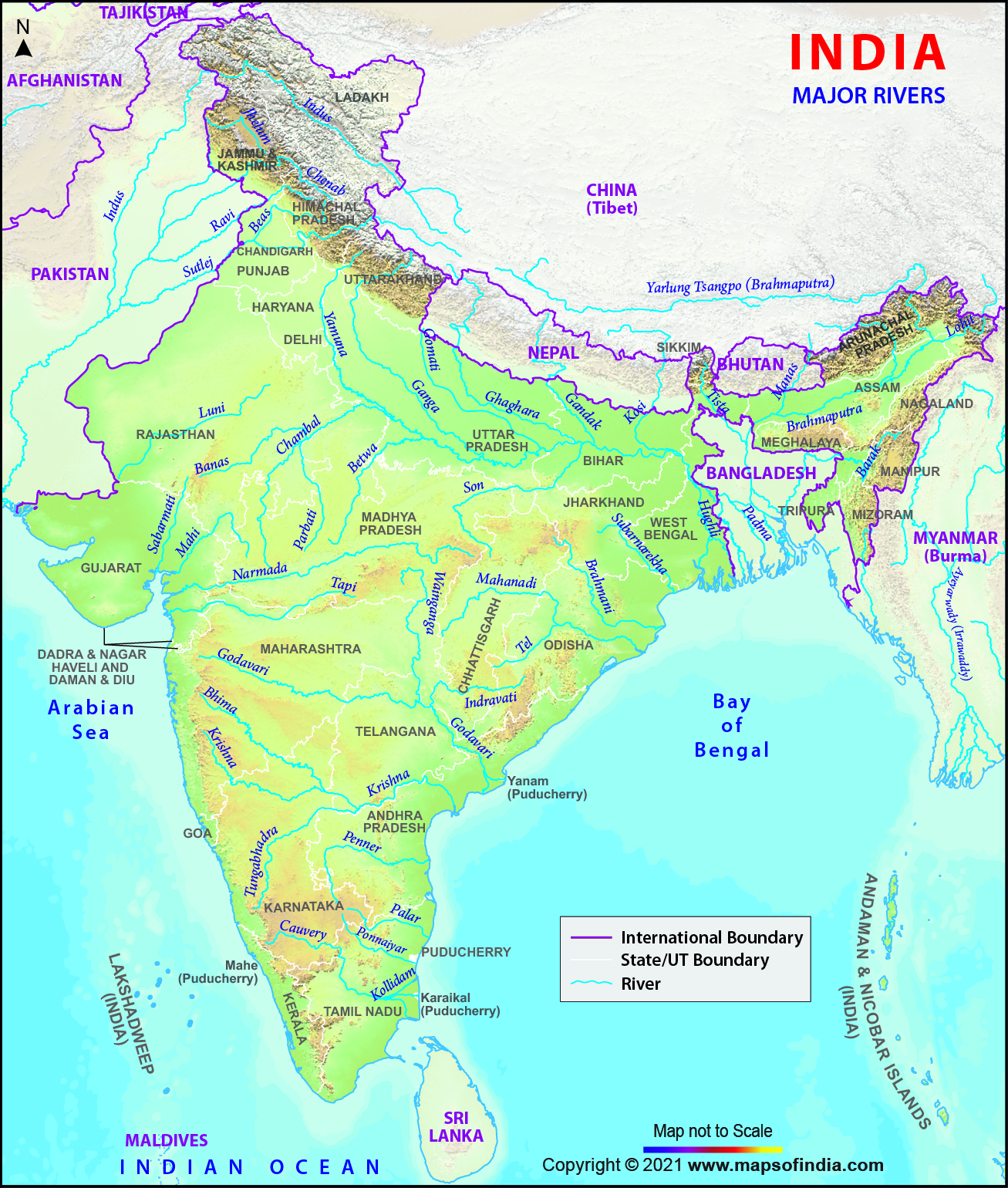



The term river system refers to the ‘river along with its tributaries'.
Based on their source, the Indian River system is classified into the Himalayan Rivers and Peninsular Rivers.
The Himalayan Rivers, as the name suggests, originate from the Himalayas and flow through the Northern Plains. The Rivers of India, originating in the Himalayas, are among the most significant water resources of the country. The indian river system includes important Himalayan and Peninsular river networks that support millions of people across different regions.
The major Himalayan River systems are:
Peninsular River System or Peninsular Drainage emerges mainly from the Western Ghats. Since the Western Ghats form a ‘water divide’, these rivers either flow eastwards into the Bay of Bengal or into the Arabian Sea towards the west. Peninsular Rivers are ‘rain-fed’ rivers and form an important part of the Indian River Systems. The river system of India is divided into different categories based on origin, flow pattern, and drainage system. The major Peninsular River Systems are:
- Mahanadi
- Godavari
- Krishna
- Cauvery
These do not originate in glaciers but are rain-fed rivers. These rivers reduce considerably or dry up during the summer.
THE HIMALAYAN RIVERS
Indus River System
The reference to the Indus River or Sindhu River is found in the early Hindu Scriptures and mythological texts. It is known as the ‘Puranik River’. The river originates in Tibet near Mansarovar Lake. Flowing westwards, it enters India in Jammu and Kashmir, further flows through Himachal Pradesh and Punjab, and enters Pakistan. Flowing further westwards, it reaches the Arabian Sea near Karachi. Indus is the largest river in Pakistan and is the country's national river. Its tributaries in India are Zanskar, Nubra and Shyok, and Hunza in Pakistan. Sutlej, Ravi, Beas, Chenab, and Jhelum are its other tributaries, after which the state of Punjab is named. These are important Tributaries of Indian Rivers frequently studied in Indian geography. The Indus River System is an important part of the major rivers of India as it contributes to the overall drainage pattern of the Indian subcontinent.
Ganga River System
The Ganga (Ganges) River system is the largest river system in India. It originates in the Gangotri glaciers. The upstream Bhagirathi joins the other stream, named Alaknanda, at Devprayag to form the River Ganga. Ganga has tributaries on both banks; its right bank tributaries are the Yamuna (which is a major river) and the Son. While Gomti, Ghaghara, Gandak, and Kosi are some left bank tributaries. The Ganges flows through the Indian states of Uttarakhand, Uttar Pradesh, Madhya Pradesh, Himachal Pradesh, Bihar, and West Bengal. It finally reaches the Bay of Bengal. The Ganga River System is one of the most important Rivers of India culturally and economically. The Ganga is among the most significant rivers name included in the complete River Map of India.
Yamuna River System
The Yamuna is a major river system in Northern India. The river rises from the Yamunotri Glacier and flows through Uttarakhand, Uttar Pradesh, and Haryana. It passes through Delhi, Mathura, and Agra and meets the rivers Chambal, Betwa, and Ken to finally join the Ganga at Prayagraj. Major tributaries of the Yamuna are the Tons, Chambal, Hindon, Betwa, and Ken. These are important Tributaries of Indian Rivers visible on a Complete river map of India with names. The Yamuna is one of the important major rivers of India and forms a significant part of the river system of India.
Brahmaputra River System
The Brahmaputra, one of the major rivers in India, originates in the Angsi glacier of the Himalayas in Tibet. There, it is known as the Tsangpo River. It enters India in Arunachal Pradesh and is called the Dihang River. It is joined by many other tributaries: the Dibang, the Lohit, and the Kameng rivers to form the main Brahmaputra River and flows its longest course through Assam, enters Bangladesh and finally falls into the Bay of Bengal. Brahmaputra carries the highest water discharge among Indian rivers. The Brahmaputra River System is also one of the most dynamic Indian River Systems. The Brahmaputra is among the important rivers name shown on the River Map of India and is an essential part of the indian river system.
THE PENINSULAR RIVERS
Mahanadi
The Mahanadi is a major river in East-central India. It originates in the Sihava mountains of Chhattisgarh and flows its major course through the state of Odisha (Orissa). This river deposits more silt than any other river in the Indian subcontinent. Mahanadi flows through the cities of Sambalpur, Cuttack, and Banki. It is prominently marked on the River Map of India. Godavari
Godavari
The Godavari River covers the second-longest course in India after the Ganga. The river originates at Triambakeshwar in Maharashtra, and together with its tributaries (Pravara, Indravati, Maner Sabri, etc.), flows through the states of Maharashtra, Chhattisgarh, Madhya Pradesh, Odisha (Orissa), Telangana, Andhra Pradesh, and Karnataka, to finally flow into the Bay of Bengal. Thanks to its long course, the river is described as Dakshina Ganga. Because of its long course, the river is described as Dakshina Ganga and is one of the major Rivers of India. The Godavari is one of the major rivers of India and is clearly visible in the river system in India due to its extensive drainage area.
Krishna River
The Krishna is the third-longest river in India, with a length of about 1,400 km. Originating from Maharashtra's Mahabaleshwar region, it flows through Karnataka, Telangana, and Andhra Pradesh to finally pour into the Bay of Bengal. The major tributaries of the river Krishna are Ghataprabha, Malaprabha, Bhima and Tungabhadra. These important Tributaries of Indian Rivers support agriculture and irrigation.
Kaveri River
The Kaveri (Cauvery) is a major river in Southern India and originates in Kodagu, Karnataka, in the form of a spring at Brahmagiri Hill at Tala Kaveri. Also known as the Ganges of the South, it is one of the holiest rivers in South India. Kaveri River widens as many tributaries, such as Hemavati, Moyar, Shimsha, Arkavati, Honnuhole, Kabini, Bhavani, Noyyal, and Amaravati, join it. It flows about 805 kilometres across the three states, Karnataka, Kerala, and Tamil Nadu, slightly touching Puducherry and drains into the Bay of Bengal. It is an essential river shown on the Complete River Map of India with names.
The Kaveri is one of the key rivers name included in the detailed study of the indian river system.
Narmada and Tapi or Tapti
The Narmada and the Tapti are the only major rivers that flow into the Arabian Sea. The total length of the Narmada flowing through the states of Madhya Pradesh, Maharashtra, and Gujarat equals 1,312 km. Amarkantak Plateau in Anuppur district, Madhya Pradesh, is the place of origin of the Narmada. Flowing mainly through Central India, from an eastward direction to a westward direction, the Narmada merges into the Arabian Sea. These west-flowing Rivers of India are unique among the Indian River Systems.
The Tapti follows a parallel course to the South of the Narmada, flowing through the states of Maharashtra and Gujarat on its way, and drains into the Arabian Sea near the Gulf of Khambhat. Its three major tributaries are Purna, Girna, and Panjhra.
Almost all the major Indian cities are situated on the banks of their rivers. Indian rivers also play a crucial role in the lives of their people, economically as well as culturally. Indian agriculture is dependent on irrigation of water drawn from its network of rivers. Most of its religious, cultural, and harvest festivals are celebrated on the banks of rivers. Like most ancient religions, the Hindu religion and its mythology regard rivers as sacred. There are nine important rivers of India, and they are the Ganges, Yamuna (a tributary of the Ganges), Brahmaputra, Mahanadi, Narmada, Godavari, Tapi, Krishna, and Kaveri. Parts of the Indus River also flow over Indian soil. These major rivers are clearly visible on the Complete river map of India with names.
The rivers name mentioned in the Indian river map represents the diversity and importance of the river system in India.
Eight important rivers, together with their various tributaries, comprise the River System of India. The majority of the rivers discharge their waters into the Bay of Bengal; nevertheless, a number of the rivers whose courses take them across the western end of India and in the direction of the east pour into the Arabian Sea. Northern portions of the Aravalli range, portions of Ladakh, and the barren areas of the Thar Desert have Inland Drainage. (Refers to drainage where the rivers do not reach an ocean or sea but empty their waters into a lake or an inland sea).
The indian river system helps explain the drainage patterns, river origins, and flow directions across different parts of India.
The River Systems of India
| Name | Length (km) | Area | Originates From | Ends in | Places Benefited |
|---|---|---|---|---|---|
| Indus | 3180/ 1114 in India | 3,21,289 Sq.Km. | in Tibet in northern slopes of Mount Kailash | Arabian sea | India and Pakistan |
| Ganga (Bhagirathi) | 2525 | 1.08 million Sq.Km. | Gangotri in Uttrakhand | Bay of Bengal | Uttar Pradesh, Uttrakhand, Bihar, West Bengal |
| Yamuna (Jamuna) | 1376 | 366223 Sq.Km. | Yamunotri in Garhwall | Bay of Bengal | Delhi, Haryana and UP |
| Brahmaputra | 916 - in India | 194413 Sq.Km. - in India | Angsi glacier in Tibet | Bay of Bengal | Assam, Arunachal Pradesh |
| Kaveri (Dakshina Ganga or Ganges of the south) | 765 | 81155 Sq.Km. | Brahmagiri hills in Kogadu, Karnataka | Bay of Bengal | Karnataka and Tamil Nadu |
| Godavari | 1465 | 3,12,812 Sq.Km. | Triambakeshwar in Maharashtra | Bay of Bengal | South-eastern part of Andhra Pradesh |
| Krishna | 1400 | 258948 Sq.Km. | Mahabaleshwar in Maharashtra | Bay of Bengal | Maharashtra & Andhra Pradesh |
| Narmada | 1312 | 98,796 Sq.Km. | Amarkantak in Madhya Pradesh | Arabian Sea | Madhya Pradesh and Maharashtra |
| Tapti | 724 | 65,300 Sq.Km. | Betul district of Madhya Pradesh in the Satpura range | Arabian Sea | Madhya Pradesh and Maharashtra |
| Mahanadi | 858 | 1,41,600 Sq.Km. | Sihava mountains of Chhattisgarh | Bay of Bengal | Jharkhand, Chhattisgarh, Orissa |
| Vaigai | 258 | 7,741Sq.Km. | Varusanadu Hills | Bay of Bengal | Madurai in Tamil Nadu |
| Periyar | 244 | 5,398 Sq.Km. | Sivagiri peaks of Sundaramala, Tamil Nadu. | Bay of Bengal | Tamil Nadu and Kerala |
| Thamirabarani | 185 | 4,400 Sq.Km. | Agastyarkoodam peak of Pothigai hills of the Western Ghats, | Gulf of Mannar | Tamil Nadu |
FAQs
Q1: What is the river system of India?
India's river system includes Himalayan and Peninsular rivers that drain different regions and support agriculture, ecosystems, and settlements.
Q2: Which are the major rivers shown on the India river map?
Major rivers include Ganga, Yamuna, Brahmaputra, Godavari, Krishna, Narmada, and Kaveri.
Q3: How many major rivers are there in India?
India has several major river systems divided mainly into Himalayan and Peninsular groups.
Q4: What are Himalayan rivers?
Himalayan rivers originate from glaciers and mountains and usually flow throughout the year.
Q5: What are Peninsular rivers?
Peninsular rivers originate from plateaus and mainly depend on rainfall.
Q6: Which is the longest river in India?
The Ganga is generally considered the longest major river flowing within India.
Q7: Why are rivers important in India?
Rivers support farming, drinking water supply, transportation, and biodiversity.
Q8: Can I find rivers state-wise on the India river map?
Yes, a detailed river map can help identify rivers flowing through different states.
Last Updated on: July 07, 2026
India general Maps