

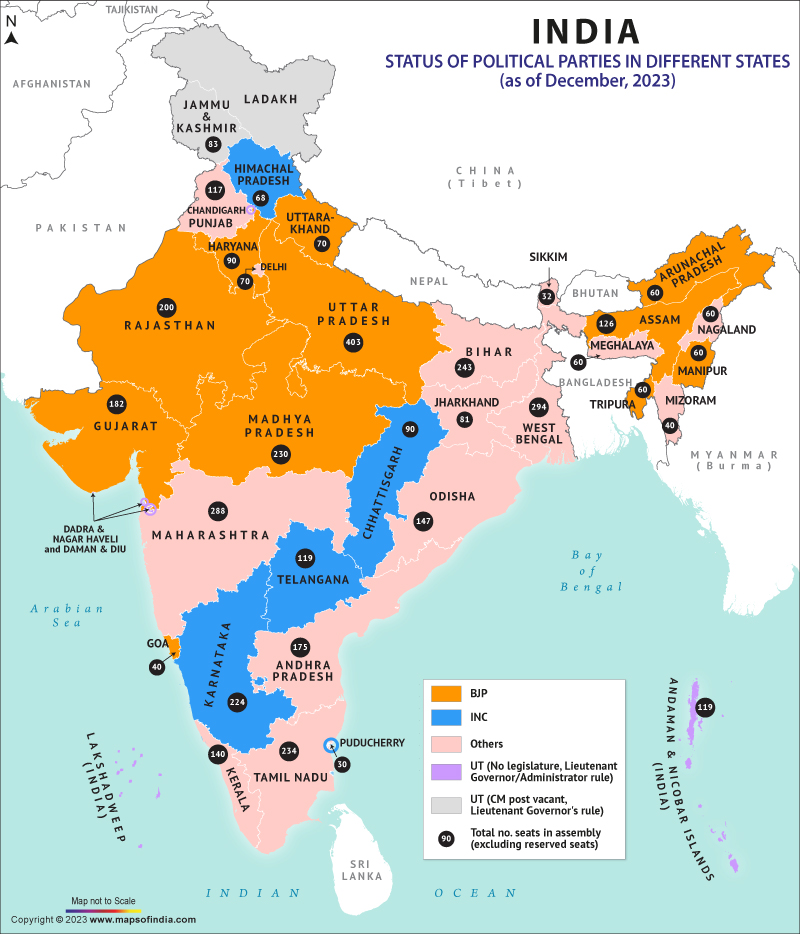



India is the largest democracy in the world and has a federal system of government, with power shared between the Union Government and the State Governments. Each and every state in India has its own elected legislative assembly and chief minister, and union territories are either under direct control of the Centre or have a limited legislative authority. Each state's ruling party has a significant influence on education, health care, infrastructure, agriculture, law and order and welfare schemes policies.
Due to the change in the political environment in India, such as assembly elections, alliance politics, coalition governments, and regional movements, the political landscape of India is constantly changing. Regional political parties play a significant role in the politics of the states, and national political parties such as Bharatiya Janata Party (BJP) and Indian National Congress (INC) rule many states. The discussion around ruling parties in India and the role of Indian state governments has become increasingly important in recent years.
The recent assembly election in West Bengal, Tamil Nadu, Assam and Kerala has changed the political landscape of India once again. These elections also reshaped the current ruling parties in India and influenced the overall state-wise ruling party list across the country.
How State Governments Work in India
The Indian Constitution has laid a pattern of governance with separation between the centre and states. Each state has a Government headed by a Chief Minister, who is usually the leader of the largest party or coalition in the Legislative Assembly.
The Governor is a constitutional head of the state, who is appointed by the President of India. The Council of Ministers is responsible for aiding the Chief Minister in administration. The State governments are responsible for the following subjects:
- Police and public order
- Agriculture
- Public health
- Local governance
- State transport
- Education (shared with Centre)
- Land and revenue affairs
State-wise Ruling Parties List
Below is an overview of major ruling parties across Indian states in 2026:
This state-wise ruling party list helps readers understand the distribution of power among various political parties in the country.
| List of Current Chief Ministers of India | ||||
|---|---|---|---|---|
| S.No. | State Name | Name of Chief Ministers | From | Ruling party of the state |
| 1 | Gujarat | Bhupendrabhai Patel | Sep 13, 2021 | BJP |
| 2 | Himachal Pradesh | Sukhvinder Singh Sukhu | 11 Dec 22 | INC |
| 3 | Karnataka | Siddaramaiah | 18 May 2023 (Oath date) | INC |
| 4 | Uttarakhand | Pushkar Singh Dhami | July 04 2021 | BJP |
| 5 | Chhattisgarh | Vishnu Deo Sai | 13 Dec 2023 | BJP |
| 6 | Punjab | Bhagwant Mann | 16 March 2022 | AAP |
| 7 | Arunachal Pradesh | Pema Khandu | Jul 17, 2016 (re-elected on May 26, 2019) | BJP |
| 8 | Assam | Himanta Biswa Sarma | 10 May 2021 (re-elected in May 2026) | BJP |
| 9 | Goa | Pramod Sawant | 19 Mar 2019 | BJP |
| 10 | Haryana | Nayab Singh Saini | 12 Mar 2024 | BJP |
| 11 | Manipur | Yumnam Khemchand Singh | 4 Feb 2026 | BJP |
| 12 | Tripura | Manik Saha | 15 May 22 | BJP |
| 13 | Uttar Pradesh | Yogi Adityanath | 19 Mar 2017 | BJP |
| 14 | Bihar | Samrat Choudhary | 15 Apr 2026 | BJP |
| 15 | Meghalaya | Conrad Sangma | 6 Mar 2018 | National People's Party |
| 16 | Mizoram | Lalduhoma | 08 Dec 2023 | Zoram People's Movement |
| 17 | Nagaland | Neiphiu Rio | 8 Mar 2018 | Nationalist Democratic Progressive Party |
| 18 | Sikkim | Prem Singh Tamang | 27 May 2019 | Sikkim Krantikari Morcha |
| 19 | Andhra Pradesh | Sri Nara Chandrababu Naidu | 12 June 2024 | Telugu Desam Party |
| 20 | NCT of Delhi (UT) | Smt. Rekha Gupta | 20 Feb 2025 | BJP |
| 21 | Kerala | V. D. Satheesan | 18 May 2026 | UDF |
| 22 | Odisha | Shri Mohan Charan Majhi | 12 Jun, 2024 | BJP |
| 23 | Tamil Nadu | C. Joseph Vijay | 10 May 2026 | TVK |
| 24 | Telangana | Anumula Revanth Reddy | Dec 7, 2023 | INC |
| 25 | West Bengal | Suvendu Adhikari | 9 May 2026 | BJP |
| 26 | Madhya Pradesh | Mohan Yadav | 13 December 2023 | BJP |
| 27 | Puducherry (UT) | N. Rangaswamy | 7 May 2021 | All India N.R. Congress |
| 28 | Rajasthan | Bhajan Lal Sharma | 15 Dec 2023 | BJP |
| 29 | Jharkhand | Hemant Soren | 04 Jul 2024 | Jharkhand Mukti Morcha (JMM) |
| 30 | Maharashtra | Shri Devendra Fadnavis | 05 Dec 2024 | BJP |
BJP-ruled States in India
In terms of the number of states controlled in India, the Bharatiya Janata Party is still the strongest political party. The BJP's rise in the last ten years has changed the political scenario of India.
By 2026, the BJP or BJP-led government is in power in many states, such as:
- Uttar Pradesh
- Gujarat
- Madhya Pradesh
- Rajasthan
- Chhattisgarh
- Haryana
- Assam
- Maharashtra
- Uttarakhand
- Goa
- Tripura
- Arunachal Pradesh
- Odisha
- Delhi
The governance structure of the party has been very much on the lines of infrastructure development, welfare schemes, digital governance, nationalism and leadership of Narendra Modi.
As per the latest political reports, the BJP's reach seems to be growing even as it faces strong opposition in certain regions in various states. Political analysts often compare the rise of BJP-ruled states in India with the changing influence of opposition parties in different regions.
Congress Ruled States
The Indian National Congress continues to be the main opposition party and runs some major states of India.
The current governments led by Congress are in:
- Karnataka
- Telangana
- Himachal Pradesh
- Kerala
But the party is challenged by the BJP and the new regional parties in various states. The competition between Congress and the current ruling parties in India continues to shape national politics.
Regional Parties in Power
Indian regional parties remain influential in Indian politics. These parties are more interested in the issue of identity, language, culture and local development issues in their respective states.
Regional parties continue to impact the ruling parties in India by influencing coalition politics and alliance formations at both state and national levels.
The dominant political parties (by power) in each of the regions are:
| State | Regional Party |
|---|---|
| Tamil Nadu | TVK |
| Punjab | AAP |
| Jharkhand | JMM |
| Andhra Pradesh | TDP |
| West Bengal (former ruling party) | TMC |
| Sikkim | SKM |
| Mizoram | ZPM |
| Meghalaya | NPP |
For example:
- Dravida Munnetra Kazhagam and AIADMK have dominated the political landscape of Tamil Nadu. Dravida Munnetra Kazhagam and AIADMK have been the backbone of Tamil Nadu politics in the past.
- For several years, Trinamool Congress had been ruling West Bengal till the change in 2026.
- Aam Aadmi Party changed the course of politics in Punjab and Delhi.
NDA vs. India Bloc State Distribution
Indian politics is now dominated by two political organizations: NDA (National Democratic Alliance) The NDA is led by the BJP and contains other parties like:
- JD(U)
- TDP
- Shiv Sena faction
- JD(S)
- The Lok Janshakti Party is divided into factions
- DMK
- TMC
- Shiv Sena (UBT)
- RJD
- JMM
- Left parties
- NCP faction
The NDA is stronger in the states at present than the INDIA bloc, particularly after winning the elections in Assam and West Bengal in recent times.
BJP vs INC State Count
National politics are captured in the political battle between the BJP and the Congress.
Approximate State Influence in 2026
| Party | States Governed Directly or Through Alliance |
|---|---|
| BJP / NDA | 17+ states |
| Congress / INDIA Bloc | 4–6 states |
| Regional Parties | Several states independently |
The BJP is still prevalent in northern, western and central India, while Congress is stronger in the southern part of the country.
The regional parties retain a balance-of-power status in several states and influence at the national level through coalition building.
Alliance Politics and Coalition Governments
A coalition government is one of the important aspects of democracy in India. Many of the states have not a single party that has won an outright majority, which results in a coalition government.
Examples include:
- Bihar’s NDA coalition
- Maharashtra’s alliance politics
- Meghalaya coalition government
- Nagaland NDPP-BJP alliance
The debate over “One Nation, One Election” has also brought up political issues between national and regional parties.
Recently Changed Governments
In 2026, substantial changes in the electoral landscapes occurred in several states.
West Bengal
The BJP had broken the shackles of years of Trinamool Congress rule in Bengal.
Tamil Nadu
With Vijay, TVK was born as a new political entity, altering the political landscape of Tamil Nadu.
Kerala
The Congress-led UDF alliance was to come back, as shown by the trends in the elections, when the Left government was under anti-incumbency pressure.
Assam
The BJP consolidated the northeast clout by keeping Assam for the third successive term.
The transformation of Indian politics at the blink of an eye due to leadership, alliances and sentiments of the voters.
Union Territories and Administrators
India currently has 8 Union Territories.
In some UTs, a government is elected, and in others, it is directly administered through an Administrator or Lieutenant Governor (L-G) designated by the Centre.
| Union Territory | Governance Structure |
|---|---|
| Delhi | Elected government + LG |
| Puducherry | Elected government + LG |
| Jammu & Kashmir | UT administration |
| Chandigarh | Administrator |
| Ladakh | Lieutenant Governor |
| Andaman & Nicobar Islands | Lieutenant Governor |
| Lakshadweep | Administrator |
| Dadra & Nagar Haveli and Daman & Diu | Administrator |
The Union Government exercises greater control over UTs compared to states.
Latest Assembly Election Updates
The 2026 Assembly elections turned into one of the most critical political events in recent years.
Key highlights include:
- BJP's big wins in West Bengal and Assam
- The remarkable growth of TVK in Tamil Nadu
- Congress Alliance's comeback in Kerala.
- There has been a diminution of the influence of regional parties, including some of the older ones.
Ruling Party Trends in India
In India, there are several important political developments that can be seen today:
- The growth and infiltration of the BJP in the eastern and southern parts of the country.
- Emergence of new regional leaders/parties.
- Loss of some traditional regional strong points.
- A rise in the significance of welfare politics.
- Increased usage of social media and digital campaigns.
- More emphasis on coalition management.
In the federal democracy of India, the regional demand, national leadership, alliance politics and voter expectations collectively drive the country's dynamic political landscape.
Last Updated on : May 08, 2026
India general Maps
