

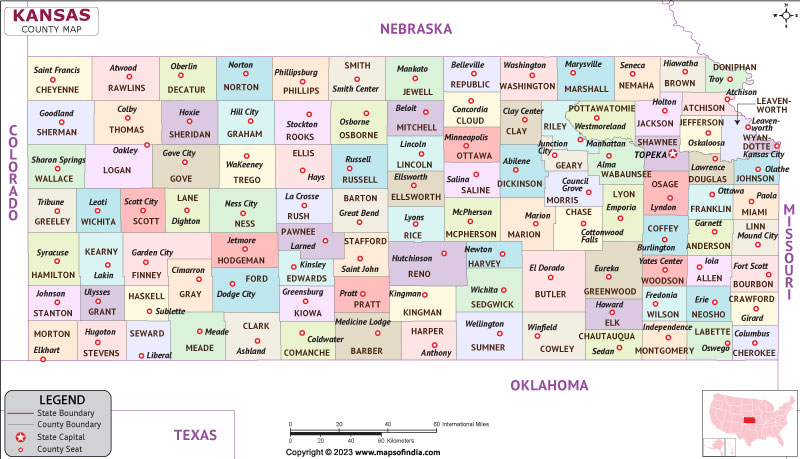





Kansas is a part of the central United States, whose vast plains have made it a place full of rich agricultural heritage and vibrant culture. It was founded as a state in 1861 and played an important role both in the westward movement and the Civil War - especially in the "Bleeding Kansas" slavery crisis.
Its capital is Topeka and its most populous city is Wichita, which serves as a center for aviation and manufacturing. The province is dotted with varied landscapes, from the Flint Hills rolling prairies to the rugged Smoky Hills country. It is also an important wheat, corn, and soybean-producing state and is often referred to as the "Breadbasket of America." Another unique feature is the number of national parks and historical sites, such as Tallgrass Prairie National Preserve.
Culturally, it presents a combination of influences, which include Native American, Western, and Midwestern; an influence visible in festivals, music, and cuisines. Sporting events— particularly college basketball and football—have central importance in the life of the community; however, local events bring in all the richness about its agricultural roots and long history.
History
There are distinctly marked periods and developments of change that shape not only the state but also a wide canvas of history in the USA.
The province of Kansas was earlier an abode for different tribes of Native American Indians before its settlement by European colonizers. It housed people who were dependent upon agriculture and hunting as ways of acquiring livelihoods within these cultures.
European explorers who settled in the 17th century made a foundational basis for change. The French and the Spanish explorers crossed the region; and by the beginning of the 19th century, the province had found its part in the United States' territorial westward movement when it came after the Louisiana Purchase in 1803.
Perhaps the most important occurrence in the history of the region was the Kansas-Nebraska Act passed in 1854. It was an act whereby the settlers voted to determine whether their territories would be free or slave states by popular sovereignty. This led to fierce battles between pro-slavery and anti-slavery factions, who came to be known as "Bleeding Kansas."
The mid-1850s violence attracted national attention due to the flood of pro-slavery advocates into the territory that led to widespread bloodshed. The province soon entered the Union as a free state on January 29, 1861, just before the outbreak of the Civil War.
The state produced troops for the Union and became a hotbed for abolitionist activism during the war. Post Civil War, the region developed considerably. The railway in the 1860s and 1870s helped people and goods movements, which advanced agriculture and trade considerably. The state became a significant agricultural producer, mostly specialized in wheat and cattle industries, hence was nicknamed the "Sunflower State."
The late 19th and early 20th centuries brought their challenges, including economic hardship, droughts, and population shifts. Yet the province continued to evolve, embracing a rich cultural heritage that included a blend of Native American, Western, and immigrant traditions. Thereby, the province’s history is the tapestry of conflict, resilience, and commitment to progress that continues to influence the identity of the state today.
Culture
The state of Kansas is cultured and rich in diversity, molded together by its history, geography, and the various people who have settled there. Its tapestry of culture is that of Native American traditions mixed with pioneer heritage and influenced by later immigrants.
Part of this background is shaped by the "Bleeding Kansas" era, and while it may have been anti-slavery, it resulted in the province’s admission into the United States as a free state. This aids in justifying many historical sites and museums, such as the Kansas Museum of History and the Brown v. Board of Education National Historic Site, which continue to be rich sites with respect to their cultural aspects.
Agriculture is a central aspect of the province’s culture. Known as the "Breadbasket of America," this state is one of the leading producers of wheat, corn, and other crops. The annual Kansas State Fair, held in Hutchinson, showcases the agricultural prowess of the state with livestock competitions, local crafts, and food, creating a sense of community and celebration.
The province has a vibrant arts scene, especially concerning visual arts, music, and literary works. There are very many artists and writers that call the province their home. This includes world renowned Langston Hughes, an African American poet known for his work as a social activist who was born in Joplin but strongly associated with the province.
The music scene is pretty diverse in the province, particularly blending in genres such as country, blues, jazz, and rock. Wichita hosts many music festivals that highlight both local talent and legendary artists. Traditional American folk and bluegrass are also very alive in rural communities.
The region also serves as a host to a variety of festivals that celebrate its diverse culture. The annual Fiesta in the Park in Wichita highlights Hispanic culture with music, food, and dance, while the Smoky Hill River Festival in Salina showcases local artists, crafts, and performances.
The region’s strong agricultural base has a deep influence on the culinary culture. Comfort food with the local ingredients makes up much of the traditional cuisine. Kansas City-style barbecue, cornbread, and a number of pies are standard. Farmers' markets abound in fresh produce and artisanal goods that show the heritage of the state.
Language
Language spoken within the province is a reflection of the cultural heritage and influences of the state. While English is the most commonly spoken language throughout the state, the region also has a variety of other languages because of its immigrant communities.
Spanish is widely spoken in areas with significant Hispanic populations, and it is often used in cultural festivals, schools, and local businesses. The Native American languages that exist within the state borders include Kansa and Osage.
Apart from those speaking English and Spanish, there are communities who speak Vietnamese, German, or other languages, which reflects upon the history of immigration in the state.
Geography
The province is situated in the heart of the central United States; located in the vast, rolling country of the Great Plains region that is generally characterized by extensive stretches of land and fertile plains. The state borders Nebraska on the north, Missouri to the east, Oklahoma in the south, and Colorado to the west.
The state’s central location has earned it the name "the Sunflower State, after its state flower; the native wild sunflower that blooms in the area. Topographically, the province is almost a flat plain, as high as 700 feet in the east, whereas in the west the elevation approaches as much as 4,000 feet.
The eastern part of the state is more fertile and hilly compared to the western portion, which consists of expansive plains and prairies. The Flint Hills, in the east-central region, have tallgrass prairie, and is one of the remaining large areas of tallgrass prairie in the world. This area is particularly remarkable in terms of biodiversity and is an important habitat for many species of wildlife.
The province is characterized by the existence of a continental climate. Summers are hot, while winters are cold. On the weather front, it is prone to severe weather such as thunderstorms and tornadoes during spring and early summer.
In terms of its hydrology, the major rivers are the Kansas River, also known as the Kaw River, which flows west to east and joins the Missouri River, and the Arkansas River, which borders the southern part of the state. These rivers have been crucial for transportation, agriculture, and water supply since the beginning of history, shaping the region’s economic landscape.
A number of notable geographic features that have been located in this state are the Smoky Hills, and the High Plains aside from numerous national parks as well as wildlife refuges for the conservation of exclusive state ecosystems. Some among these are the Kansas Landscape Arboretum as well as the Kansas Tallgrass Prairie National Preserve, which are known to elegantly preserve beauty.
Agriculture is one of the most significant contributors to the land use of Kansas's economy, and wheat is the most vital crop. Due to this, the province is sometimes also referred to as the "Wheat State" because it ranks among the top states that produce the most wheat in the United States. Other vital crops are corn, soybeans, and sorghum.
| Official Name | Kansas |
| Capital | Topeka |
| Area | 82278 km2 |
| Population | 2940865 (2020) |
| Religion | Christianity |
| Language | English |
| Major Cities | Topeka, Wichita, Kansas City |
FAQs
Q1: Why do we refer to Kansas as the Sunflower State?
In Kansas’ case they are known as the Sunflower State which is due to wild sunflowers which grow in that area. The sunflower also is the state flower and has become a very strong symbol of Kansas’ natural beauty, agriculture, and identity.
Q2: What languages are spoken in Kansas?
English is in the main use in Kansas. In many communities Spanish is very much present which is to say in the large cities and rural areas which are in the agricultural sector. Also Kansa and Osage which are Native American languages are maintained by Indigenous groups.
Q3: How important is agriculture to Kansas?
Agriculture is the base of Kansas’ economy. In the U.S. Kansas is a leader in the production of wheat, beef cattle, corn, soybeans, and sorghum. Also farming supports very many jobs and we see large scale food production which is what that state is known for.
Q4: Does Kansas experience tornadoes?
Yes. Kansas is in Tornado Alley which is active mainly during spring and early summer. We have modern forecasting systems and emergency preparedness programs which help to reduce those risks for residents and visitors.
Q5: What does Kansas’ economy mainly consist of?
Agriculture is the largest industry in Kansas. Also we see health care, renewable energy, transport, finance, education and advanced manufacturing as very important sectors. Wichita is a world leader in aviation manufacturing.
Q6: When is the best time to go to Kansas?
March to June and September to November are the best times to visit Kansas. In these seasons the weather is great, outdoor activities are at their peak and also many local festivals and agricultural events take place.
Last Updated on: July 23, 2026

