




Introduction
Bhavnagar district is located in the Saurashtra peninsula of Gujarat. It was established in the 1700s under Maharaja Bhavsinhji Gohil. Positioned near the sea, the city grew shaped by vessels arriving, departing, and docking. Busy market lanes hum alongside a precise craft: refining diamonds into clarity. Further down, at Alang, ships come to be taken apart - this site ranks among global leaders in such work. Still, machinery does not define everything; older rhythms persist beneath the surface. Takhteshwar Temple climbs upward, opening wide sightlines across land and water. Meaning while steel yields to torches, knowledge fills shelves inside Barton Library. Older echoes linger where newer rhythms take shape, forming a place that holds history while stepping forward. What stands out in Bhavnagar reveals itself through quiet gestures, long-held customs, besides how time folds gently into daily routines.
History
Bhavnagar district lies within Gujarat’s Saurashtra peninsula, holding a past built across centuries through shifting rulers, sea-based exchange, royal governance, alongside deep-rooted traditions. Positioned near the Gulf of Khambhat, this district offered clear benefits - not distant waters but access enabling ships, goods, economic growth, shaping its role as a port-driven hub. Begun long ago, it expanded to dominate the Gohilwad landscape in size and influence. While known for valor, its leaders showed sharp judgment in governance, focusing on economic channels alongside defense.
Trade routes flourished because harbors improved steadily under state support. Ship construction received active backing, allowing local traders to sail beyond coastal limits. Cotton, salt, and regional produce moved through these sea lanes regularly. As ships traveled farther, people and ideas flowed back, shaping a diverse urban life shaped by foreign contacts. Distance did not isolate; instead, exchange defined daily reality near the shore. Bhavnagar stood out - not just in wealth, but in how it chose to govern. While tradition held sway elsewhere, its leaders poured energy into schools, infrastructure, and change. This forward motion planted seeds early, shaping what the city would become once India gained freedom.
Bhavnagar kept changing after independence, mixing old traditions with new industries. Notably recognized abroad, its diamond-cutting trade began drawing global attention. Coastal positioning helped shape another key activity - salt manufacturing grew steadily here. Starting with dismantling vessels, Alang emerged as a massive ship-recycling site, rare in scale worldwide. Offshore freighters arrive daily, stripped down by workers who recover steel for reuse - livelihoods tied closely to tides of global trade. Though scrapping fuels local income, concerns surface over safety and long-term environmental toll.
Bhavnagar changed over time, yet never lost what made it distinct. Though new developments have arrived, old customs remain strong - festivals unfold yearly, handmade goods still circulate, residents speak warmly of their roots. Where temples stand quietly beside factories, life moves at two different rhythms. Palaces share space with schools shaped by current needs. This blend shapes how the town sees itself - not frozen in the past, nor swept into the future.
Monuments exist, certainly; however, the real story hides within daily routines, passed without words between generations. The past unfolds through movement, change, yet steady growth. Starting with the Gohil Rajputs leaving Marwar, then building a new capital on Gujarat’s coast, their choices shaped what followed.
Culture
Bhavnagar has a culture that is diverse and shaped by years of history. Palaces rise alongside shrines, each telling stories where courage meets craft, tradition blends with touch. Among them, Nilambagh wears its mixed heritage like a faded crown - part Indian intricacy, part colonial line.
High above, the Takhteshwar Temple watches, carved into elevation both physical and spiritual, framing sky and settlement below. More than old walls or rooftops, these places hold meaning; they speak even now, shaping how the district sees itself.
Spiritual practice here blends seamlessly with heritage and place. Elsewhere in the area, Hindu practices thrive just as intensely as Jain beliefs, marked by numerous temples spread throughout the landscape. Spiritual commitment here grows naturally alongside mutual respect, shaped by generations living side by side. Devotion isn’t separate from routine - it weaves into meals, work, and conversation without announcement. Amid these shared spaces, belief becomes a quiet habit rather than display.
Though far removed now, old port routes opened doors to foreign ideas long ago. Because of commerce, artisans found opportunity, building reputations through fabric, salt work, one craft leading to another. Over time, skills shifted - diamond polishing emerged where sailmakers once worked. Along the coast, Alang still hums with activity, ships dismantled piece by piece, tide after tide. This connection to water lingers, not just in jobs, but in how people see themselves. Driven less by grand visions than steady effort, daily doing matters most.
Festivals unfold like daily prayers, steady and sure, passed hand to hand across generations. Temples hum with routines older than memory, while markets answer present demands without pause. Craftsmen work stone and thread much as their parents did, though tools now shift with need. Not because change forces it, but because staying relevant feels natural here. Spirituality weaves into labor, not apart from it. Art appears not only in galleries, but in how people shape objects, days, lives. Progress does not erase the past; instead, each feeds the other, unseen but felt. What stands out is not grandeur, but steadiness - a rhythm kept alive simply by doing, being, continuing.
Language
In Bhavnagar district, language goes beyond speech - it reveals layers of history, shifting cultures, and community belonging. While most people call Gujarati their first language, it is far from uniform across the region. Shaped by old trading routes along the sea, local customs, and contact with nearby areas, the version heard here has a unique Saurashtrian character. Daily interactions, classrooms, government work, and creative expression rely heavily on this tongue.
Because of this variation, residents feel a personal bond when using their native register. Garba lyrics danced through Navratri nights, prayers hummed inside shrines - these unfold naturally in familiar phrasing. When elders recount old stories by lamplight, they do so without switching codes. Myths travel well, thanks to a spoken tradition rooted firmly in everyday words. Cultural memory stays alive mainly because narration never left the mother tongue.
In the distirct Hindi spreads easily beyond just city centers, carried by traders and students alike. While Gujarati holds its ground, it shares space with Hindi that bridges local routines to national systems. Films light up homes here, their dialogues in Hindi shaping how people listen, speak, even dream. Television follows similar paths, pulling everyday talk toward wider linguistic patterns. Music clips on phones hum in Hindi more than any other tongue.
Over time, schools began treating English like a steady companion, not just an option. Offices now expect some grasp of English, quietly making it part of career steps. Even small businesses write notes or emails using bits of English. Culture shifts without announcing itself - through screens, classrooms, quiet workplace habits. The air fills with mixed phrases, borrowed rhythms, new blends of expression. Despite regional roots, these languages serve practical reach across broader areas.
Beyond religion, language in Bhavnagar tells a story of layered traditions. Though Gujarati dominates home conversations, the Jain population holds close to Prakrit and Sanskrit - especially within temples and scripture. Not part of casual speech today, these older forms still shape how faith is expressed locally. At ports long active in seafaring commerce, contact with Arab and Persian traders introduced quiet shifts in word choices. Terms tied to shipping, markets, or bargaining carry traces of those old dialogues between shores.
Geography
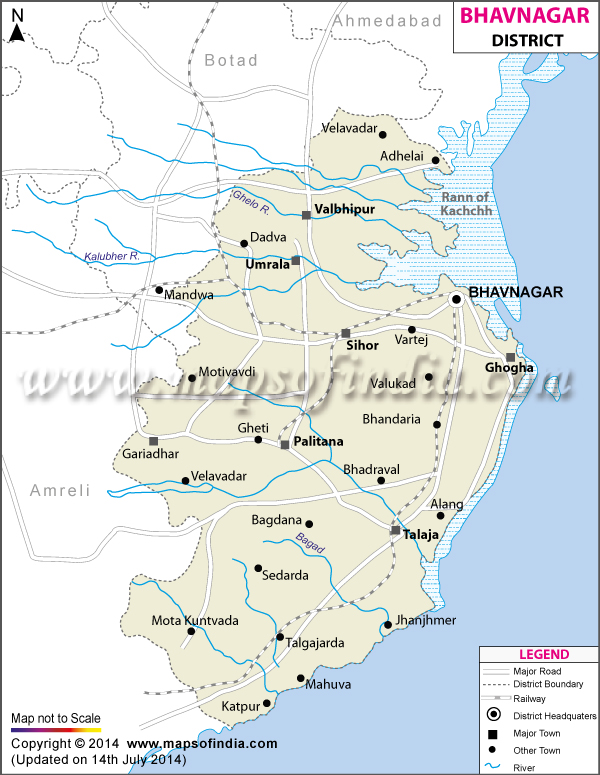
Diverse terrain defines Bhavnagar district in Gujarat's Saurashtra area, influencing how people live and work there. Occupying the southern stretch of the Kathiawar peninsula, it meets the Gulf of Khambhat on its eastern edge - a feature granting an extended coastline. Because of this coastal position, sea-based commerce has long driven local activity, along with salt harvesting and marine construction. The Alang ship-recycling site emerged here - its scale tied directly to favorable conditions like deep offshore zones and reachable beaches ideal for taking apart large ships.
Besides stretching along the Gulf of Khambhat, it holds countless salt pans across its shorelines - a sign of its deep ties to salt making. Because tides here carry intense salinity and forceful flows, conditions turn highly favorable for harvesting salt. Coastal landforms shape how people fish too; families often rely on modest catches to support daily life.
It sits close to the shoreline, shaping its role as an administrative hub along with economic and cultural activity. Though rooted in designs laid out by the Gohil dynasty, its structure now stretches into newer zones filled with schools, factories, because trade routes evolved over time. Urban character shifts when moving outward from the core, given how places such as Palitana carry religious heritage while Vallabhipur holds rural governance importance. Location matters here - not just for access to sea-based networks but also due to layered development patterns that unfolded gradually.
| Facts of Uttarkashi District | |
|---|---|
| Official Name | Bhavnagar |
| Location | Southeastern Gujarat |
| Area | 7034 km² |
| Population | 2410211 |
| Language | Gujarati |
FAQs
Q1: At what time do you find the best experience in Bhavnagar?
Between October and February is the best time to visit. At this time you will see that the weather is very pleasant for you to explore the temples, heritage buildings, local markets and nearby attractions.
Q2: Why is Alang internationally recognised?
Alang is home to the largest ship breaking industry in the world. From many countries large ships come in for dismantling which in turn see to the recovery of steel and other materials that are put back into use. Through the years it has also proven to be a very important element of the local and national economy.
Q3: Is Bhavnagar only an industrial district?
In the case of diamond processing, salt production, and ship recycling which do very well, in addition to these industries, Bhawanagar has preserved its royal past, religious practices, historical libraries, temples, and cultural festivals which present to the tourist so much more than a strictly industrial setting.
Q4: Which language do people mostly use in Bhavnagar?
Gujarati is the primary language of daily use which includes the local Saurashtrian dialect which is very common. Hindi is well known which in turn English is very much a part of education, business and official communication.
Q5: What role has the coast played in the growth of Bhavnagar?
It’s location by the Gulf of Khambhat which has shaped this district for centuries. The coast promoted maritime trade, fishing, salt production and later industries like ship breaking. Today the sea still plays a key role in the region’s economy.
Q6: Is Bhavnagar a great place for heritage lovers?
Yes. The district is a reflection of the Gohil’s past through their temples, palaces, public buildings and historic institutions.
Last Updated on : July 14, 2026
