






About
The Mehsana district is a large administrative subdivision located in the northern part of the Indian state of Gujarat. The district is also characterized by a very high agricultural prosperity, industrial development and culture richness which fill a large part of the socio-economic structure of the state. The town is believed to have been named after a local cotton landlord Mehsaji Chavda who started the town. The district grows and rises continuously to become a significant and key district which is directly contributing to the growth of Gujarat in various domains with the passage of time.
Mehsana district is geographically situated in North Gujarat, and borders on other districts like Patan, Gandhinagar, Sabarkantha and Banaskantha. It is defined by semi arid climate, plains and well developed irrigation network which favors agriculture. The city that the headquarters of the district was situated is Mehsana which is an administrative, trade, and educational center.
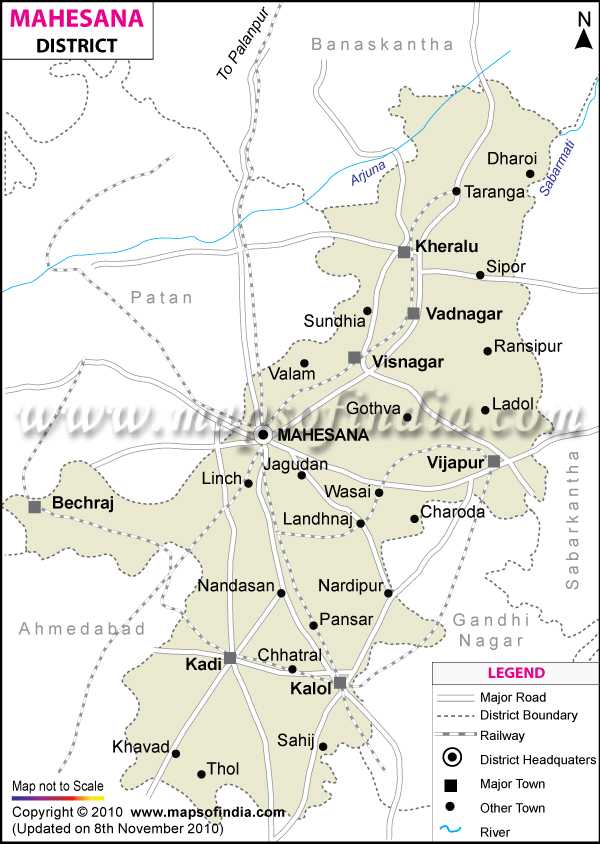
The map of Mehsana district provides a clear image of the geographical side of that area and towns/villages, road system and nature. The dairy industry, temples, stepwells, and thermal power generation are some of the popular industries in the district. Being both a traditional and the modern district, Mehsana is a significant constituent of Gujarat.
History and Culture
The history of the Mehsana district dates back to the times of ancient history, settlements of the Indus Valley Civilisation in the neighboring lands can be evidenced. The region fell under the control of other dynasties over the centuries with the Chavdas, Solankis, Vaghelas and the later Mughals. All these monarchs made an impression on the architecture, culture, and administration of the district.
Art and architecture thrived in the region throughout the Solanki period. During this period, temples and stepwells were built some of which remain, even today, as wonderful monuments to medieval art. An architectural masterpiece of the time is that the Sun Temple of Modhera, situated in the district. The Mehsana district map assists to find such historical places that bring out the glorious past of the district.
Mehsana district is extremely rich in terms of culture. Holis, Navratri, Diwali, Uttarayan and festivals such as these are observed in a very happy-go-lucky fashion. All sections of the society are not averse to the traditional Garba and Dandiya Raas dance during Navratri. Such cultural festivities can be noted in various towns with the aid of the Mehsana district map.
There are also common handicrafts, folk music and local cuisine. Quite a number of old fashioned Gujarati foods like dhokla, thepla and khandvi are generally eaten. The Mehsana people are a welcoming, simple but very treasuring cultural lot and they continue to characterize the district.
Economy
Mehsana district has a well balanced and diverse economy with agricultural, industry and services contributing towards it. It is believed to be among the economically developed districts of North Gujarat.
Administrative offices, public welfare programmes, and educational institutions within the government industry have a vital role to play in offering employment and promoting development. The Irrigation, rural development and infrastructure efforts made by the government have done a great work in enhancing the quality of life in the district. The Mehsana district map assists planners and administrators in efficiently undertaking development projects in different areas.
The state sector consists impressively of macro enterprises, especially energy and dairy industries. The oil and natural gas corporation, ONGC, is also operating in the region. The district is also home to the well known Dudhsagar Dairy that is one of the largest Cooperative dairies in India. This milk is crucial in thousands of farmers resorts.
The land is also still agricultural. The significant crops are wheat, bajra, mustard, cotton and groundnuts. Irrigation sources, which comprise tube wells and canals have facilitated agriculture. Compared to the map of the Mehsana district, the Mehsana district is more of an agricultural district which is supported by a large irrigation network.
Services sector within Mehsana district has experienced rapid growth in the past years. Services in banking, education, health services, retail and transportation services have increased. There are various learning centres in the district, such as colleges of engineering and management, which are of interest to all of Gujarat. Mehsana district map also shows urban centres with concentration of service sector activities.
Small and medium industry, such as textiles, ceramics, and food processing, are also adding to the economic development of the district. All in all, Mehsana district has become a prominent economic area with a decent proportion of both traditional and modern industrial bases.
Tourism
Mehsana district has numerous tourist attraction sites which depict both historical, cultural and natural richness that can be observed in the district. The area is especially being famous due to its oldest temples, stepwells, and heritage sites.
One of the outstanding attractions is the Sun Temple of the Sun God, at Modhera. A temple which was built during Solanki era is known by the elaborate arts of carving and designing. The complex comprises of a stepwell and a Sabha Mandap and is therefore a good tourist site among history lovers. The district map of Mehsana assists a visitor in finding out Modhera and locating it in an effective way.
The other important site of interest is a step well, known as Rani ki Vav stepwell, a UNESCO World Heritage Site, and situated near Patan. It is located immediately adjacent to the district border, but is commonly considered part of a tourism circuit of Mehsana. It is connected in the Mehsana district map regarding heritage sites.
The Bahucharaji Temple is a well-known pilgrimage on which the name Becharaji is attached. Devotees go and visit this temple throughout the year within the state. Becharaji was a key religious centre as indicated by the Mehsana district map.
Thol Lake is a good birdwatching place in Mehsana/Ahmedabad district on the border of Mehsana and Ahmedabad district. During winter period, migratory birds come to the lake and this makes the lake a quiet place. The map of Mehsana district shows the place of such natural attractions.
The district also features a number of stepwells (vavs). These buildings did not only fulfill certain practical use but were also cultural and social in nature. All in all, the historical relics, religious and natural charms make Mehsana district a good tourist spot.
Demographics
The population of Mehsana district is diverse and dynamic and helps in its social and economic growth. The district has a population of about 2 million according to census of India 2011. High rates of urbanisation and economic opportunities have contributed to a steadily increasing population.
In Mehsana district the literacy rate is about 84 per cent as opposed to the national average of 74 per cent as of 2011. It indicates the educational focus of this district and high school and college density. The Mehsana district map assists in determining the location of urban and rural region that is concentrated with educational institutions.
The language spoken in the district is Gujarati although Hindi and English is also spoken especially in the urban centers. The cultural diversity in the district is due to a population comprising of people of different communities.
Sex ratio and population density is similar to other districts in Gujarat which implies equal growth of the population. The Mehsana district map gives information on the distribution of population in various parts of the district.
There is also a so-slow movement of demographic profile of Mehsana district towards urbanisation as towns like Mehsana, Kadi and Unjha have become significant urban centres. Ease of access to better jobs, education and health facilities has led to migration into such towns by people who leave their rural areas. In spite of this trend a great number of the population still lives in rural territories and continues to practice agriculture and allied works. Social aspects like health awareness, clean water and sanitation have been enhanced over the years through a number of government projects that can be better depicted in the form of a spatial analysis with reference to the Mehsana district map.
Administration
The Mehsana district is well-organised and subway divisions exists in the number, and consequently Mehsana district is properly governed with division of services. This district also hosts tehsils (talukas) like Mehsana, Kadi, Visnagar, Vijapur, Becharaji, Unjha and Satlasana, among others that are of significance.
Each tehsil also has its administrative office that oversees the implementation of the government policy and the maintenance of law and order. The map of Mehsana district is also very important in administrative planning, as it gives a perfect understanding of boundaries and infrastructure.
The district carries a great many villages, under which a gram panchayat governs. These local governance and development functions are carried out by these village-level institutions. The Mehsana district map can be used in the identification of the location of villages and in planning rural development projects.
Handling of urban centers is under management by municipalities and nagarpalika, which undertakes civic duties, including water supply and sanitation as well as road maintenance. The district administration collaborates with state and central administration to see to it that overall development occurs. The Mehsana district map is a vital instrument to administration, planners and researchers because it gives a lot of information about the structure and infrastructure in the district.
Besides the simple administrative structure, Mehsana is a district that has incorporated the current methods of governance such as e-governance and electronic record management to enhance efficiency and transparency. Development reviews are carried out by district authorities on a regular basis and schemes in the fields of agriculture, education, health and infrastructure are implemented. The police administration there directly takes the responsibility for the law and order that has existed in the district for a long time, and also the liaison between various sectors which has been keeping the public services running smoothly without any hassle.
FAQs
Q1: Why is Mehsana important in Gujarat?
The district is a key player in Gujarat’s economy via agriculture, dairy farming, and industries. Also it is a major educational and commercial center.
Q2: What industries are important in Mehsana?
In addition to dairy farming we have industries that deal with oil and natural gas, ceramics, textiles, engineering, and food processing in our district. Also these sectors employ many of our local people.
Q3: Does Mehsana have educational institutions?
Yes, we see a wide range of institutions in this district, including but not limited to many universities, large scale engineering institutes and special professional training centres. From other areas too, students come in large numbers for higher studies.
Q4: What makes Bahucharaji Temple popular?
The temple is a top pilgrimage site in Gujarat. All year round there are thousands of devotees that come to seek blessings.
Q5: What is ONGC’s role in Mehsana?
ONGC is a large player in that district which is into oil and natural gas production. Also they have created jobs and backed industrial growth.
Q6: Why should tourists visit Mehsana district?
Mehsana has a blend of the past and present, from old temples to bright local markets. The district is a true representation of North Gujarat.
Q7: What is the best time to visit Mehsana?
From April to September is the best time for travel. The weather is great for seeing the temples and heritage sites.
Last Updated on : July 14, 2026
