






About
Home to vast farmlands, Anand district sits at the heart of Gujarat, India. Famous for its white gold, it earned the nickname Milk Capital of India over decades. Because of grassroots efforts here, dairying changed across the nation. It is located between Ahmedabad and Vadodara. Because of this the transportation becomes easy. It links fuel commerce, learning, and farm-linked production. At its heart sits the town of Anand - serving as both governance base and focal point for schools and factories alike. Born from a wave of change, the district earned acclaim across India and beyond as where the White Revolution began. Hosting Amul - the nation's leading milk brand - this region turned farming into a collective force. Through shared effort, wealth reached many villagers, transforming how rural families earn their living. What sets it apart isn’t just its economy - its schools, lively culture, and calm atmosphere stand out too. Home to places such as the Institute of Rural Management Anand, along with Sardar Patel University, learning thrives here. Thoughtful ideas take root where education gets space to grow.
History and Culture
Once home to shifting empires, Anand district's past flows alongside Gujarat’s larger story. Ruled by the Mauryas first, then shaped under Gupta authority, power eventually passed to the Solankis. Centuries unfolded with layers of belief systems - Hindu practices blended here, Jain thought took root, while Islamic currents also left marks. Culture in this area grew not from one source, but from steady waves of spiritual coexistence.
The governance of the area shifted to the Delhi Sultanate before passing into the hands of the Mughals. Later when the authority passed in the hands of Marathas, it marked an important point in the history of the region. With the coming of the East India Company, changes became even more evident.
Throughout the 1900s, change swept through Gujarat, altering daily routines in villages. Dairies run by local groups sparked major shifts; central to this shift was Verghese Kurien, whose drive helped launch what many now call the “White Revolution."It , previously unnoticed, grew into the core of India’s journey toward producing its own milk. Small farmers slowly gained power through shared efforts - control over income, respect in labor followed. Strength built together eventually placed India near the top of global milk output - not just an economic milestone, yet a symbol of endurance and honor for countryside populations.
What happens in Anand goes beyond milk - roots run deep into how Gujarat lives day by day. Festivals shape the rhythm here, moments when people draw close again. As Navratri begins, clapping patterns rise, feet move fast in Garba circles, sticks click during Dandiya fights - all motion carrying old ways forward. Then comes Diwali, night after night lit by oil wicks flickering on windowsills and sidewalks, kin meeting under brightness that remembers victory of light. Floating above, the sky transforms during Uttarayan, alive with kites tracing bright paths in sudden dips and climbs. More than just display, these gatherings spark something deeper - the shared energy rising through laughter, faith, and quiet connection between neighbors.
Taste speaks where words pause. In Gujarat, a thali arranges flavors like thoughts - measured, intentional. Lentils sit beside bread, vegetables shift with seasons, pickles add sharp memory. One flavor follows another, yet none dominate; harmony matters most. Even sweetness finds space, treated not as afterthought but necessity. Time bends at mealtimes, stretched by routine instead of rushed. Conversation grows around plates, built bite by shared bite. Still present long afterward isn’t luxury, yet substance: how minimalism, if respected, offers abundance far exceeding quantity. Course after course, the thali suggests heritage survives not just through ceremonies or celebrations - also within shared meals taken daily.
Economy
Farming plus milk production anchor Anand district's varied, strong economy. Gradually, factories and trade activities began shaping expansion too. Most jobs in the area come from administrative centers, schools, or community support systems. Development in farming, water access, and village infrastructure has lifted economic conditions across the region. Leadership at the state level drives growth through organized planning and resource distribution.
Few decades back, travel was harder; now paved routes link even remote villages. Schools once lacked basics - today most offer steady lessons under reliable roofs. Medical clinics stand closer than before, easing access for many families. Support programs reached farms first, then spread to local shops and workshops. These efforts, though slow at times, helped anchor household incomes during uncertain seasons.
Farmers’ collectives shape much of the public services. A leading case - Amul - runs through the Gujarat Cooperative Milk Marketing Federation. Thousands of farmers gain access to an organized marketplace through this collaborative approach. Efficiency marks every stage - from gathering milk to its processing and delivery - supporting stable income for those who produce it. From rural dairies sprouted a model others tried to mirror. Jobs followed - inside factories, along transport routes, within sales networks.
Farming thrives where soil is rich, growing tobacco alongside rice; wheat appears in fields too, while vegetable plots dot the landscape. Yield follows fertility, each plant finding its place under open sky. Fueled by countless village homes, milk production stands central to the region’s livelihoods. Though often unseen, this work shapes daily life across wide stretches of countryside. Farming supplies often feed into local factories where goods get prepared for market. Some villages host workshops that turn crops into shelf-ready items. Processing plants usually sit near harvest zones to cut transport needs. Finished products move out through regional distribution points. Still, Anand shows what rural economies might achieve when farming blends with collective ownership. Its growth comes not just from crops but through shared enterprise shaping long-term progress.
Tourism
Quiet rather than flashy, tourism in Anand district draws those curious about heritage, tradition, and village progress. Though not grand in scale, the Amul Dairy stands out as more than machinery - it marks the heart of India’s White Revolution. Visitors leave informed, having seen how farmer-led collaboration reshaped agriculture nationwide. Because of figures like Verghese Kurien, the journey through this place feels charged with purpose. Instead of crowds and noise, there is meaning - built slowly, told gently, remembered longer.
Swaminarayan Temple located in Vadtal is another major attraction in the region. It is linked to the traditions of Swaminarayan Sampradaya. It is not just a religious place but also has deep connection to the spiritual and communal traditions. Thousands of pilgrims come to visit this place across all seasons but during the festivals the crowd is even more. ISKCON temple located in Vallabh Vidyanagar provides a suitable place to people who like to meditate and ones who seek solace.
A visit to Vallabh Vidyanagar offers quiet appeal, thanks largely to tree-lined paths and the presence of active college life. Home to Sardar Patel University, the town carries an orderly stillness different from surrounding urban centers. Nearby Dakor, just beyond the border, draws crowds for its revered Krishna temple known as Ranchhodrai. Despite being located elsewhere administratively, pilgrims often group it within the district tours due to spiritual value. Experiences here tend toward reflection and understanding, skipping hurried checklists for deeper engagement
Demography
Situated centrally within Gujarat, Anand district hosts a slowly expanding populace tied closely to farming and learning. The 2011 headcount recorded slightly above 2.09 million residents - about 1.08 million men, nearly 1 million women. Growth has persisted since then; today’s figures hover near 2.5 million souls. Stability comes through consistent field labor supporting village existence, while schools draw households toward urban centers like Anand town and Vallabh Vidyanagar.
Though agriculture remains foundational, education increasingly influences where people choose to live across the region. Numbers shift gently year by year, shaped less by sudden change than steady patterns of opportunity. With over 650 people occupying each square kilometer, the area ranks among the denser regions. At 925 women for every thousand men, the gender distribution falls just under nationwide figures. Notable instead is how living patterns align - villages form the core, yet towns hum with schools, medical posts, and trade hubs. Tradition weaves into newer rhythms where daily life unfolds.
The literacy rate in the district is 84.37 percent. Men show a high rate - 91.82 percent - women reach 76.36 percent. Because universities like Sardar Patel University operate here, along with many nearby colleges, learning opportunities have taken stronger shape over time. For many years, family values shaped views on school, guiding young people toward longer study instead of quick entry into jobs. Because of this focus, classrooms became spaces tied less to wages, more to respect, growth, possibilities. Learning slowly came to stand for movement upward, not just daily work.
Within Anand, speech patterns shape part of who people are. Across households, bazaars, and rural areas, Gujarati flows steadily, anchoring routine exchanges in shared tradition. Where different communities meet - markets, festivals, transport hubs - Hindi emerges naturally, easing conversation among varied speakers. In institutions like classrooms or government buildings, English appears regularly, offering a steady framework for documentation and instruction. Each tongue occupies its own space, yet overlaps occur without erasing distinctions.
Administration
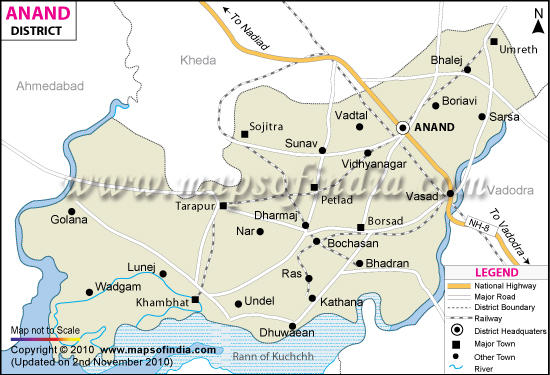
One way the Anand district manages operations is through a structured setup meant to support daily administration across city and village areas. Spread out within it are subdivisions - Anand, Anklav, Borsad, Khambhat, Petlad, Sojitra, and Tarapur - each running under distinct jurisdictional units. From village halls, decision-making flows through Panchayati Raj setups shaping daily rural life. Because these councils handle growth projects, they also look after roads, water, and shared concerns. Over three hundred fifty settlements lie within the district boundaries - each helping shape farm output and milk supply chains. When regional offices link with local leaders, progress moves steadily into far-flung corners. Governance takes root where fields meet footpaths.
| Facts of Anand District | |
|---|---|
| Official Name | Anand |
| Location | Western India |
| Area (km2) | 3204 |
| Population | 2358745 |
| Language | Gujarati, Hindi |
FAQs
Q1: What is Anand district famous for?
It is also home to Amul which was made famous for its cooperative model that brought about a change in the Indian dairy industry.
Q2: What do people in Anand do for a living?
Agriculture and dairy farming are the base of our economy. Also many families are into education, food processing and related industries.
Q3: Why is Amul important to Anand?
Amul which began in Anand has gone on to become India’s most successful dairy cooperative. It improved the lives of thousands of farmers through the model of collective ownership.
Q4: Which festivals do we have in Anand district?
Navratri, Diwali, and Uttarayan see great celebrations. In these festivals which are very special, Garba and kite flying stand out.
Q5: Does Anand have any religious attractions?
Yes we have the Swaminarayan Temple in Vadtal and the ISKCON Temple in our district which are very popular. All through the year they attract devotees and visitors.
Q6: Why should tourists visit Anand district?
Anand is a blend of dairy past, academic institutions, temples, and real Gujarati culture. Also you will find in that area rural heritage as well as modern growth.
Last Updated on : July 14, 2026
