






About
Chhota Udaipur district is a most culturally rich and geographically diverse district of the eastern part of the Indian state of Gujarat. It was created as an independent administrative department in 2013, out of the previous Vadodara district to enhance improved administration in the tribal dominated regions as well as development. The district is named after the city of Chhota Udaipur, the historical seat of a princely state and the administrative, cultural, and economic centre of the district.
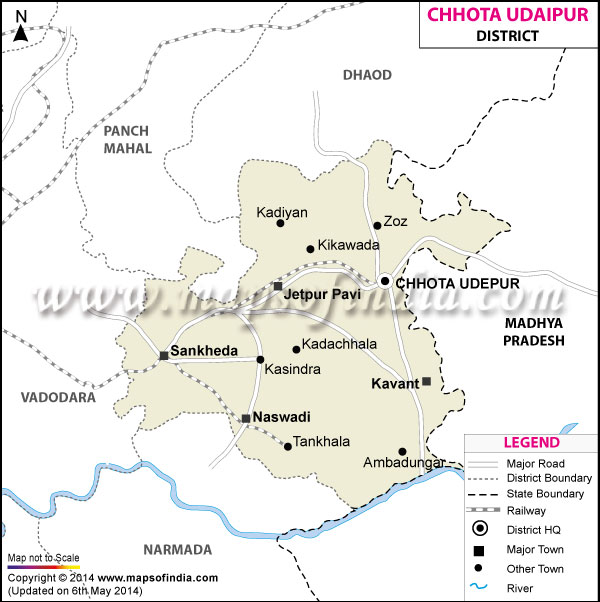
The district is mostly occupied by a tribal society which has made it have a unique socio-cultural identity as compared to the other regions in Gujarat. It has been considered as belonging to the tribal heartland of western India. The Chhota Udaipur district map is very significant in knowing its geographical layout of the district such as its relationship with the other neighbouring states, its river systems as well as settlement distribution pattern of the district.
History and Culture
The origin of the Chhota Udaipur district is deeply intertwined with its history, as a state of chiefs and tribal rulers area, more specifically with Rathwa chieftains. The area was isolated, partly owing to its rough topography and thick forest, and partly because of the lack of the greater imperial powers, over centuries.
The district is culturally famous with the rich tribal heritage particularly Rathwa tribe and Bhil tribe. These people have preserved their traditional life styles like unique art, music and dancing. One of the most remarkable cultural manifestations is the Pithora painting tradition, a ritual art, used to offer deities, painted on the walls of houses. These prints are lively, symbolic and very spiritual, portraying the views and beliefs of the Rathwa people as part of the worldview.
The tribal identity and community cohesion is brightly portrayed through festivals in the district. Though there are some mainstream Indian festivals, including Holi or Diwali, local ones like Bhagoria and Gher Fair are important. Specifically, Bhagoria is connected with the courtship rituals within the tribal youth and is characterized by the music, dance, and colorful markets. The traditional music, colourful dresses and dances on a rhythm constitute the component of these celebrations.
The geography of the district is strictly connected with cultural landscape. The Chhota Udaipur district map shows the way villages are distributed in the hills and forests that affected the cultural activity and interactions of the communities. Moreover, there is an available Chhota Udaipur district map to trace the places of the cultural centers and heritage sites which shape the identity of the district.
Economy
Chhota Udaipur district has basically been an agriculture based economy for a long time being. Here it is the key source of sustenance for most of the population living here. The crops that are grown by farmers in this district include maize, paddy, pulses and millets, all of which are uniquely adapted to the climatic and soil conditions in the area. Farm productivity is slowly increasing with efforts of constructing better irrigation facilities.
The role of government sector in economic development of the district is very important. The Government of Gujarat has initiated various welfare programs that seek to empower the tribal communities by offering them education, health, housing, and other employment opportunities. Rural development initiatives such as the building of roads and electrification have had a great effect by enhancing accessibility and living standards.
The institutions in the public sector include schools, colleges, healthcare centres, and administration offices. Such institutions are not only involved in offering necessary services but also offer the locals work opportunities. Educational programs have played a major role especially in enhancing literacy levels and development of skills among the youth.
Several sectors are still in their developing stages, yet the services one is in its gradual growth. It encompasses retail trade, transportation, small businesses, and tourism related services. Haat (weekly markets) is a significant economic activity where agricultural goods, livestock, and handcrafts are traded. The traditional crafts, like tribal art and handcrafts, are also a part of the local economy and source of additional income to the families.
The economic planning using the map known as the Chhota Udaipur district map is an important tool because it shows the location of agricultural areas, market places, and roads. In addition, the Chhota Udaipur district map identifies the spaces where the industrial and service sector could develop, which will benefit policymakers and investors.
Tourism
The district of Chhota Udaipur has a special combination of natural beauty, tribal culture and ancient heritage that can be witnessed during the tourism. The district has great potential in eco-tourism and cultural tourism although it is not well known as other tourist spots within Gujarat.
Kavant is considered as one of the major attractions and is known to hold tribal fairs and brightly-colored festival of Bhagoria. During these festivals, visitors will have the chance to hear and observe traditional music and dance and practices of the locals. Devhat is another interesting place, a peaceful site encircled by natural environment and is also famous by religious importance.
Another reason why the area is scenic is the hills, forests and rivers which bring beauty to the area and offer nature to be explored. Visitors are also provided with a rich cultural experience of traditional ways of life, art and everyday activities, as there are tribal villages where visitors can observe and study.
At Chhota Udaipur visitors get to see the remains of the princely past within the form of palaces and administration building which will reveal the architectural style of the region. These buildings give an insight into the historical development of the district and royal background.
Chhota Udaipur district map especially comes in handy to those putting a visit to the place since it allows them to explore important areas they would like to see and also plan their routes. Moreover, the " Chhota Udaipur district map will allow the visitor to explore little known locations that have much to offer in terms of natural and cultural value.
Demographics
Chhota Udaipur is a district with a population of about 1.07 million people (as per 2011 Census). The district is mainly rural and the proportion of Scheduled Tribe population is high with majority being the Rathwa and Bhil. Such demographical structure has a considerable impact on the cultural and social life of the district.
The literacy rate in the district is approximately 62, lower than the state average, but has been improving well over the years. The government program and non-governmental programs have been instrumental in advancing education and alleviating illiteracy. It has paid senior attention to tribal education, creation of residential schools and scholarship programmes.
The district is mainly seen speaking the Gujarati language which is used as the official language of administration and communication. Moreover, local languages like Rathwi and Bhili are mostly used by the local community. It is also spoken in Hindi especially in education and government matters.
Its district map of Chhota Udaipur gives important details regarding the distribution of population, patterns of settlements as well as variations in density in the district. Moreover, the " Chhota Udaipur district map" can be used to plan a social infrastructures like schools, hospitals, and community centres.
Chhota Udaipur district is mostly tribal in terms of social composition with the Scheduled Tribes constituting a large majority. A large number of the villages lie either on hills or in the forest and this can cause connectivity and service delivery to be difficult. Nonetheless, there have been gradual changes in human development indicators with the help of specific government programs with emphasis on tribal well-being, nutrition, and education. Remote habitats are often marked in a map of the Chhota Udaipur district which is used to identify the habitats to target them with infrastructure and welfare outreach.
The youthful population is another significant demographic factor since a substantial number of the residents are in the working age bracket. This poses opportunities and challenges. Migration, underemployment, and access to educational opportunities are of concern, although the economic growth through the development of skills and the creation of jobs can positively occur. There are also attempts to enhance the vocational training and stimulate the local industries in order to keep the workforce in the district. The " Chhota Udaipur district map" will help the planners to determine where the education institutions and training centres are in order to serve the dispersed populations.
Administration
Chhota Udaipur is an administrative district that is subdivided into a few tehsils or talukas such as Chhota Udaipur, Kavant, Naswadi, Sankheda, Bodeli and Jetpur Pavi. Every taluka is tasked with the local government and administration, and they have to ensure implementation of government policies and development programmes.
The district has over 800 villages which reveal its ruralism nature. The administration of a village is conducted by Panchayati Raj institutions, which is important in the administration at the grassroot level as well as development of the community. These institutions make local decisions, administer welfare programs as well as manage basic infrastructure.
Administratively, the governance in the Chhota Udaipur district focuses on decentralisation and community involvement. These agencies play a pivotal role in executing rural development programs, which control local resources, and also handle community-oriented problems. The Chhota Udaipur district map is also commonly used by the administrative governments to track the jurisdiction limits as well as provision of efficient services.
Moreover, the district administration puts a high priority on enhancing the connectivity and infrastructure, especially in the tribal remote areas. Projects aimed at bridging the gap between rural and urban areas are increased on the road development, electrification, and digital connections. The coordination of various units in the administration is essential when formulating these objectives, and map technology is essential in planning and implementation. The above efforts are backed by the " Chhota Udaipur district map" which offers a visualization system that allows the infrastructure development of the regions as well as inter-departmental coordination.
FAQs
Q1: What is the total number of villages in Chhota Udaipur district?
Chhota Udaipur district has more than 800 villages, highlighting its largely rural composition.
Q2: What is the population of Chhota Udaipur district?
The district has a population of approximately 1.07 million people according to the 2011 Census.
Q3: What is Chhota Udaipur district famous for?
It is famous for its rich tribal culture, Pithora paintings, traditional festivals such as Bhagoria, and its scenic natural landscapes.
Last Updated on : July 13, 2026
