




About
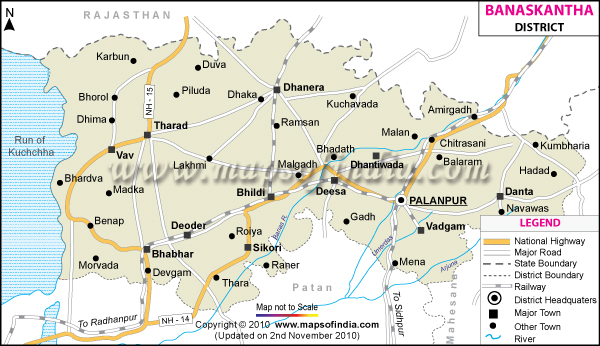
Banaskantha district is one of the largest and most important in terms of geographical territory and socio-economic input to the whole Indian state of Gujarat, and in the north of the state. The district is named a Banas River which runs through it, thus the region is culturally and geographically blended because it has Rajasthan located on its north and northeast sides. The headquarters are located in Palanpur which is a historic town and has been used as an administrative and cultural centre. The Banaskantha district map assists in realizing the sheer expanse spread of the district, which comprises of a dry plain territory, semi deserted areas with some fragments of fertile agricultural regions.
The significance of Banaskantha is the variety of its scenery, the presence of agriculture, and the changing industry. It is associated with the dairy farming, oilseeds production, and an increasing contribution to renewable energy. Its connectivity is another area that is pointed out in the Banaskantha district map, as it is connected by both road and rail networks, to the main cities like Ahmedabad and the neighbouring Rajasthan. The district has national highways, state roads that make easy trade and movement. Banaskantha district map also shows that it has rivers, seasonal streams and a groundwater resource that sustains agricultural activities and settlement.
The district has extreme climatic conditions characterized by hot temperature during summer and relatively cool temperatures during winter. It receives an average amount of rainfall, but the nature of rain is quite unpredictable and that is why water management is one of the most important aspects in this place. Nevertheless, Banaskantha has evolved with irrigation plans and co-operative programs to be a productive area. Banaskantha district map will be useful in managing water resources and zoning of agriculture.
History & Culture
The history of Banaskantha district is very old and dated to both ancient and medieval eras. It was part of a number of dynasties, such as the Solankis dynasty and the Vaghelas dynasty, and was engaged in the rule of the Delhi Sultanate, and the Mughals. The district headquarters known as Palanpur was governed by the Nawabs of Palanpur in the times of the British rule, and it grew to be a great princely state. These historical influences are understandably depicted in the Banaskantha district map as there are forts, temples and old settlements scattered around the area.
Banaskantha was a part of the Bombay Presidency during the colonial rule and later on with the formation of the state of Gujarat in 1960, it became one of the Districts of this state. The district has over the years experienced restructuring of administration and development of infrastructural facilities. The Banaskantha district map has played a significant role towards recording these changes and providing developmental policy pathway.
Indeed, Banaskantha is a rich cultural amalgam of Gujarat and Rajasthani. The district boasts of different communities, some of which are Rabaris, Patels, Rajputs, and tribal communities with their cultural makeup. Another specificity is the traditional clothes, particularly the embroidered dresses of the Rabari people in multicoloured. Folk music and dance including Garba and dandiya raas were part of the identity of this region especially on festival occasions.
Such festivals as Navratri, Diwali, Holi and Uttarayan are done with so much enthusiasm that communities gather and feast with colourful displays of religiosity and love. Banaskantha district map also indicates some fairgrounds and religious places where they have fairs that are conducted annually, which attract visitors to the neighbouring areas.
Economy
The Banaskantha district is mainly agricultural with a well developed dairy industry and an industrial sector that is progressively growing. Banaskantha district map shows that there are large areas of farmland where crops wheat, bajra, mustard, castor, cumin, and potatoes are planted. There is also an increase in horticulture such as the production of the vegetable and fruits. Canals, wells, and new methods can support irrigation but there are challenges in the region caused by semi-arid climatic conditions.
Government Sector, as a part of the district, is essential in the development of the district. The schemes of rural development, irrigation, healthcare, education, and infrastructure are covered in several state and central government plans. Check dams and watershed management are projects that are concerned with water conservation and have been dearly instituted. The Banaskantha district map becomes very useful in the planning and implementation of such initiatives in an effective way that is sufficient to balance the allocation of resources.
The Cooperative institutions particularly the dairy industry feature strongly in the Public Sector. Banaskantha plays an important role in the Gujarat Cooperative Milk Marketing Federation that produces the Amul brand. One of the largest milk producers in Asia is the Banaskantha District Cooperative Milk Producers Unit which has been able to employ thousands of farmers and contribute towards the rural economy. According to the Banaskantha district map, there are many milk collection centres spread all over the villages, which signify the extensive network of dairy. The map of Banaskantha district provides idea about industry areas and transportation connection that enhances such activities.
Services Sector is also experiencing consistent growth in the past years. Education, health care, banking services, retailing, transportation services are on the rise, especially in the city centres such as Palanpur and Deesa. Presence of religious and natural attractions is a reason why tourism related services are becoming increasingly more significant. Also, the district is experiencing a rise in renewable energy entering effects, particularly solar energy power plant and this is contributing to the sustainable development. The appropriate places to locate such projects are identified with the help of the Banaskantha district map.
Altogether, the economic system of the Banaskantha is a mix between ancient agriculture and high-tech industries, which creates the district of dynamic and developing life with great perspectives of development.
Tourism
Banaskantha district is a blend of religious, historical and natural sites influenced by which visitors come to its location all over the country. The Banaskantha district map is a good guide that has helped tourists in visiting these diverse destinations and have their journeys well planned.
The most notable tourist site is the Ambaji Temple which is raised along the Gujarat-Rajasthan border. It is a holy place of worship of goddess Amba and is the place visited by tens of millions of pilgrims particularly during the Bhadarvi Poonam fair. Ambaji is a key religious landmark and pilgrimage centre, which is featured in the map of the Banaskantha district.
The Balaram Palace and Balaram Ambaji Wildlife Sanctuary is also another major destination. According to the Banaskantha district map, the sanctuary is situated within the forested hills hence making it a usual destination to the nature lovers.
Kumbhariya Jain Temples are situated near the Ambaji and are characterised by elaborate marble carvings and architectural work. These temples form a significant place of pilgrimage in the Jain community and are the indication of high artistic standards in medieval India.
Other attractions are the Koteshwar Temple, Kedarnath Mahadev Temple and the town of Palanpur itself where there are historical buildings, gardens and deriving cultures. The local markets and seasonal fairs are also part of the tourist experience and these give an insight into the traditions and lifestyle of the district. To help the visitors move around these attractions, the Banaskantha district map helps them with their navigation.
Demographics
The district of Banaskantha has a heterogeneous and a gradually increasing population. The current available estimates show that the district has over 3 million people. The map of Banaskantha district shows the population distribution between urban and rural regions with large majority living in villages.
There is an increase in the number of educational institutions in the form of schools, colleges, and vocational training centres within the district. There are efforts in making further improvement on the literacy especially to women and in rural communities. This is based on the map of the Banaskantha district which is commonly employed in educational infrastructure planning.
Some of the languages spoken in the district are Gujarati which is the official and most common lingo. Hindi is also widely spoken and dialects of Rajasthan are used in parts that are near the borders of Rajasthan. The consideration of this linguistic diversity is based on the geographical location of the area and cultural contacts. The Banaskantha district map can represent the linguistic and cultural areas of the region, the map can be produced in various ways.
The region of the district is marked by a diversity of communities, such as different castes, tribes, and religious communities, which makes it a very diverse place socially. The population density is unevenly distributed all over the district with higherity on urban centres and agricultural productive areas.
Administration
The district of Banaskantha is further split into a few tehsils or talukas so as to have proper governance and service provision. The significant tehsils are Palanpur, Deesa, Dhanera, Tharad, Vadgam, Danta, Amirgadh, Bhabhar, Kankrej, Lakhani and Suigam. Banaskantha district map is clear in the sense that it has assisted in comprehending the form of governance in the district.
The district includes more than 1200 villages and thus is amongst the largest rural districts in Gujarat. Managing these villages is done by network of local self-government institutions such as gram panchayats which are important in administration and development. Administrative authorities are fond of using the Banaskantha district map in planning, resource allocation as well as check development activities.
The district has urban setting areas in the form of municipalities like Palanpur and Deesa that are among trading, educational, health and administration centres. These towns have government offices, courts and institutions providing services to the people and are the main location of these institutions. These urban centres are identified as nodes within the administrative network of the Banaskantha district in the chart of the district.
The district is being supported by a well-organized police force to provide law and order and the state government departments in collaboration with the district level authorities supervise the development activities within the district. The administrative system provides interdependence between the rural or urban areas resulting in balanced and inclusive development.
FAQs
Q1: Where is Banaskantha located?
The district is in the north of Gujarat which also has its border with Rajasthan. That which is a very important passage between the two states.
Q2: Which city is the headquarters of Banaskantha?
Palanpur is the seat of the district administration. Also it is the main center for education, trade and government offices.
Q3: What do we grow in Banaskantha?
Farmers are growing mainly into cumin, castor, wheat, mustard, potatoes, and bajra. Also we have seen a rise in the area of horticulture and that of vegetable farming in past few years.
Q4: Does Banaskantha have historical importance?
Yes, we see which dynasties ruled that district at different times: the Solankis and the Nawabs of Palanpur. Also many ancient temples and heritage sites are there which tell of the past’s grandeur.
Q5: What makes Palanpur an important town?
Palanpur is also the district capital which in addition to that is a major commercial and educational center. Also in history it was a very large role of Palanpur in the region.
Q6: Is Banaskantha suitable for religious tourism?
Yes, it is that every year many pilgrims visit the district for Ambaji Temple, Kumbhariya Jain Temples, and which also have some very old Hindu shrines.
Last Updated on : July 14, 2026
