

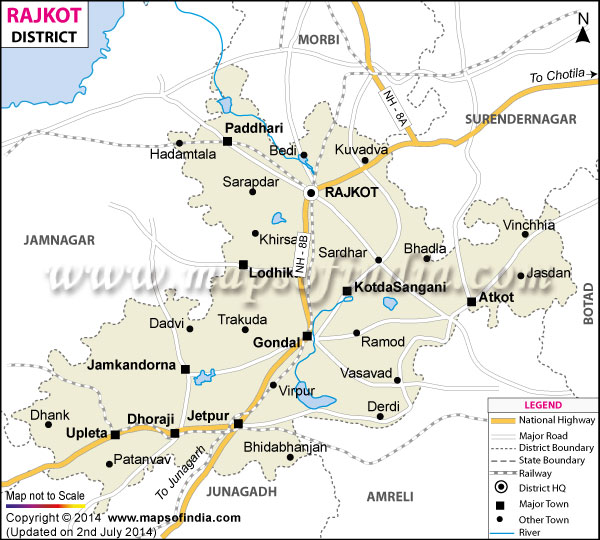



Introduction
The district of Rajkot is a major administrative and cultural unit which is found in the peninsula region known as Saurashtra of the western state of India (Gujarat). The city of Rajkot serves as the administrative center, the center of business, education and government. The city and the towns around have been evolving over the years to create a vibrant city with an expanding infrastructure, industrialization, and education facilities. The entrepreneurial spirit and traditional commercial roots are manifested in markets, workshops and business centers.
The region has existed under a series of ruling dynasties and princely states that have had an influence on politics and culture in the region. Such historical impacts are manifested in the urban layout, temples, palaces and the government buildings. The cultural landmarks and the existence of historical buildings portray the significance of the area in the history of Saurashtra.
The district is also a major player in the industrial sector of Gujarat. It is specifically known in the field of engineering industries, machine tools and small scale manufacturing units that are of great contribution to the local economy. All these industries are driven by many businessmen and talented employees, which is why the region is an industrial production center in western India.
History
Rajkot district history is strongly related with the political development of Saurashtra peninsula. According to archaeological and historical data, civilization in the area came centuries ago as the land was in a favorable geographical location and its closeness to trade routes linking various regions of the western India.
The founders of the modern city of Rajkot were the Jadeja who ruled the area in the early 17th century. Thakur Sahib Vibhoji Ajoji Jadeja is said to have built the city in 1612. The creation was the starting point of the development of the city as the political and administrative hub in the area.
In the medieval and early modern times the region was fragmented into a number of states in control of a number of princely states under the leadership of the Rajput rulers. These sovereigns ensured political power and trade in addition to diplomatic ties with adjacent states. During the period, forts, palaces and government structures were erected in order to enhance the rule of the land.
The time of the British Raj was characterized by the influence of the British on the region while local princely governments retained internal autonomy. Modern infrastructure and schools and governmental institutions that were introduced by the British government transformed the social and economic set-up of the region.
The district was also there in the early days of Mahatma Gandhi. When his father was a Diwan of the princely state, Gandhi was partly raised in the place. The home, Kaba Gandhi No Delo, he resided in has been preserved and turned into a museum dedicated to his teachings and life.
The region experienced increasing political awareness and involvement in national movements against colonial rule during the time of Indian independence movement. Political rights and self-government were the campaign messages the majority of local leaders and citizens backed.
The states of Saurashtra which had been the United State of Kathiawar became part of the Indian Union after India attained independence in 1947. The present day district was formed through administrative restructuring later on once the state was formed through the year 1960 in the state of Gujarat.
Since gaining independence the district has had a gradual growth towards industry, education and infrastructure. The present-day city development has impacted the city and environs by turning them into a successful economic hub even as they take care of historic landmarks.
Culture
The cultural heritage of the whole Saurashtra has been reflected in the cultural traditions of the Rajkot district as well as the impressions of the different communities that have lived centuries in this land. The city is part of the everyday life in the district which includes festivals, folk music, traditional craft and cuisine.
The other significant festival celebrated in this area is the Janmashtami that celebrates the birth of Lord Krishna. Home and temple are illuminated with lights and flowers and devotional songs and performances are arranged all over the district.
Another significant element of cultural life is the art of classic crafts. Handicrafts that are created in the district include bandhani textiles, Jetpur's block printing, embroidery and decorative metalwork. These are the crafts portraying Saurashtra artwork and are usually sold in domestic markets and exhibitions.
The food in the district is heavily influenced by Gujarati cuisine. There are meals that are usually made of various vegetarian meals that are served as a traditional thali. Popular foods are such as dhokla, thepla, khichdi and undhiyu. Various foods are done in a manner that includes both sweet and spicy, as well as savory flavor, which is unique to Gujarati cuisine.
The preservation of regional heritage is also conducted through the cultural institutions, museums and educational centers. A prominent cultural site in the district is the Watson Museum that exhibits historical artifacts and sculptures and other pavilions pertaining to history and culture of the area.
Language
Most residents primarily use the language of Gujarati which is the chief language of communication in their day to day activities, in the form of education, as well as in administration. Gujarati literature and poetry has a rich history and has a significant role of contribution in the cultural life of the district.
Hindi is commonly spoken and comprehended in the district. Since the region welcomes migrants and traders of various regions of India, Hindi is often used as a connecting language with the help of which communication between people of different linguistic backgrounds is simplified.
English is used in education, business and government institutions. It is taught in many schools as well as colleges and English is widely used in business circles. Consequently, a large population in the area, particularly the youth, speaks English, Gujarati and Hindi.
In the rural parts of the district, other local versions of the Gujarati language are used. These languages capture the cultural variety of the Saurashtra area and they usually contain distinct vocabulary and emphasize particular patterns of pronunciation.
Multi-lingualism has been an outcome of the co-existence of various languages so that individuals often switch languages based on the context. Market, office and school conversations are usually characterized by a mix of Gujarati, Hindi and English. This language diversity is a manifestation of the fact that the district has a history of trade, migration and inter-cultural exchange.
Geography
The district of Rajkot has features of a semi arid plain, rounded hills, river systems that are of Saurashtra peninsula. The district is a very important region located in the center of the peninsula, as there are a number of other districts of Gujarat which surround it.
It has a topography consisting of flat plains and rocky elevations in some cases. This area has good agricultural plains as it is one of the agricultural areas that contribute to the rural economy of the district. The crops that are produced by the farmers are dependent on the availability of rain and the availability of irrigation of crops like groundnuts, cotton, wheat and millet.
The district is traversed by a number of little rivers which help to promote agriculture and supply of water in the neighborhood. These include the Aji River that is also significant in supplying the region with water resources. Dams and reservoirs have also been established to regulate the resources of water and assist in irrigation.
The weather in the district is usually semi-arid, with hot summer, monsoon season and winters. Summer temperatures may be very hot and the monsoon period between June and September is the period of rainfall which serves to sustain agricultural activities and renews water bodies.
The vegetation in the area is mainly dry adapted shrubs, grasses, and sparse trees. Large parts of the rural environment are covered by agricultural fields and cultivated lands. The agricultural activities in the region have been modified to ensure that farmers utilize the available water effectively irrespective of the fact that the climate is relatively dry.
The landscape of the district has changed in some areas through industrial areas, places of residence, and transportation facilities. The district is connected to the major cities in Gujarat and other parts of India via highways and railway lines and this encourages trade and travel.
The well-developed transportation and economic center of the Saurashtra region are important features of the district.
FAQs
Q1: Why do we see Mahatma Gandhi in connection to Rajkot?
Mahatma Gandhi spent some of his formative years in Rajkot which was home to his father in his post of the Diwan of the princely state. In present time that very home is a museum known as Kaba Gandhi No Delo.
Q2: What do you see at Kaba Gandhi No Delo?
Visitors to the site will see photos, personal items, historical displays and we also have exhibits which detail Mahatma Gandhi’s early years and what he stood for.
Q3: Why do people into history visit Rajkot?
Rajkot has a collection of royal palaces, museums, colonial architecture, and heritage sites which tell the story of the Jadeja rulers’ past and Saurashtra’s time as a princely state.
Q4: What is the connection between Rajkot and other cities in Gujarat?
Rajkot is a well connected city via road, rail and air which also includes major cities in Gujarat and India.
Q5: How does the weather in Rajkot district fare?
Rajkot has hot summers, also it has monsoons which usually run from June to September and also the winter which is mild and pleasant.
Q6: What sets Rajkot apart from other districts in Gujarat?
Rajkot is a city which presents a royal past, a thriving engineering industry scene, traditional crafts, and which also has a legacy of Gandhi’s heritage which gives it a distinct place in Gujarat.
Q7: Is it true that Rajkot is great for shopping?
Yes. Visitors to Rajkot’s markets which are very active may find a large choice of Bandhani fabrics, handcrafted items, jewelry, traditional clothing and local products.
Last Updated on : July 14, 2026
