






About
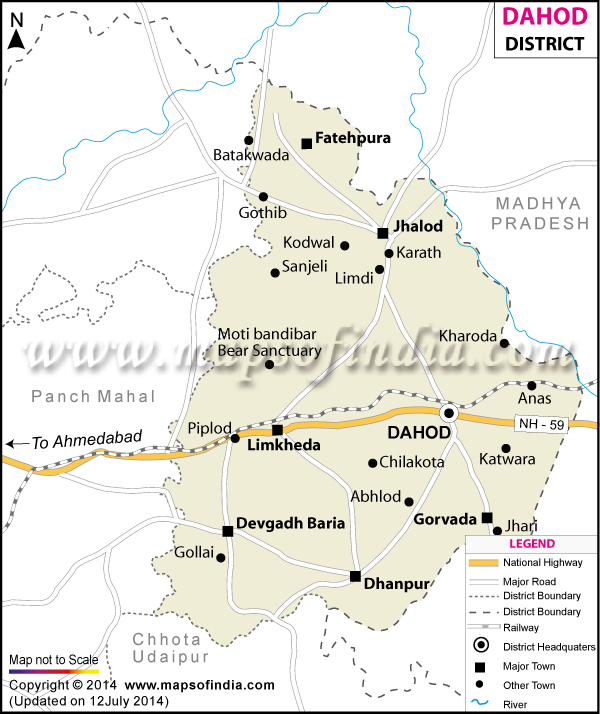
Dahod district, a district of Gujarat, is an administrative area in the eastern area of the Indian state of Gujarat, and it shares boundaries with the states of Rajasthan and Madhya Pradesh. The district has name of its headquarters city of Dahod, which is assumed to have been a passage in the middle and western India in the history. The term is usually thought of in reference to the phrase of Dohad or two boundaries as it borders the geographic location of intersection of various cultural and regional influences. Dahod district map is very important in gaining an insight into its strategic position, topography, and accessibility in Gujarat and other neighbouring states.
Dahod district is situated in an area that is mostly tribal geographically and is typified by wave-shaped hills, woodlands, and cultivated lands. It belongs to the eastern tribal line of the Gujarat thus socially and culturally different to the more urbanised western districts. As can be seen in the map of the Dahod district, it is also close to such major districts as the Panchmahal, Chhota Udaipur, and the neighboring states and provinces of Madhya Pradesh, which affects its economic and cultural interaction.
The area is synonymous with the rich tribal history, especially, Bhil and other native population, who form a large part of its identity. Agriculture is still the main driver of the area, and the slow industrialization and infrastructure expansion are forming the contemporary face of the region. Dahod district map is also necessary to understand the transportation of villages, roads, and natural resources that does the scenery of the entire district.
History and Culture
Historical meaning of Dahod district is very strong and traces its origin way back in ancient and medieval times. It is generally conceded that the Mughal emperor Aurangzeb was born in Dahod and this provided it with a distinguished history. Throughout the centuries, the area had experienced a reign of different so called dynasties like the local tribal chieftains and the Rajput rulers and then the Mughals and the British. The map of the Dahod district reveals evidence about the former trade routes and settlements which formed as a result of a favorable location.
In the British times Dahod belonged to the Panchmahal district, and had its share in the management of administrative and economical systems of the regions. In 1997, after five decades to the independence of India, a new district known as Dahod was created and a large chunk of Panchmahal was split off and a major milestone in the administrative history of Dahod. These administrative changes and the reorganisation of the boundaries of the Dahod district can be seen in the Dahod district map.
Dahod has a culture that is mostly controlled by tribal culture, especially that of the Bhils. The traditions find their reflection in very expressive folk dances, music, and in the form of art which is closely tied to nature and to the seasons. Such festivals like Holi, Diwali, Bhagoria are celebrated in a boisterous manner and they usually include traditional practices and community based events. The Dahod district map can be used to find the area where certain cultural practices are more notable.
Cultural signs are also important and include handicrafts and traditional clothes. Tribal jewellery, embroidery and bamboo craft work are common and have a contribution on the culture economy in the district. The oral traditions, folklore and story telling proceedings still survive the heritage of the district through the generations. It is possible to trace the pattern of tribal population and of topography due to cultural centres in the Dahod district by the use of the Dahod district map.
Economy
The Dahod district has a high agrarian economy, with majority being agricultural based as the main source of livelihood to the people. The large scale crop varieties are maize, wheat, pulses, and oilseeds, which are maintained by the seasonal rainfall and practice of traditional farming. Dahod district map is applicable in the distribution of agricultural land and the irrigation facilities within the area.
Government Sector
The government sector is the critical sector in the Dahod district development that has focused on the enhancement of infrastructure, education, healthcare and rural development. They are undertaking different government initiatives that target tribal welfare, job creation, and reduction of poverty. Dahod district map is also common in designing and implementing such initiatives to provide good coverage to remote and rural locations.
Public Sector
In Dahod, the contribution of the public sector towards industrial growth has also played an important role, particularly the development of industries, which are related to roads. The most significant changes are the existence of one of the biggest manufacturing firms in the railway sphere offering workers a chance to earn money and enhance the local economy. Dahod district map can be used to find the location of industrial areas and their interrelations with transport systems.
Services Sector
Services This area is seeing gradual increase in services sector since education services, healthcare services, retail services, and transportation services have gone up in the district of Dahod. Schools, hospitals, and minor companies are taking the form of key players to the economy of the district. Dahod district map helps to determine urban centres and service centres that serve this sector.
Other than these sectors, there are other small-scale industries, handicrafts and forest-based activities that are also contributing to the local economy. The Dahod district map is a detailed map of the distribution of economic activity and the distribution of resources, thus it holds a significant basis of planning development.
Tourism
Dahod district does not have good fame as compared to other tourism destinations in Gujarat, even though, it has a variety of attractions that depict its nature, its historical facts and also its rich culture. The Dahod District map comes in especially handy because tourists can find out where to visit and when to have their tours to the area.
There is the Ratanmahal Sloth Bear Sanctuary, which is one of the interesting sights and is in the hilly forest area of the district. Sloth bears and numerous plants and animals are found here and it has made the sanctuary a favorite among the wildlife lovers and nature lovers. The map of the Dahod district shows where the sanctuary is located and the approaches to it.
Devgadh Baria is another significant place of interest which has an old palace and picturesque environment. The architecture of the palace is built on the heritage of the region, and those visitors who are concerned with history and culture visit it. The map of the Dahod district gives one a clear idea on the way to this place in relation to the various sections of the district.
There are also a number of temples and religious sites within this district with both devotees and tourists visiting. These are the ancient shrines in the natural place, giving calm and serene spiritual experience. The Dahod district map aids in the determination of the religious sites and how close they are to other attractions.
Other than these, there are also local fairs and festivals which give an exclusive chance to the visitors to feel the rich tribal culture of Dahod. Music, dancing, and crafts These are traditional, and they are performed during such large-scale events, giving one a preview of the rich cultural heritage of the district. These cultural hotspots are good to be explored using the Dahod district map.
Demographics
Dahod district comprises mostly of rural people with a large percentage of the population being of tribal groups. The current available data is showing that the district has a population of about 2.1 million. The map of the Dahod district helps to visualise the way people are distributed in different regions and settlements.
The literacy rate capable of Dahod district is approximately 60 percent lower than the state average hence, the importance of further education and awareness programme needs to be given. The government and non-governmental organisations are working to raise literacy levels especially among the tribal groups. Dahod district map assists in determining areas that need specialized educational interventions.
The district is a part of Gujarat province with Gujarati being its official language which is combined with Hindi and other tribal languages. The cultural diversity of the territory is manifested in these languages, which have a significant influence on the communication process and social interaction. The map of the Dahod district can be also applied to comprehend the patterns of language distribution in the district.
Administration
Dahod district is technically subdivided into a number of tehsils that assist in administering the district and administration of the district. Some of the tehsils which we can see in the distrcit does include Dahod, Garbada, Dhanpur, Limkheda, Jhalod, Fatepura and Devgadh Baria. These tehsils surely are well governed and each tehsil has an administrative structure and this implies that the government policies and programmes are executed successfully. It is possible to observe these administrative divisions and boundaries on the map of Dahod district.
The district is rural, and this has resulted in a large number of villages. The Dahod district has over 700 villages and each one of them has left their mark in the total agricultural and cultural tissues of the district. The Dahod district map is essential in describing the spatial position of these types of villages and the connection with urban centres.
It is done through the help of the Panchayati Raj institutions that are very instrumental in the development of the rural area and the community. Dahod district map is popular in administrative planning and decision-making of a region to have balanced development in all regions.
FAQs
Q1: Why is Dahod considered historically important?
Dahod is the birthplace of Mughal emperor Aurangzeb which many people know of, thus the district’s place in Indian history is unique.
Q2: Which wildlife attraction does the area of Dahod have?
Ratanmahal Sloth Bear Sanctuary is a top destination in the district which is very much visited by nature and photography enthusiasts.
Q3: In what languages do people speak in Dahod?
Gujarati is the primary language which also includes the use of Hindi and a number of tribal languages.
Q4: Does Dahod have any major industries?
Yes in that district which has rail related manufacturing and also a large number of small industries that are providing employment to local people.
Q5: What is Devgadh Baria known for?
Devgadh Baria is known for its historical palace and beautiful surroundings which in turn makes it a popular local attraction.
Q6: What does the government do for development in Dahod?
Government programs which put focus on education, health care, tribal welfare, infrastructure and rural development in each district.
Last Updated on : July 16, 2026
