




About
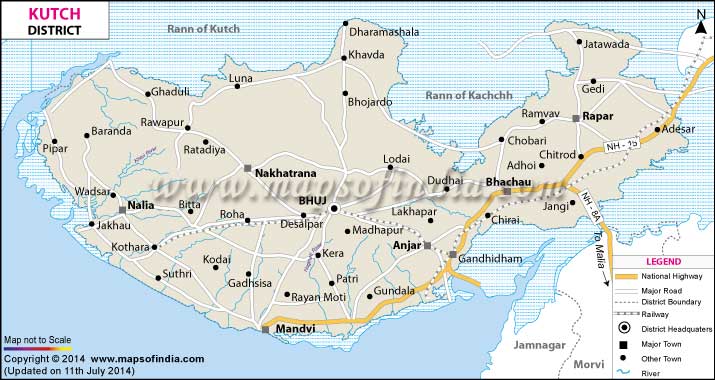
In day to day language the area is also known as Kutch district, however it is important to recognise that the district is officially known as Kachchh district and is the largest district in Gujarat State and indeed throughout India. It is the boundary of the state with Pakistan on the west. To the southwest it is bathed by the Arabian Sea. Since the region is so large and wide, the term for the district is often used to denote the region as well. A Kachchh district map will help in understanding the region better.
Head office of this administrative district is in Bhuj, another historical city of Bhuj. The large size of the district poses problem in managing all the governance offices from same location at times. The Kachchh district in Gujarat has geographical peculiarity best exemplified by the Great Rann of Kachchh, one of the largest seasonal salt desert in world. At times, the area appears to be just a dry and white desert but rains of monsoon soon transform the area into sea of water. Such peculiarity makes it hard to define. The Kachchh district map helps to locate the area of Kachchh district on earth surface and to understand the affect of this geographical peculiarity on locations of settlements in district and natural paths of connectivity between them.
History and Culture
Kachchh region has its origins in ancient times. Remnants of Indus Valley Civilisation have been found scattered around the district with Dholavira as the most striking archaeological site. This place gives us glimpses of how its inhabitants must have lived and survived. In medieval times Kachchh was a princely state with Bhuj as its capital. Rulers built forts, palaces, temples, etc. and many of them are still around, some in disarray as earthquakes have affected the region more than once. In order to know and understand as to where these monuments are located, a Kachchh district map can be referred.
Kachchh is a district of incredible diversity with numerous communities residing within its borders. Communities such as Rabaris, Ahirs and Jats, to name a few, inhabit the region alongside mainstream populations and go about their lives following customs and traditions which often complement yet frequently contrast with those more familiar. Most famous of all Kachchh’s crafts must be embroidery, bandhani, leather and pottery – even so its skilled artisans are dogged by the same problems as those elsewhere in India concerning income and ready market for their wares, resulting in quite unstable circumstances for the living of these skilful people.
Festivals and fairs are an integral part of life in Kachchh district. Many local festivals like Rann Utsav, Navratri and Diwali are celebrated with great funfair. Rann Utsav has acquired almost international recognition and is popular as the tourist destination, thus drawing tourists from all over the world. Rann of Kachchh or Great Rann of Kachchh is therefore the right destination to relish and revisit different facets of Indian culture. A map of Kachchh district would also show you how and where tourists and people travel to these festive destinations.
Natural Calamities like Earth Quake has affected the region most notably the one in the year 2001 and the district has gone through difficult times. Post disaster the Rehabilitation and Reconstruction provided some relief to affected population and it once again showcased people’s spirit and Administrative setup’s ability to address crises albeit with scope of improvement. A Kachchh district map is very often referred in executing activities related to reconstruction and development of the region.
Economy
Economy of Kachchh district is mixed with both rural and urban mode of living and has a mixture of traditional methods of earning livelihood and modern methods of industrial growth. However, there is a lot of disparity in this growth. In some areas of the district, there is still a long way to travel and Government Sector plays a very important role in the District’s growth be it in providing infrastructure, Disaster Management, Health & Family Welfare or implementing various Rural Welfare Programmes etc. Growth may not be smooth at times but there would be no progress if there would be constant stoppages. A Kachchh district map helps the planners to identify the areas of need.
The Public Sector plays a very significant role in the development of Kachchh district as the two major ports of the country, Kandla Port (now known as Deendayal Port) and Mundra Port, are based here. These ports are not only vital for the district but for the country as a whole. However, they also generate certain environmental problems which are often ignored or left unattended. The map of Kachchh district provides better idea of the geographical space of the region and also locates the ports of the country along with their connections to other parts of the country.
The Services Sector has grown in recent years largely due to an increase in tourism and small businesses. However, these gains have not been spread evenly throughout the district. Handicrafts continue to provide an important source of income for many families, albeit on an unpredictable basis with earnings dependent on external markets.
Agriculture in Kachchh district is confined mainly to rain dependent crops like millet, pulses and cotton where soil and climate permits. Animal husbandry is another important activity that is mostly confined to rural areas and helps in livelihood of people. A Kachchh district map highlights the areas where agriculture and grazing are done.
the local economy is emerging but there are some challenges to be addressed by better planning and policies.
Tourism
Tourism is one of the major components in the economy of Kachchh district. Though there is lack of necessary infrastructure all over the region, the Great Rann of Kachchh is one of the most visited tourism destinations in the region. The area houses the vast expanse of white salt desert creating unique geography. A Kachchh district map displays the location and details of this particular tourist destination and Rann Utsav – a celebration of local culture through different programs and activities.
In addition to the main local attractions there are also remains of a settlement from the Indus Valley Civilisation at Dholavira but these are a considerable distance from Bhuj and best visited by car or on a long day trip tour.
Bhuj, the capital city of Kutch is famous for the beautiful Aina Mahal and Prag Mahal, the marvellous architectural skills of the rulers in the past though badly damaged in the earthquake of 2001. The main tourist points for Kutch include Mandvi beach, Vijay Vilas Palace.
Wildlife sanctuaries including Kachchh Desert Wildlife Sanctuary and Narayan Sarovar Sanctuary provide opportunities to view a large number of wildlife species; however conservation is on and on. A Kachchh district map will help tourists to locate these areas.
On other locations of interest are Kala Dungar and several handicraft villages including those for handmade dolls and games. It is advisable to carry a map of Kachchh district to help track locations.
Demographics
Kachchh district is very large in extent, and even at the point of having a population of 2.1 million (2011 Census) the population density in Kachchh is very low because the population is dispersed over such a very large area. A Kachchh district map can be very helpful to locating the places where the people actually reside in the district.
The literacy rate of the district is 71.6% which is still far from state average but it is gradually improving due to establishment of schools and increased infrastructure and awareness.
Languages of the district include Kutchi as well as many other Indian languages including Gujarati, Hindi and Sindhi. You can also get a map of the Kachchh district to help you understand the various language groups within the region.
Apart from general population characteristics, the demographics of Kachchh district are further influenced by the flows of migration, which is not static and keeps changing with shifting economic opportunities and environmental circumstances. Many people living in rural areas of Kachchh migrate to urban areas like Bhuj and Gandhidham in search of better opportunities for work, education etc. Although their migration is not always permanent, sometimes it gets seasonal. A map of Kachchh district helps us to locate the areas of high population density and also understand the emergence of clusters of population around urban centres of the region, while many parts of the district remain uninhabited.
While going through the demographics of Kachchh district, it is interesting to note the variations in the gender ratio and also how the population of different social groups are distributed. The gender ratios and the social composition do not remain the same all over the district. They have variations that are often comparable to those seen in other parts of India. However, these specific variations do get reflected in specific areas of Kachchh and in some areas, these variations may translate into variations in access to education and health services. A Kachchh district map can prove to be very useful regarding understanding many general variations also.
Administration
Kachchh district is further divided in to tehsils like Bhuj, Anjar, Mandvi, Mundra, Bhachau, Rapar, Nakhatrana, Abdasa, Lakhpat and Gandhidham. Managing Kachchh district with these divisions is a bit difficult and also not very efficient. A Kachchh district map would help you in identifying the administrative divisions of the region.
Though administration tries to provide essential public services, mitigate natural disasters, and upgrade basic infrastructure in a better way; There is still plenty of scope for corrective action and better planning. A Map of Kachchh district is essential tool for such administrative planning and decision making.
Another aspect to administration could be the role of local governance institutions such as gram panchayats and municipal bodies who put into effect the plans at local level. There can be differences in how efficiently these bodies function based on their resources, leadership and connect with higher bodies. Sometimes this results in delays or shortcomings at the point of implementation. Administration often refers to such maps of the district to ensure that all parts of it are covered. However, there are some limitations in how effectively this can be done.
FAQs
Q1: Does Kachchh have beaches as well?
Yes. Mandvi Beach is a popular coastal destination which is very peaceful, has beautiful sunsets and also gives you a look into the area’s maritime past.
Q2: Is Kachchh suitable for family holidays?
Yes. Families will enjoy visiting historical sites, cultural villages, the wildlife, beaches, desert scenery and local festivals which in turn makes it suitable for all age groups.
Q3: What is the local community doing to preserve their traditions?
Many in Kachchh still practice the art of traditional embroidery, weaving, pottery and folk music which in turn helps to preserve our culture for many years.
Q4: Is the White Rann truly white all year round?
No. During the monsoon’s end when the water recedes we are left with a vast layer of salt which extends for miles.
Q5: What makes Kachchh handicrafts so special?
Most of what we offer is hand made using methods that have been in our families for many years. In which we do best mirror work, embroidery, leather crafts and pottery are what we focus on.
Q6: At what time of year should I visit Kachchh?
The fall and winter months of November to February are the best. Also at this time the Rann Utsav takes place and we experience perfect weather for sightseeing.
Q7: How has tourism transformed Kutch over the years?
Tourism has brought forward new chances for local artisans, hotels, transport services and village communities which also as a result has put the district’s cultural heritage on the map for visitors from all over the world.
Last Updated on : July 14, 2026
