






About
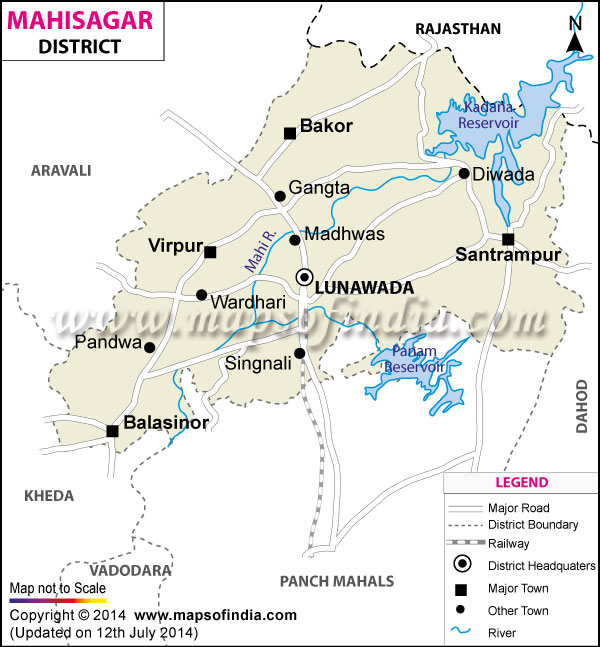
Mahisagar district is a new administrative district of Gujarat created in 2013 as a subdivision of Panchmahal district. The Mahisagar name is also explained by two major geographical factors the Mahi River, and the symbolic sign of sagar or massive water bodies, which underscores the relationship of the district with water resources and natural sceneries. The district which is situated at the eastern area of Gujarat borders both Rajasthan and Madhya Pradesh and therefore it is strategically positioned culturally as well as geographically.
Lunawada is a town, which serves as an administrative centre and a local economic centre of the district. The map of the Mahisagar district depicts an area that was a combination of plains, low hills, forested patches and valleys of rivers. Such geographical difference does not only affect agriculture but also settlement and culture. The region is mainly rural and the tribal communities are very high in number, and they have maintained their customs since the times of their ancestors.
On a further examination of the Mahisagar district map one can find that the district is a transitional area between the more developed parts of central Gujarat and the tribal belts within the eastern end of India. Although not as industrialised as other Gujarat district, Mahisagar has a reserved strength of agriculture and community existence. The Mahisagar district map is also useful in realizing the spatial distribution of its villages, water bodies and the road networks which are very critical in the regional planning and development.
History and Culture
Mahisagar district has a rich history; it is very closely linked to that of the Panchmahal. This region has in the past been under the influence of different dynasties such as the Solankis and subsequently the Mughals in the past and during antique and medieval periods. The area being close to the borders with Rajasthan and Madhya Pradesh, in general, was a cultural crossroads, taking over influences of the surrounding regions.
Panchmahal was ruled as an independent region during the British colony time and the part which is presently Mahisagar was under the administrations system. It further developed even after gaining independence until it was officially recognised as an independent district in 2013 in order to enhance governance and development outreach. This restructuring of the administration enabled the government to pay more attention to the demands of the local people with the tribal groups in the first place.
The Mahisagar district map brings out the concentration of tribal population especially in eastern and hilly areas within the district. Such societies like the Bhils have been living here centuries and they have preserved their own identity by language, customs and traditions. Their way of life is directly related to nature and most of their activities show high regard to forests, land and seasons.
There is a rich cultural life in Mahisagar although it is rural. Classical folk dances, songs and story telling are part of the social gatherings. The festivals like Navratri, Diwali and Holi are popular but tribal festivals and local fairs provide a certain flavour to the culture of the district. These fairs are quite likely to have handicrafts, traditional foods and rituals of the people which reinforce the social connection.
Mahisagar district map as well indicates the presence of a cluster of heritage sites such as temples and small historical structures that portray the past of the Mahisagar district. The use of oral traditions in preserving history is still high in most of the villages. The information about ancestors, the local heroes and the mythological tales are transmitted across generations to become a significant component of the identity of the district. Cultural expression cannot be considered as an exclusive characteristic of festivals only, as it is present in everyday life, clothes, and local traditions.
Economy
Mahisagar district economy is agrarian based meaning that majority of the population is involved in farming and other related activities. The Mahisagar district map is an indication of vast agricultural land, and the support to the land is in form of seasonal rivers and irrigation systems. Maize, wheat, pulses and oilseeds are crops that are regularly grown, though depending on the monsoon and the types of soils.
Administrative services, education, and healthcare are the industries that offer the largest number of employment opportunities in the government sector. The government offices, schools and primary health centres offer stable jobs and lead to the socio-economic development of the district. There are different government initiatives of uplifting the rural areas, facilitating irrigation, and the welfare of the tribes, which continues to enhance the availability of basic services.
The government is very instrumental in the development of infrastructure. Initiatives on irrigation, road networks and electrification have helped the living conditions to improve slowly. The Mahisagar district map shows that there is significance of Mahi River and other related water resources in order to facilitate agriculture and to sustain livelihoods. Other water conservation programs such as use of check dams and small irrigation programs have also helped in stabilizing agriculture.
Services sector is gradually growing and particularly in such towns as Lunawada and Balasinor. The small businesses, retail trade and education and transportation are the pillars in this industry. In rural settings, especially the weekly markets are essential, as they are the hubs of trade and social demonstration. The Mahisagar district map can be used to explain the nature of the linkage of remote villages to bigger markets by the means of these service centres in an economic exchange.
Other notable elements of the rural economy are animal husbandry. Livestock provides households with supplementary income, dairy production and farming. In spite of poor industrial development, it has a potential of increasing in agro-processing industries, food stores and small scale industries. There may be a more diverse economic development in the district in the future as the infrastructure and investments will be improved.
Tourism
Tourism in Mahisagar district is small yet provides distinct experiences to the interested people who focus on history, nature, and rural culture. The Mahisagar district map shows that the Mahisagar district has some attractions which though not much commercialised are of great local and scientific value.
The dinosaur fossil park in the vicinity of Balasinor is among the most remarkable ones. This location has become a source of interest due to its immaculate fossil records and is a significant tourist attraction to scientists and other prehistoric life fans. It is among the few sites in India where fossils of dinosaurs can be studied in place and this gives scientific importance to the district.
Another attraction site is the Kadana Dam constructed on the Mahi River. It is an important irrigation and power generation project besides providing scenic sites and a serene atmosphere to the tourists. The other landscape around the place, more so during the time of monsoon and winter, grows very attractive.
The Mahisagar district map also identifies forested and hilly terrains that are good areas of nature lovers. These are the areas which are most likely to have the tribal groups and are relatively clean and offer chances to do some eco-tourism and exploration of culture. The district also has small temples, village shrines and natural viewing points contributing to the low profile appeal.
Demographics
Mahisagar district is home to about 994, 624 (2011 Census). It has a major country population, the majority of which are rural and a large percentage of them are Scheduled Tribes. This distribution is reflected in the Mahisagar district map in which there are clusters of settlements on varied terrains.
The district literacy level is approximately 61% which is lower in comparison to the state level. The efforts to enhance education have been done through government initiatives, infrastructure of schools and awareness programmes. Primary school enrolment and secondary schools are slowly raising the standards of literacy.
The major language in the district is Gujarati and Hindi is also a popular language spoken in the district. In certain regions like the tribes, local languages like Bhili are also spoken in their day-to-day activities. This polyglutic variety contributes to the cultural multiplicity of the area, and it serves as the evidence of the historical links of the area with the neighbour states.
Administration
The district of Mahisagar is politically divided into a number of tehsils, such as, Lunawada, Balasinor, Kadana, Khanpur, Santrampur, and Virpur. All the tehsils have significant roles in the local government and execution of development programmes. Mahisagar district map will be needed to know the limits and administrative topography of these areas.
District has approximately 716 villages which are under the Panchayati Raj system. These are the villages which constitute the basis of the administrative and social organization of the district. The local government units deal with the development strategies, the infrastructural maintenance, and the needs of the population.
The district administration runs its activities through Lunawada where most government offices are found. Governments are interested in rural development, infrastructure development, education, and health care services. A particular attention is paid to tribal welfare programmes as the district has the demographic structure.
Administrative planning is becoming more and more based on the use of data and mapping and surveys are used to define the areas of focus in development. Accessibility in terms of road networks, access to digital facilities and provision of basic facilities such as public services are slowly catching up with the mainstream development in the remote areas.
FAQs
Q1: When was Mahisagar district formed?
Mahisagar in 2013 became a separate district which was out of Panchmahal district. This new district was created for better local administration and development.
Q2: Which town is the headquarter of Mahisagar?
Lunawada is the head of the district. It is the primary center for administration, education and business in the district.
Q3: Why do history lovers visit Balasinor?
Balasinor is known for the Dinosaur Fossil Park in which fossils were found there. There are also very few places in India which has what visitors can learn of the past.
Q4: What is it that sets the Dinosaur Fossil Park apart?
The park is home to actual dinosaur fossil sites which are of great scientific value. We have researchers, students and travelers who visit us for our past exhibits.
Q5: Why does the Mahi River matter to Mahisagar?
The Mahi River is a source of water for farming and irrigation which in turn affects many areas of the district. Also it is a key element in local livelihoods.
Q6: Which languages are spoken in Mahisagar?
Gujarati is the primary language which is used in the district. In many areas also spoken are Hindi and Bheli which include in large proportion tribal communities.
Q7: What role does animal husbandry play in the lives of local families?
Many families increase their income through livestock which they also use to produce milk. Livestock farming supports agriculture and better living in the rural areas.
Q8: Is Mahisagar more rural than urban?
Yes. In most of the district’s area are found villages, and farming which is the main source of income still preoccupies many in Mahisagar.
Last Updated on : May 12, 2026
